Why isn't the titration answer multiplied by 10 for 100 cm³ sample?

  • Topic:
  • Thread starter markosheehan
  • Start date
  • Tags Tags
    Titration
7 replies · 4K views · last reply
markosheehan
Messages
133
Reaction score
0
I am confused on a titration question.

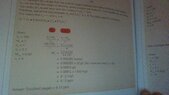
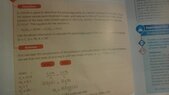
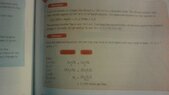
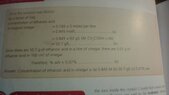
View attachment 7278View attachment 7279I understand most of it but I do not see why they do not multiply their answer by 10 at the end because it says 100 cm^3 of water was analysed but that formula gives answers in moles/L so to make it into a liter they should multiply by 10 but they do not ?
 
Attachments
  • Photo of a textbook page showing a Winkler dissolved oxygen question and answer, with Mn(OH)2, I2 and S2O3 2- equations (b), (c), (d) and the 1:4 ratio of O2 to thiosulfate.
    WIN_20170909_09_22_29_Pro.jpg
    86 KB · Views: 165
  • Handwritten-style worked example in a printed textbook page calculating dissolved oxygen by titration: Given V = 100, Mn(OH)2 steps, V = 5.7, M = 0.02, n = 4, leading to 0.000285 moles/L, 9.12 mg/L and answer 9.12 ppm.
    WIN_20170909_09_24_11_Pro.jpg
    88 KB · Views: 146
markosheehan said:
I am confused on a titration question.

I understand most of it but I do not see why they do not multiply their answer by 10 at the end because it says 100 cm^3 of water was analysed but that formula gives answers in moles/L so to make it into a liter they should multiply by 10 but they do not ?

The unit of $100\text{ cm}^3$ cancels against the unit of $5.7\text{ cm}^3$.
That is, we're left with the ratio between those 2 volumes, which is unit-less.
That leaves the unit of the concentration $M=0.02\text{ g/L}$ (I can't read the subscript), which is already in $\text{g/L}$.
 
ok. thanks . i think i get it.

i am confused on this question though.

View attachment 7280

View attachment 7281

View attachment 7282

here they divide their answer by 4 at the end even though both units are in cm^3

- - - Updated - - -

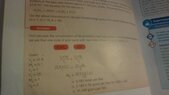
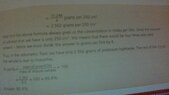
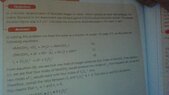
i also do not understand this question. i understand that they multiply at the end by 5 as there was a dilution factor of 5 but I do not see why they do not divide by 10 as the vinegar was in a 100 cm^3 volumetric flask .View attachment 7283

View attachment 7284
 
Attachments
  • Photo of a textbook page showing a worked titration question on the percentage purity of potassium hydroxide, with the equation H2SO4 + 2KOH → K2SO4 + 2H2O and the answer's working for concentration.
    WIN_20170909_14_48_52_Pro.jpg
    55.5 KB · Views: 172
  • Textbook page showing a worked titration answer: H2SO4 + 2KOH gives K2SO4 + 2H2O, with given values and M_b = 0.183 moles per litre, then 10.248 grams per litre for KOH.
    WIN_20170909_14_49_00_Pro.jpg
    54.6 KB · Views: 159
  • Worked solution from a chemistry textbook: 10.248 divided by 4 gives 2.562 grams per 250 cm³, then % purity = 2.562 / 3.0 × 100 = 85.4%, answer 85.4%.
    WIN_20170909_14_58_39_Pro.jpg
    78.8 KB · Views: 139
  • Photo of a textbook page showing a titration question about diluted vinegar, with the question text, balanced equation CH3COOH + NaOH → CH3COONa + H2O, and a worked answer calculating M_a = 20 × 0.12 / 14.2 = 0.169 moles per litre.
    WIN_20170909_14_54_15_Pro.jpg
    52 KB · Views: 159
  • Printed worked solution for ethanoic acid concentration: 0.169 x 5 = 0.845 mol/L, then 0.845 x 60 = 50.7 g/L, then 5.07 g per 100 cm³, giving 5.07% w/v.
    WIN_20170909_14_54_45_Pro.jpg
    49.9 KB · Views: 159
markosheehan said:
ok. thanks . i think i get it.

i am confused on this question though.

here they divide their answer by 4 at the end even though both units are in cm^3

The given concentration is in $\text{g/L}$.
That is, the number of grams that would be in 1 liter.
Since we're talking about $250\text{ cm}^3$, which is a quarter of a liter, we need to divide by 4.

markosheehan said:
i also do not understand this question. i understand that they multiply at the end by 5 as there was a dilution factor of 5 but I do not see why they do not divide by 10 as the vinegar was in a 100 cm^3 volumetric flask .

Again, the concentration is given in $\text{g/L}$, which is the number of grams that 1 liter would have.
And it's not the number of grams in the original flask - that would be 1/10th.
 
in the vinegar titration they ask for the the concentration of the ethanoic acid in the original vinegar so if you get your answer in grams per liter. so would be not have to take into this consideration by dividing by 10 to find the amount of grams in the original solution.
 
markosheehan said:
in the vinegar titration they ask for the the concentration of the ethanoic acid in the original vinegar so if you get your answer in grams per liter. so would be not have to take into this consideration by dividing by 10 to find the amount of grams in the original solution.

Only if they would have asked for the 'grams' (the mass).
But they're asking for the 'concentration'. For concentration the volume is irrelevant - it has been 'divided out'.
So whether we have 1 liter with 60 g/L, or we have 0.1 liter with 60 g/L, they have the same concentration of 60 g/L.
Of course there are 60 grams in that liter, and only 6 grams in the 0.1 liter.
 
Thanks . Ok so only divide when you are dealing with grams of a substance in a solution to find out the number of grams in that amount of solution.