phantomvommand
- 287
- 39
Summary:: Please see the attached photo.
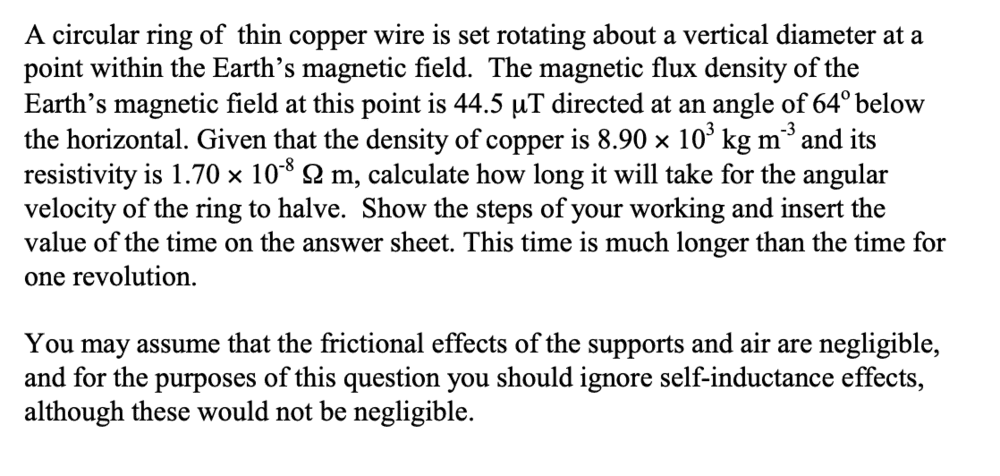
I have obtained the correct answer, and my solution agrees with the official solution. However, I have some questions about why the solution is correct. (One may have to draw out some diagrams for this problem, it was quite hard to visualise for me.) The solution goes as such:
1. Find the induced current in the ring using Faraday's Law
2. Find the magnetic torque mu x B, where B is the horizontal component of B-field
3. Using average torque = Ia, solve for a, and then perform some integration.
My question at step 2. Notice that there is still a vertical component of B-field that is perpendicular to the Area vector, and thus perpendicular to magnetic dipole moment mu. Wouldn't this component of B-field exert a torque on the ring about another axis, resulting in the ring rotating about 2 axes? Why can this torque be ignored?
All help is appreciated. Thank you!
I have obtained the correct answer, and my solution agrees with the official solution. However, I have some questions about why the solution is correct. (One may have to draw out some diagrams for this problem, it was quite hard to visualise for me.) The solution goes as such:
1. Find the induced current in the ring using Faraday's Law
2. Find the magnetic torque mu x B, where B is the horizontal component of B-field
3. Using average torque = Ia, solve for a, and then perform some integration.
My question at step 2. Notice that there is still a vertical component of B-field that is perpendicular to the Area vector, and thus perpendicular to magnetic dipole moment mu. Wouldn't this component of B-field exert a torque on the ring about another axis, resulting in the ring rotating about 2 axes? Why can this torque be ignored?
All help is appreciated. Thank you!