Why use the Palatini action instead of Einstein's field equations

Join the discussion
Registration is free. Start your own thread to ask a follow-up.
2 replies · 2K views
ohwilleke
Gold Member
Messages
2,695
Reaction score
1,669
Most often, general relativity is formulated in terms of Einstein's field equations:
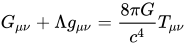
021a494922172bfe1c9fa4e80d25ac90228d72cf
whose terms are familiar to readers in this forum.

But, I understand (and feel free to correct me or qualify my statement if I am incorrect) that it is also possible to describe general relativity with an equivalent expression known as the Palatini action sometimes written as:

b5fe37f32e7a0cf7d575d811c8db7b53de2376e6


where
b1bf5685176a73483c07965052331f422514de4e
but now
d3556280e66fe2c0d0140df20935a6f057381d77
is a function of the frame field.

The Palatini action is used, for example, in a recent pre-print by SangChul Yoon, "Lagrangian formulation of the Palatini action" (May 5, 2018).

What are the insights or mathematical benefits that are involved in using the Palatini action? What are the disadvantages to using this formulation of general relativity?
 
Physics news on Phys.org
This review:
https://arxiv.org/abs/1106.2476
provides decent insight into the Palatini procedure. This is not my area of expertise (I am a total GR amateur), but as far as I can tell, the main upshot is that the Palatini procedure allows you to treat the metric and the connection as independent variables (in standard GR, the Levi-Civita connection is a function of the metric and its derivatives). But if you assume zero torsion, once you minimize the action integral with respect to the connection, you get back the Levi-Civita connection and hence general relativity. One interesting complication that the review mentions is that this procedure only assumes coupling of matter to the metric, not to the connection. If matter couples separately to the metric and the connection, things apparently get quite a bit more complicated.
 
  • Like
Likes   Reactions: ohwilleke and Dale
TeethWhitener said:
This review:
https://arxiv.org/abs/1106.2476
provides decent insight into the Palatini procedure. This is not my area of expertise (I am a total GR amateur), but as far as I can tell, the main upshot is that the Palatini procedure allows you to treat the metric and the connection as independent variables (in standard GR, the Levi-Civita connection is a function of the metric and its derivatives). But if you assume zero torsion, once you minimize the action integral with respect to the connection, you get back the Levi-Civita connection and hence general relativity. One interesting complication that the review mentions is that this procedure only assumes coupling of matter to the metric, not to the connection. If matter couples separately to the metric and the connection, things apparently get quite a bit more complicated.

Thanks. That's really helpful, especially your discussion of that last complication.