ZFC .... Axioms of Foundation .... and Infinity ....

  • Context: Undergrad 
  • Thread starter Thread starter Math Amateur
  • Start date Start date
  • Tags Tags
    Axioms Infinity Zfc
Click For Summary
SUMMARY

The discussion centers on Proposition 1.7.5 from D. J. H. Garling's "A Course in Mathematical Analysis: Volume 1: Foundations and Elementary Real Analysis," specifically regarding the foundation axiom of set theory. Participants clarify that the foundation axiom implies the existence of an element \( n \in \mathbb{Z}^+ \) such that \( f(n) \cap f(\mathbb{Z}^+) = \emptyset \). The conversation emphasizes the logical equivalence between the existence of \( f(n) \) and \( n \) within the context of the foundation axiom, highlighting the importance of proper substitutions in understanding the proof.

PREREQUISITES
  • Understanding of set theory axioms, particularly the foundation axiom.
  • Familiarity with mathematical notation, including \( \mathbb{Z}^+ \) and functions.
  • Knowledge of logical equivalences in mathematical proofs.
  • Basic comprehension of D. J. H. Garling's work on mathematical analysis.
NEXT STEPS
  • Study the foundation axiom of set theory in detail.
  • Explore logical equivalences in mathematical proofs.
  • Review D. J. H. Garling's "A Course in Mathematical Analysis" for deeper insights.
  • Investigate the implications of the axiom of infinity in set theory.
USEFUL FOR

Mathematicians, students of mathematical analysis, and anyone interested in the foundations of set theory and logical proofs will benefit from this discussion.

Math Amateur
Gold Member
MHB
Messages
3,920
Reaction score
48
I am reading D. J. H. Garling's book: "A Course in Mathematical Analysis: Volume 1: Foundations and Elementary Real Analysis" ... ...

I am at present focused on Part 1: Prologue: The Foundations of Analysis ... Chapter 1: The Axioms of Set Theory ...

I need help with an aspect of the proof of Proposition 1.7.5 ...

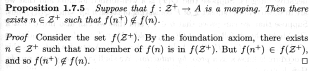
Proposition 1.7.5 reads as follows:
?temp_hash=b76931c3b3d3d72ef267167009d99a51.png
In the above proof we read the following:

"By the foundation axiom, there exists ##n \in \mathbb{Z}^+## such that no member of ##f(n)## is in ##f( \mathbb{Z}^+ )##. ... ... "

Can someone please explain how/why the foundation axiom implies that there exists ##n \in \mathbb{Z}^+## such that no member of ##f(n)## is in ##f( \mathbb{Z}^+ )##. ... ... ?

PeterNOTE:

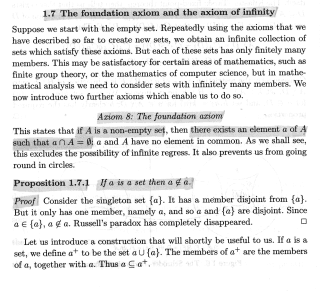
To enable readers to follow the above post I am providing Garling's text on the foundation axiom and the axiom of infinity ... ...
?temp_hash=b76931c3b3d3d72ef267167009d99a51.png

?temp_hash=b76931c3b3d3d72ef267167009d99a51.png
 

Attachments

  • Garling - Proposition 1.7.5 ... ....png
    Garling - Proposition 1.7.5 ... ....png
    6.3 KB · Views: 565
  • Garling - 1 - Foundation Axiom ... Axiom of Infinity - PART 1 ... ....png
    Garling - 1 - Foundation Axiom ... Axiom of Infinity - PART 1 ... ....png
    25 KB · Views: 634
  • Garling - 2 - Foundation Axiom ... Axiom of Infinity - PART 2 ... ....png
    Garling - 2 - Foundation Axiom ... Axiom of Infinity - PART 2 ... ....png
    22.4 KB · Views: 629
Physics news on Phys.org
The claim can be re-stated as:

There exists an element ##n## of ##\mathcal Z^+## such that ##f(n)\cap f(\mathcal Z^+)=\emptyset\quad\quad\quad\quad\quad## (1)

Line up statement (1) next to the statement of the foundation axiom and see if you can find some substitutions to make to the foundation axiom to get (1). The substitution is not one-for-one exact, but the variation from exact substitution should not be too hard to negotiate.
 
  • Like
Likes   Reactions: Math Amateur
Hi Andrew ... sorry to be slow in replying ... had to travel interstate ...

Sorry to be slow Andrew ... but can you explain how ...

the statement that there exists an ##n \in \mathbb{Z}^+## such that ##f(n+) \notin f(n)## ...

is equivalent to ...

the statement that there exists an element ##n \in \mathbb{Z}^+## such that ##f(n) \cap f( \mathbb{Z}^+ ) = \emptyset## ...

Peter
 
The statement in the text we are trying to match is:
Math Amateur said:
there exists ##n \in \mathcal{Z}^+## such that no member of ##f(n)## is in ##f( \mathcal{Z}^+ )##. ...
That is equivalent to
there exists ##n \in \mathcal{Z}^+## such that ##f(n)\cap f( \mathcal{Z}^+ )=\emptyset##. ...

The foundation axiom is
if ##A## is non-empty then there exists ##a \in A## such that ##a\cap A=\emptyset##. ...

Now substitute ## f( \mathcal{Z}^+ )## for ##A## and ##f(n)## for ##a## in that last one, to get
if ##f( \mathcal{Z}^+ )## is non-empty then there exists ##f(n) \in f( \mathcal{Z}^+ )## such that ##f(n)\cap f( \mathcal{Z}^+ )=\emptyset##. ...
and note that ##\mathcal{Z}^+## is non-empty by definition, hence so is ##f(\mathcal Z^+)##, and that if
  • there exists ##f(n)\in f( \mathcal{Z}^+ )## such that ##f(n)\cap f( \mathcal{Z}^+ )=\emptyset##; then
  • there exists ##n\in \mathcal Z^+## such that ##f(n)\cap f( \mathcal{Z}^+ )=\emptyset##
since "##\exists n\in\mathcal Z^+##" is logically equivalent to "##\exists f(n)\in f(\mathcal Z^+)##", given that the domain of ##f## contains ##\mathcal Z^+##.

Note also that the Z is ##\mathcal Z##, which is not the integers ##\mathbb Z## (although he may end up identifying it with the positive integers later on). The TeX code around the Z is \mathcal rather than \mathbb.
 
  • Like
Likes   Reactions: Math Amateur
Thanks so much for the help, Andrew ... clear now ...

Peter
 

Similar threads

  • · Replies 9 ·
Replies
9
Views
3K
  • · Replies 2 ·
Replies
2
Views
2K
  • · Replies 2 ·
Replies
2
Views
3K
Replies
4
Views
2K
  • · Replies 3 ·
Replies
3
Views
3K
Replies
1
Views
2K
  • · Replies 1 ·
Replies
1
Views
2K
  • · Replies 2 ·
Replies
2
Views
2K
  • · Replies 1 ·
Replies
1
Views
2K
Replies
2
Views
2K