View Full Version : tension question (this should be basic)
nick727kcin
Feb12-06, 05:05 PM
A .6 kg steel block rotates on a steel table while attached to a 1.20 m-long hollow tube. Compressed air fed through the tube and ejected from a nozzle on the back of the block exerts a thrust force of 4.10 N perpendicular to the tube. The maximum tension the tube can withstand without breaking is 50.0 N. (coefficient of kinetic friction:.6) If the block starts from rest, how many revolutions does it make before the tube breaks?
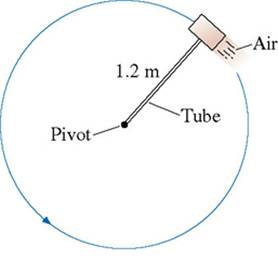
http://session.masteringphysics.com/problemAsset/1000593/10/knight_Figure_07_55.jpg
im stumped...
look 1 post down... im trying
nick727kcin
Feb12-06, 08:24 PM
ah i found something:
at= 6.833333 m/s^2
Fr= mat - Ff
Fr= 4.1N- Ff
= 4.1-3.528
=.572N
a(c)= .953333m/s^2
nick727kcin
Feb12-06, 08:55 PM
ok heres what i tried:
at 50N, the object is going at:
v= 10m/s
so i plugged this in the T=(mv^2)/r equation and got: T=50s, but this looks wrong, and i dont know how to get revs from this...
nick727kcin
Feb12-06, 09:26 PM
hmmm...
angluar velocity= (at/r)t= 284.722rad/s= 2718.89 rpm
2718.89= 45.315 revs/second
45.315 x 50 = 2265.75 revolutions (wrong)
nick727kcin
Feb12-06, 09:42 PM
guys please help me, theres only one hour left
Here's a start:
The angular acceleration is given by
I \frac {d^2 \theta}{dt^2} = r (F_T - \mu mg)
where I is the moment of inertia (essentially just m R^2). Use the equation solve for the angular velocity and the angular displacement as a function of time then determine the time at which the centripetal force reaches the breaking point.
nick727kcin
Feb12-06, 09:59 PM
Here's a start:
The angular acceleration is given by
I \frac {d^2 \theta}{dt} = r (F_T - \mu mg)
where I is the moment of inertia (essentially just m R^2). Use the equation solve for the angular velocity and the angular displacement as a function of time then determine the time at which the centripetal force reaches the breaking point.
thank you , thank you for responding
nick727kcin
Feb12-06, 10:01 PM
Here's a start:
The angular acceleration is given by
I \frac {d^2 \theta}{dt^2} = r (F_T - \mu mg)
where I is the moment of inertia (essentially just m R^2). Use the equation solve for the angular velocity and the angular displacement as a function of time then determine the time at which the centripetal force reaches the breaking point.
thanks so much, but i dont really get what youre saying. what does Ft mean? o, i didnt learn about inertia yet
nick727kcin
Feb12-06, 10:21 PM
guys, i dont want you to waste your time. if you arent able to help in the next 30 minutes, dont even worry about it
vBulletin® v3.8.7, Copyright ©2000-2012, vBulletin Solutions, Inc.