valjok
- 70
- 0
Revising my old university lectures, I have encountered the famous law of magnetic field around a closed loop:
[tex]\oint_L \mathbf{H} \cdot \mathrm{d}\boldsymbol{\ell} = \sum I[/tex]
The integral is simplified down to a product Hl when the perfectly round loop is orthogonal to the current. In this case H is constant on the loop and length of a circle l = 2 Pi r, wherefrom we can derive the [tex]\mathbf{H} = \frac{I}{2 \pi r}[/tex].
For instance, if the first current goes into the screen while another comes out of it, we can compute the field at point R, which distance is r from both currents:
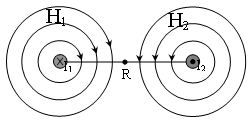
[tex]H_R = H_{1R} + H_{2R} = (I_1 + I_2)/2\pi r[/tex]As I understand the writing, it allows us to compute the field in any point by just summing H from all circles orthogonal to the current direction. Everything looks fine until a wire of current is considered:
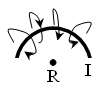
Here, a wire with current I surrounds the point R. The wire consits of infinitely many points and there is the current in every point, so that each point of wire contributes a finite amount of field to R, resuling in infinite H. I suspect that my treatment of shape of current is too loose in the fromula Hl = I and must be clarified.
[tex]\oint_L \mathbf{H} \cdot \mathrm{d}\boldsymbol{\ell} = \sum I[/tex]
The integral is simplified down to a product Hl when the perfectly round loop is orthogonal to the current. In this case H is constant on the loop and length of a circle l = 2 Pi r, wherefrom we can derive the [tex]\mathbf{H} = \frac{I}{2 \pi r}[/tex].
For instance, if the first current goes into the screen while another comes out of it, we can compute the field at point R, which distance is r from both currents:
[tex]H_R = H_{1R} + H_{2R} = (I_1 + I_2)/2\pi r[/tex]As I understand the writing, it allows us to compute the field in any point by just summing H from all circles orthogonal to the current direction. Everything looks fine until a wire of current is considered:
Here, a wire with current I surrounds the point R. The wire consits of infinitely many points and there is the current in every point, so that each point of wire contributes a finite amount of field to R, resuling in infinite H. I suspect that my treatment of shape of current is too loose in the fromula Hl = I and must be clarified.
Attachments


Last edited: