PDA

View Full Version : QM vs SR


rjbeery
Mar23-09, 03:02 PM
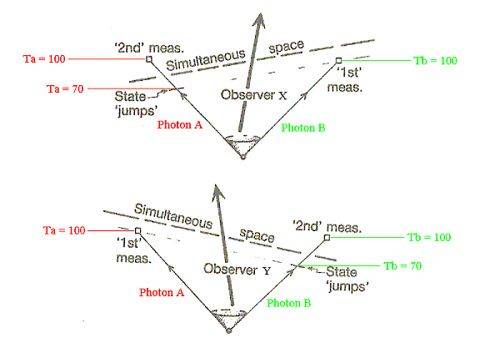
Greetings! This is my first post so go easy. I read through the thread addressing the Sci Am article claiming that entanglement violates relativity. The article actually addresses a symptom of a larger issue that exists between QM and SR. I would like to get feedback on this issue as illustrated in the following picture...
http://farm4.static.flickr.com/3444/3379413463_f6f19c76e5.jpg
Click here if picture is not showing (http://farm4.static.flickr.com/3444/3379413463_f6f19c76e5.jpg)

"If a piece of knowledge is calculated about a system with certainty then such knowledge is intrinsically represented by the system in the form of a physical reality without the need for a verifying measurement." - paraphrasing of the critical assumption made by the authors in the EPR paradox paper.

The attached picture contains two entangled particles in an EPR experiment, as seen from the perspective of two different observers moving relative to one another. Analyze the picture and reconcile it with the above statement with consideration to "when" each particle's wavefunction has collapsed. The point is that the wavefunction supposedly collapses "simultaneously" between the particles, yet simutaneity is (in absolute terms) meaningless in a Relativisitic world. As can be seen in the picture each particle's wavefunction has collapsed before it is measured.

I'm not claiming that this violates either theory. It does appear to impose certain restrictions upon which QM interpretations remain viable, however. Before I get into my opinion on that, though, I would welcome comments.

Thanks

DrChinese
Mar23-09, 03:23 PM
Welcome to PhysicsForums!

In QM, the order of these type measurements does not matter to the expected results. So in that sense, special relativity is not an issue.

On the other hand, entangled particles do seem to be connected in a way which is "non-local" and therefore somehow violating the speed of light c. However, no one has been able to put their finger on any way in which this actually conflicts with any specific part of SR. Certainly, no information can be transmitted in this manner (as we currently understand things).

Also, you can't technically rule out interpretations of QM on this basis, as you seem to suggest. However, it might affect your own preference. (I certainly *prefer* an interpretation in which c is a fundamental constant. I also prefer an interpretation in which h is a fundamental constant.)

rjbeery
Mar23-09, 03:41 PM
DrChinese: Hello, and thank-you. This issue is not related to the order of measurements, which I understand would not affect the results. I am speaking specifically about the physicality of each particle, respectively, as described in a manner local to that particle. In other words, a typical QM interpretation might claim that particle A is in a state of superposition at Ta = 10, and possessing a definite spin at Ta=110. What is the description of particle A at Ta=75, however? Is it both in a state of superposition and possessing a definite spin? This would seem to contradict Local Lorentz Covariance (http://en.wikipedia.org/wiki/Lorentz_covariance) of space-time.

Also, once (or rather if) one believes there is a problem here, then it is a small step to see that the many-worlds interpretation suffers from the same problem...

DrChinese
Mar23-09, 07:57 PM
DrChinese: Hello, and thank-you. This issue is not related to the order of measurements, which I understand would not affect the results. I am speaking specifically about the physicality of each particle, respectively, as described in a manner local to that particle. In other words, a typical QM interpretation might claim that particle A is in a state of superposition at Ta = 10, and possessing a definite spin at Ta=110. What is the description of particle A at Ta=75, however? Is it both in a state of superposition and possessing a definite spin? This would seem to contradict Local Lorentz Covariance (http://en.wikipedia.org/wiki/Lorentz_covariance) of space-time.

There are definitely a lot of interpretations that deny there is a local physicality to such particles (since they are in an entangled state - a superposition) and therefore not in a state of definite spin. If you believe the HUP is fundamental - as I do - then you typically would not assert that particles have well-defined attributes outside of a specific measurement anyway. Some folks call that "contextuality".

I don't think this actually defies the Local Covariance you describe, as the predicted results will be the same in all frames as far as I can see.

aristurtle
Mar23-09, 08:40 PM
DrChinese: Hello, and thank-you. This issue is not related to the order of measurements, which I understand would not affect the results. I am speaking specifically about the physicality of each particle, respectively, as described in a manner local to that particle. In other words, a typical QM interpretation might claim that particle A is in a state of superposition at Ta = 10, and possessing a definite spin at Ta=110. What is the description of particle A at Ta=75, however? Is it both in a state of superposition and possessing a definite spin? This would seem to contradict Local Lorentz Covariance (http://en.wikipedia.org/wiki/Lorentz_covariance) of space-time.

Also, once (or rather if) one believes there is a problem here, then it is a small step to see that the many-worlds interpretation suffers from the same problem...

I think a state of superposition or possessing a definite spin is the same thing for spin.It depends on how you choose the basis vector of hilbert space.But spin mixed state(as sunlight polarization) are different from "definite spin"(or superposition, which is the same thing).

debra
Mar24-09, 02:17 AM
DrChinese: Hello, and thank-you. This issue is not related to the order of measurements, which I understand would not affect the results. I am speaking specifically about the physicality of each particle, respectively, as described in a manner local to that particle. In other words, a typical QM interpretation might claim that particle A is in a state of superposition at Ta = 10, and possessing a definite spin at Ta=110. What is the description of particle A at Ta=75, however? Is it both in a state of superposition and possessing a definite spin? This would seem to contradict Local Lorentz Covariance of space-time.


Why do you think it contradicts Lorentz Covariance? Do you believe the spins should have an altered 'rate' due to the relative velocities between them - or something along those lines?

rjbeery
Mar24-09, 08:03 AM
There are definitely a lot of interpretations that deny there is a local physicality to such particles (since they are in an entangled state - a superposition) and therefore not in a state of definite spin. If you believe the HUP is fundamental - as I do - then you typically would not assert that particles have well-defined attributes outside of a specific measurement anyway. Some folks call that "contextuality".

I don't think this actually defies the Local Covariance you describe, as the predicted results will be the same in all frames as far as I can see.
DrChinese: Thanks for your feedback. To deny a physicality to the particles until they are locally measured seems reasonable, but then you must ask yourself what the nature of the wavefunction is. The wavefunction is intended to be a mapping of the possible states of the system which it is describing. Now, for Observer X, particle B has a definite spin at Tb=100 and Ta=70 (his simultaneous space), so I assume we can agree that particle B is not in a state of superposition at this time. If one believes that particle A continues in a state of superposition between Ta=70 and Ta=100, then what wavefunction describes the possible states (i.e. what are the possible spins) of particle A for that period? There is only a single answer (specifically, the complement of particle B), whereas before particle B was measured there were many, which to me suggests that any wavefunction describing particle A as having the same "options of existence" before Ta=70 and after Ta=70 is the wrong one.

I appreciate your reference to HUP, and I'm not suggesting it isn't fundamental, but a fundamental limitation upon knowledge available to us does not necessitate that the physicality of the system in question simply doesn't exist.

Aristurtle and Debra: Unfortunately, I labeled the particles as photons in the diagram while in my text I am referring to measuring "spin" (rather than angle of polarization), which may be confusing. You may think of the particles as electrons whose spin must be complementary in order for the conservation of angular momentum to hold. Local Lorentz Covariance would be violated if particle A possessed a spin at a given point in space-time yet did not possess that same spin at the same point in space-time after a Lorentz transformation.

DrChinese
Mar24-09, 03:47 PM
DrChinese: Thanks for your feedback. To deny a physicality to the particles until they are locally measured seems reasonable, but then you must ask yourself what the nature of the wavefunction is. The wavefunction is intended to be a mapping of the possible states of the system which it is describing. Now, for Observer X, particle B has a definite spin at Tb=100 and Ta=70 (his simultaneous space), so I assume we can agree that particle B is not in a state of superposition at this time. If one believes that particle A continues in a state of superposition between Ta=70 and Ta=100, then what wavefunction describes the possible states (i.e. what are the possible spins) of particle A for that period? There is only a single answer (specifically, the complement of particle B), whereas before particle B was measured there were many, which to me suggests that any wavefunction describing particle A as having the same "options of existence" before Ta=70 and after Ta=70 is the wrong one.

I appreciate your reference to HUP, and I'm not suggesting it isn't fundamental, but a fundamental limitation upon knowledge available to us does not necessitate that the physicality of the system in question simply doesn't exist.


We know there are issues when you make deductions about measurements that weren't made. :smile: Obviously, you can end up with a paradox. As to the HUP: believing in it does not, as you point out, require you to deny physicality of elements of the system under study (HUP implying limits to our knowledge). But now, after numerous studies of entangled pairs, you might agree there is the distinct possibility that the HUP actually reflects the underlying reality itself.

rjbeery
Mar24-09, 04:32 PM
Obviously, you can end up with a paradox.
DrChinese: Forgive me but I took the liberty of checking out your website, and specifically your resume, because I've discussed this issue with a handful of Physicists and these words would never pass their lips, except behind closed doors if they believed it. Actually it appears you and I have quite a bit in common (I have a degree in Comp Sci but a passionate hobby in studying QM). It appears we may differ on politics...but I digress :wink:

Anyway, I'm having a problem understanding the relationship you are referring to between HUP and entangled particles. I agree that HUP will apply to the results of any measurement made upon a system, quantum or not, but I am not personally familiar with lab results which suggest that the HUP limitation is due to a lack of physicality of the particles themselves. Or maybe you are suggesting a parallel in that if we assume that HUP is a consequence of the indefiniteness of reality then it makes accepting wavefunctions as a physical representation of reality seem a more natural thing to do?

jnorman
Mar24-09, 05:20 PM
in entanglement, the probability for the two photons is treated as a system, rather than as two individual photons. they share a probability function, such that when you determine polarity for one, the wave function collapses for the system, determining the state for both photons at the same time. SR is not violated.

another way to look at this is to recall that "communication" between photons (unbound by c) is not the same as information transfer via photons to the physical world (bound by c). photons exist at c, and hence their wavefunctions occupy all locations within the universe simultaneously, overlapping - i.e., there is no distance between photons.

rjbeery
Mar24-09, 05:40 PM
jnorman: thanks for joining the discussion; I understand and do not contest what you say. It is your opinion, then, that particle A possesses a distinct spin at Ta=70 without the need for a verifying measurement due to the A+B system's wavefunction collapsing upon particle B's measurement at Tb=100?

DrChinese
Mar24-09, 06:16 PM
Anyway, I'm having a problem understanding the relationship you are referring to between HUP and entangled particles. I agree that HUP will apply to the results of any measurement made upon a system, quantum or not, but I am not personally familiar with lab results which suggest that the HUP limitation is due to a lack of physicality of the particles themselves. Or maybe you are suggesting a parallel in that if we assume that HUP is a consequence of the indefiniteness of reality then it makes accepting wavefunctions as a physical representation of reality seem a more natural thing to do?

:smile:

If there is particle property realism (or hidden variables or whatever you want to call it) depper than the HUP allows us to see: then why do entangled particle pairs "conspire" to hide that from us? A reasonable expectation - certainly that of Einstein - was that you would be able to "beat" the HUP using entanglement. That was the EPR Paradox. But that was later demostrated to be false, refuting the EPR statement to the effect (last paragraph of the paper) that "no reasonable viewwould allow reality to be shaped by a measurement at a distant location."

As to the paradox I was referring to about making assumptions about mwasurements not made: Hardy's Paradox - which has been experimentally verified recently - specifically involves making assumptions about the history of a particle.

Direct observation of Hardy's paradox by joint weak measurement with an entangled photon pair (http://www.iop.org/EJ/article/1367-2630/11/3/033011/njp9_3_033011.html)

I'll see if I can post some additional related to this too.

rjbeery
Mar24-09, 07:05 PM
DrChinese: Measuring each particle along a different axis produces results which speak to the very nature of quantum phenomena - the particle will produce a spin along any axis measured. I don't believe that this is an attack on HUP, nor a validation of it; rather I believe Einstein was using HUP in his example to prove that QM was incomplete because it was a virtually incontrovertible tool for him to use at the time, as was the notion that the propagation of information at speeds FTL was impossible. He was wrong, of course, but not because his weapons were faulty; only his interpretation of the QM results.

I look forward to discussing my opinion of when the wavefunction collapses, including Hardy's paradox, but first I would like to tally your "vote". Do you believe that the wavefunction collapses upon measurement? If so, does measurement of any part of the system suffice? Could you refer to the picture when giving your answer? Yes, I'm probing a bit, but it's because I'm searching for new perspectives which I feel are consistent, and in my experience most perspectives are simply not completely thought out because the math behind QM and its predictive accuracy is so powerful that a full explanation of what is going on is simply not needed.:bugeye:

DrChinese
Mar24-09, 07:20 PM
Another experimental version of the Hardy Paradox (http://www.physorg.com/news151164690.html)

"For nearly a century, the widespread interpretation of quantum mechanics suggests that everything is uncertain until it is observed, and that observation inevitably alters reality," says Professor Steinberg. "However, in the 1990s, a technique known as 'interaction-free measurement' seemed to promise the ability to 'see without looking,' as a Scientific American article put it at the time. But when Lucien Hardy proposed that one could never reliably make inferences about past events which hadn't been directly observed, a paradox emerged which suggested that whenever one attempted to reason about the past in this way they would be led into error."

Over the course of nearly two years of work, Steinberg and then-student Jeff Lundeen, now a research associate at the National Research Council of Canada, built a complicated quantum optical experiment and developed new theoretical tools. In essence, they combined Hardy's Paradox with a new theory known as weak measurement proposed by Tel Aviv University physicist Yakir Aharonov, showing that in one sense, one can indeed talk about the past, resolving the paradox. Weak measurement is a tool whereby the presence of a detector is less than the level of uncertainty around what is being measured, so that there is an imperceptible impact on the experiment. "We found that all of the seemingly paradoxical conclusions in Hardy's Paradox can, in fact, be experimentally verified," says Steinberg, "but that the use of weak measurement removes the contradiction."

The point, as it relates to your post, is that discussing timing of these measurements similarly is using classical reasoning to make inferences. Those inferences, with entangled particles, are already known to be paradoxical. And yet QM keeps on going, and going... :smile: I am a strong believer in the fundamental nature of c, but I don't think there is an actual discrepancy between these theories. Somehow, they just manage to brush up against one another without being in absolute conflict.

rjbeery
Mar25-09, 12:14 AM
Well my personal explanation is a version of Absorber Theory which involves retro-causality. I'm a bit tired to go into it right now but accepting block time returns much (almost all!) of our classical intuitions that QM heretofore has required us to throw out the window (e.g. locality, reality, determinism, et al). It also has the benefit of being a FULL explanation, rather than something like MWI which, in my experience, reduces to a bit of arm waiving once its proponents are questioned. I'll explain more tomorrow if you care to hear it.

ThomasT
Mar25-09, 02:34 AM
Also, once (or rather if) one believes there is a problem here, then it is a small step to see that the many-worlds interpretation suffers from the same problem... Yes, there's a problem, wrt the assumption that is the point of departure for MWI and the basis of your OP. It's exemplified in the following statements/questions (and some others in the thread):

Do you believe that the wavefunction collapses upon measurement?

What is the description of particle A at Ta=75, however? Is it both in a state of superposition and possessing a definite spin? This would seem to contradict Local Lorentz Covariance of space-time.

... the wavefunction supposedly collapses "simultaneously" between the particles ...
These statements seem to assume that quantum wavefunctions are descriptions of real physical states in some underlying reality between emitters and detectors.

Why should we make that assumption? I can't think of any good reason for it. On the other hand, there are some good reasons to assume that quantum wavefunctions are not descriptions of an underlying physical reality -- not the least of which is that it obviates all the problems, paradoxes, nonsensical interpretations, and conflicts with SR that come with assuming that they are.

Whether this was the point of your post or not, you have, imho, in effect, provided yet another variation on that theme.

... accepting block time returns much (almost all!) of our classical intuitions that QM heretofore has required us to throw out the window (e.g. locality, reality, determinism, et al). QM doesn't require us to throw locality, reality, or determinism out the window.

The acceptance of 'block time' (a la GR?) entails some inconsistencies with some very sound, imho, inferences from observations.

debra
Mar25-09, 09:22 AM
in entanglement, the probability for the two photons is treated as a system, rather than as two individual photons. they share a probability function, such that when you determine polarity for one, the wave function collapses for the system, determining the state for both photons at the same time. SR is not violated.

another way to look at this is to recall that "communication" between photons (unbound by c) is not the same as information transfer via photons to the physical world (bound by c). photons exist at c, and hence their wavefunctions occupy all locations within the universe simultaneously, overlapping - i.e., there is no distance between photons.

The electrons exist in information space as data - all next to each other - and only communicate with 3D space through the HUD / wavefunction when 'observed'. Otherwise they are not in 3D space - they send information to co-ordinates in 3D space that are being 'observed' (3D space is also algorithmic data in information space).

Entangled particles share the same piece of data about state correlation because they are in reality, not 'living' in space-time they 'live' in information space where there is no spacial separation.

nfelddav
Mar25-09, 09:49 AM
The electrons exist in information space as data - all next to each other - and only communicate with 3D space through the HUD / wavefunction when 'observed'. Otherwise they are not in 3D space - they send information to co-ordinates in 3D space that are being 'observed' (3D space is also algorithmic data in information space).

Entangled particles share the same piece of data about state correlation because they are in reality, not 'living' in space-time they 'live' in information space where there is no spacial separation.

Alright, I'm not very familiar with information space (so please correct me if I misinterpret something), but I don't see how this resolves the paradox.
Is the proposition that the information on the result of the measurement has always existed, and the two measurements independently retrieve it?
Or is the information in some way altered by the measurement? In this case we would still have the "which event happened first" paradox.

DrChinese
Mar25-09, 10:08 AM
Well my personal explanation is a version of Absorber Theory which involves retro-causality. I'm a bit tired to go into it right now but accepting block time returns much (almost all!) of our classical intuitions that QM heretofore has required us to throw out the window (e.g. locality, reality, determinism, et al)...

Like Cramer's? Generalized absorber theory and the Einstein-Podolsky-Rosen paradox (http://www.npl.washington.edu/npl/int_rep/gat_80/)

Along the same line, there is more recently (Aharonov & Tollaksen, 2007): New Insights on Time-Symmetry in Quantum Mechanics (http://arxiv.org/abs/0706.1232)

Both of these preserve the fundamental status of c and h, and explain the reason for the apparent non-locality we observe with wave function collapse. I think these type approaches deserve more attention.

nfelddav
Mar25-09, 10:08 AM
Am I correct in that this paradox is in CI, but not, for example in MWI?

rjbeery
Mar25-09, 01:39 PM
These statements seem to assume that quantum wavefunctions are descriptions of real physical states in some underlying reality between emitters and detectors.

ThomasT: That is precisely my point, thank-you. I do NOT assume that the wavefunctions are a literal physicality, but in my experience many (if not most) Physics are taught that this is the case; that the quantum particles either lack physicality at all until observed (as Debra has just suggested), or that quantum particles possess multiple or partial physicalities (ala MWI, or even simple electron clouds). Because of this, I was trying to gently show that these points of view do not seem to be logically consistent with SR.

DrChinese: Yes, my personal interpretation is similar to Kramer's with a twist. I'll summarize it in my next post.

nfelddav: IMHO the paradox persists in MWI even moreso than it does in CI, if only because I don't even really consider CI to be a complete "interpretation". To me CI is basically "we only know what we know", with no real attempt to explain what we do not. It reminds me of The Far Side cartoon where the scientist has a large blackboard full of complicated calculations and a 3-step summary of his findings, part two of which says "2. And then a miracle occurs..."

nfelddav
Mar25-09, 02:14 PM
Here would be my analysis in MWI (which is probably flawed - so I would appreciate any help in understanding):

The photons A and B are entangled.
At Ta = 100 observer at A measures the photon, becomes entangled with A and B
At Tb = 100 observer at B measures the photon, becomes entangled with A and B
We now have a wavefunction of A, B, observer A and observer B.

At some point, you receive the results of the measurement from one of the observers.
At this point, you become entangled with this wavefunction, or if you prefer, it collapses relative to you. Then of course the report from the other observer will match.

So I don't see the paradox here.

rjbeery
Mar25-09, 03:49 PM
nfelddav: Ask yourself specifically what it means to have Observer X become entangled with A and B. Is it limited to his/her body? What about the lab? What about his mother down the street? Is it the entire Universe which "becomes entangled" at the point of measurement, or just the Universe as seen from the observer's light cone moving forward?

Simplify the experiment to be a single photon moving through a half-silvered mirror. At the observation event you are implying that the observer now has two potentialities: one in which the photon passed through the mirror and one in which the photon was reflected. Now, run the experiment again with a 75% silvered mirror. Are there now 4 "worlds", 3 in which the photon was reflected? If there are still only 2 worlds, describe the mechanism which would make experiencing one world more likely than the other so as to insure that the MWI interpretation is consistent with the statistical analysis of such experiments.

I will be happy to continue discussing MWI here but I think it would be more appropriate to post my QM interpretation in its own thread which I will hopefully be able to do shortly. :smile:

nfelddav
Mar25-09, 04:50 PM
Only the universe in the light cone becoming entangled seems the most intuitively correct, and I don't see that this poses a problem... (I would say that it spreads at maximally the speed of light, and slower under some circumstances)

I dislike the "splitting of universes" analogy of MWI, many apparent issues seem to be resolved by considering the wavefunction instead. When you measure, there will be a wavefunction of you and the experiment: \sqrt{75}*|particle reflected, you see reflected particle> + \sqrt{25}*|particle transmitted, you see transmitted particle>

As to how your consciousness chooses which path to perceive, this seems more of a metaphysical question, but in my mind it's organized as:
"Your consciousness" is one infinitesimal piece of the wavefunction, sort of a dphi
The wavefunction is made up of infinitely many of these
When the universe "splits" as above, 75% are now in one universe, 25% in the other
You thus have a 75% probability of seeing the photon reflected.

debra
Mar26-09, 02:53 AM
As to how your consciousness chooses which path to perceive, this seems more of a metaphysical question, but in my mind it's organized as:
"Your consciousness" is one infinitesimal piece of the wavefunction.....


ummm, I cannot quite visualize that. I'm trying though. If consciousness is intelligence and knowledge then there is plenty of that in information space. I suppose chunks of data could split producing localized realities....

There have been a few threads in this forum about 'does a photon exist' when not being observed, that's a key fact IMO. It does not exist in 3D space because its actually in information space. It only reports to 3D space when asked (observed). Again, 3D space is in information too, so one piece of information reports to another piece when asked. It is not doing it continuously that would be a bad waste of resources.

Demystifier
Mar26-09, 04:26 AM
The acceptance of 'block time' (a la GR?) entails some inconsistencies with some very sound, imho, inferences from observations.
Perhaps you might find this interesting:
http://fqxi.org/data/essay-contest-files/Nikolic_FQXi_time.pdf

Ilja
Mar26-09, 01:01 PM
Here would be my analysis in MWI (which is probably flawed - so I would appreciate any help in understanding):

The photons A and B are entangled.
At Ta = 100 observer at A measures the photon, becomes entangled with A and B
At Tb = 100 observer at B measures the photon, becomes entangled with A and B
We now have a wavefunction of A, B, observer A and observer B.

At some point, you receive the results of the measurement from one of the observers.
At this point, you become entangled with this wavefunction, or if you prefer, it collapses relative to you. Then of course the report from the other observer will match.

So I don't see the paradox here.

I look at this "explanation" simply from point of view of what I think an explanation should look like to be an acceptable explanation. Some definitions you can find at ilja-schmelzer.de/realism/definition.php.

From point of view of this definition, your explanation does not fit.

rjbeery
Mar26-09, 02:04 PM
Ilja: Thanks so much for contributing. I have an affinity for your categorization of theories into statistical vs realistic because it succinctly puts into words what I've been trying to say: CI is a statistical interpretation because it does not try to describe what is actually going on; MWI is an attempt at a realistic interpretation which I have never had explained to me in a convincing way - on the contrary, when I begin probing a MWI proponent I find that they have usually taken the subscription on faith rather than running all of the consequences to their full conclusion.

IMHO the Transactional Interpretation (a spin off of Absorber Theory) is a realistic interpretation without any contradictions. Of course, there remains the intuitive hurdle of accepting retro-causality, but once that is done TI is the most appealing to me. In fact yesterday I tried to post my version of TI in "Beyond the Standard Model" but I apparently did not pass ZapperZ's crank-test. :grumpy:

Dmitry67
Mar26-09, 02:20 PM
As to how your consciousness chooses which path to perceive, this seems more of a metaphysical question, but in my mind it's organized as:
"Your consciousness" is one infinitesimal piece of the wavefunction, sort of a dphi
The wavefunction is made up of infinitely many of these
When the universe "splits" as above, 75% are now in one universe, 25% in the other
You thus have a 75% probability of seeing the photon reflected.

Yes, of course, consciousness follows all possible pathes.
Just accept that consciousness is not a line from birth to death, but a tree.
As memory is always pointed towards the past, you have an illusion that it is a line

DrChinese
Mar26-09, 03:32 PM
...IMHO the Transactional Interpretation (a spin off of Absorber Theory) is a realistic interpretation without any contradictions. Of course, there remains the intuitive hurdle of accepting retro-causality, but once that is done TI is the most appealing to me. In fact yesterday I tried to post my version of TI in "Beyond the Standard Model" but I apparently did not pass ZapperZ's crank-test. :grumpy:

ZapperZ sets a pretty high threshold for that stuff. However, if you started a discussion of TI in a new thread, and start with a couple of peer reviewed references (including the ones I gave earlier for instance), I think it would pass muster. If we keep the thread aimed at actual discourse of legitimate ideas/questions, there will be some interest. Cramer's work is discussed from time to time, but TI has not received its due really. The key is to ask meaningful questions which may be of interest to others.

debra
Mar26-09, 04:07 PM
Yes, of course, consciousness follows all possible pathes.


What does this mean? Is it some sort of meditation tract?

Dmitry67
Mar26-09, 04:22 PM
It means that in Shroedinger cats experiment you have 2 conscious copies, one observing dead cat and another one observing alive cat.

You can assume that for some reason consciousness somehow choses only one path. In that case you face difficult questions:
1. Why that path, not another one?
2. Does consciousnesses of different observers all fall into the same branch?
if yes, then how they are syncronized?
if no, then we are surrounded by p-zombies! (check wiki)

rjbeery
Mar26-09, 05:14 PM
DrChinese: Thanks for the suggestion but now I'm a bit gun-shy to start another thread. ZapperZ smacked me down *twice* even after I provided foundational references (and Cramer's TI paper was one of them!). If someone else starts a thread on TI I will be happy to share my twist on Cramer's extremely interesting theory/interpretation.

Dmitry: Schrodinger's cat does not elucidate MWI's inner workings IMO. Remember, we do not have two "consciousnesses" represented - the potential atomic decay event is a continuous function over T, which means that we must represent an infinite number of consciousnesses that observe cats which have been dead for varying lengths of time. Among it's other problems I tend to feel that the infinite-world requirement causes MWI to fail on the Principle of Economy.

Moreover, I feel it is nonsensical to claim that an observer is in a state of superposition because our thoughts are discrete and represented by very specific neuron firings. Either we have a thought, or we do not. This thought may exist on an informational plane but it is represented by a distinct physicality as evidenced by our ability to experience but a single existence. I can accept a rock, for example, as potentially existing in a state of superposition, but I do not believe it is meaningful to attribute such a state to sentient beings.:bugeye:

Dmitry67
Mar27-09, 02:30 AM
Dmitry: Schrodinger's cat does not elucidate MWI's inner workings IMO. Remember, we do not have two "consciousnesses" represented - the potential atomic decay event is a continuous function over T, which means that we must represent an infinite number of consciousnesses that observe cats which have been dead for varying lengths of time. Among it's other problems I tend to feel that the infinite-world requirement causes MWI to fail on the Principle of Economy.


yes, that was an oversimplification, there are much more cats... (but the number of states in QM is finite event function is continious so the numbe rof cats is very big but finite)

Regarding the Principle of Economy, what do you think about our INFINITE universe? Can you accept that it is INFINITE? Does it violate the principle of economy?

If no, then why one infinity (spacial) is easily accepted while another infinity is not? If our Universe is already infinite then adding billions of alternative branches does not make it 'bigger'

Ilja
Mar27-09, 04:02 AM
IMHO the Transactional Interpretation (a spin off of Absorber Theory) is a realistic interpretation without any contradictions. Of course, there remains the intuitive hurdle of accepting retro-causality, but once that is done TI is the most appealing to me. In fact yesterday I tried to post my version of TI in "Beyond the Standard Model" but I apparently did not pass ZapperZ's crank-test. :grumpy:

I see no reason at all to give up normal classical causality in favour of some retro-causality.

The only advantage of that number would be some Lorentz-invariance. But to give up something fundamental for preserving the effective symmetry group of a wave equation?

rjbeery
Mar27-09, 08:48 PM
But to give up something fundamental for preserving the effective symmetry group of a wave equation?
That's the real crux, isn't it? What exactly shall we sacrifice? Causality mustn't be completely sacrificed if one adopts John Cramer's "Weak Causality" in lieu of "Strong Causality".

Strong Causality is defined as requiring that all causes precede effects, while Weak Causality allows for quantum causes to follow their effects. It is my opinion that this is the least offensive solution to the EPR paradox. Look at what is recovered - Objective Reality, Locality, Determinism (potentially), single history; other interpretations are not able to do this. Our Classical intuitions which QM has taught us to question or outright throw out the window can be recovered. This is attractive to me.

(but the number of states in QM is finite event function is continious so the numbe rof cats is very big but finite)
Unless you are implying "quantized time" (which I am not opposed to) I do not understand how a poison gas being triggered by an atomic decay process does not produce an infinite number of outcomes. Also, I do not believe that the Universe is infinite.

LaserMind
Mar28-09, 10:56 AM
That's the real crux, isn't it? What exactly shall we sacrifice? Causality mustn't be completely sacrificed if one adopts John Cramer's "Weak Causality" in lieu of "Strong Causality".


I have researched weak causality which allows effect before cause, here is a 'good' letter on it (even though I do not agree with it):

Quote:
Physics Letters A 349 (2006) 411–414
Causality in quantum mechanics
David T. Pegg
Abstract
We show explicitly how the causal arrow of time that follows from
quantum mechanics has already been inserted at a deeper level by the choice
of normalisation conditions. This prohibits information being sent backwards
in time but does not determine a time direction for state propagation"


"To find out where the asymmetry associated with
causality is inserted into our basic quantum postulates, we first
consider the case in which the evolution is removed by allowing
the interval between preparation and measurement to be much
shorter than the characteristic evolution time. We must then be
careful to avoid first inserting the asymmetry into our probabil-
ity postulate. We proceed, therefore, by adopting a fundamental
postulate that time is symmetric in preparation and measurement."

End Quote

I question whether it is sensible to allow "We proceed, therefore, by adopting a fundamental
postulate that time is symmetric in preparation and measurement"

Is this sensible? It leads to backwards time phenomena (in BM) where the particle knows its goal when it starts out.

rjbeery
Mar28-09, 12:07 PM
In a way I think it's more sensible that time obeys no directional arrow since any Physics equation involving a time parameter is reversible. You may point to entropic processes but my feeling is that there is a correlation between human experience and entropy which is independent of time's "arrow".

Dmitry67
Mar28-09, 12:16 PM
In a way I think it's more sensible that time obeys no directional arrow since any Physics equation involving a time parameter is reversible. You may point to entropic processes but my feeling is that there is a correlation between human experience and entropy which is independent of time's "arrow".

Whats about the microscopic arrow of time, known as CP violation = T symmetry violation?
Standard Model is explicitly T-assymetric (the parameter is called 'CP violation phase', I believe)

rjbeery
Mar28-09, 12:45 PM
I'm certainly no QFT expert but the apparent CPT symmetry violation is not necessarily the final edict on the subject. I read a proposal recently...let me try finding it.

Ilja
Mar29-09, 09:07 AM
That's the real crux, isn't it? What exactly shall we sacrifice? Causality mustn't be completely sacrificed if one adopts John Cramer's "Weak Causality" in lieu of "Strong Causality".

Strong Causality is defined as requiring that all causes precede effects, while Weak Causality allows for quantum causes to follow their effects. It is my opinion that this is the least offensive solution to the EPR paradox. Look at what is recovered - Objective Reality, Locality, Determinism (potentially), single history; other interpretations are not able to do this. Our Classical intuitions which QM has taught us to question or outright throw out the window can be recovered. This is attractive to me.


Unless you are implying "quantized time" (which I am not opposed to) I do not understand how a poison gas being triggered by an atomic decay process does not produce an infinite number of outcomes. Also, I do not believe that the Universe is infinite.

I see absolutely no reason to replace classical common sense causality by some notion of "weak causality" which can lead to closed causal loops. Quantum nonlocality has a simple causal solution: Take a preferred frame and classical causality in this preferred frame.

Relativistic symmetry is emergent. I think, this is a quite natural conclusion, once one has understood that it appears in every wave equation. Wave equations in condensed matter theories are, last not least, not fundamental, but emergent.

But if relativistic symmetry is emergent, there is no reason at all not to take a preferred frame.

Then, I don't understand how you can think of some sort of backward causal influence and talk at the same time about "Our Classical intuitions can be recovered". The way to recover classical intuitions is clearly and obviously pilot wave theory.

All what we have to "give up" in pilot wave theory is a rather strange and non-intuitive thing if we think about it as fundamental - relativistic symmetry. The symmetry group which appears as emergent in every wave equation.

debra
Mar29-09, 09:48 AM
Then, I don't understand how you can think of some sort of backward causal influence and talk at the same time about "Our Classical intuitions can be recovered". The way to recover classical intuitions is clearly and obviously pilot wave theory.


"Our Classical intuitions can be recovered" is a backward step IMO.

ThomasT
Mar30-09, 12:41 AM
Perhaps you might find this interesting:
http://fqxi.org/data/essay-contest-files/Nikolic_FQXi_time.pdfDemystifier, thanks for the link. I read the paper. It was interesting, but I've learned to think about time a bit differently. Whether we're talking about subjective or objective records of the world, the past is different from the present. This means that the spatial configurations that we're indexing are transitory, that the universe is in a continual state of flux.

I think that all time arrows can be reduced to the radiative time arrow. I see this as the fundamental dynamic of our universe, and it can be expressed in precise mathematical terms.

Ilja
Mar30-09, 06:24 AM
"Our Classical intuitions can be recovered" is a backward step IMO.

Why? There is nothing inherently bad with them. They have made science the greatest success story of humanity.

And if one recognizes that relativistic symmetry is simply the emergent symmetry which appears in a natural way with every wave equation, there is no reason to follow the fundamental spacetime program which was developed at a time when symmetry groups were something new in physics.

Demystifier
Mar30-09, 10:26 AM
"Our Classical intuitions can be recovered" is a backward step IMO.
Quite generally, a backward step is not allways a bad thing to do.
Humans make mistakes occasionally, and backward steps are often the best strategies in such occasional situations.

rjbeery
Mar30-09, 02:54 PM
I see absolutely no reason to replace classical common sense causality by some notion of "weak causality" which can lead to closed causal loops. Quantum nonlocality has a simple causal solution: Take a preferred frame and classical causality in this preferred frame.
Ilja: I want to better understand your perspective. Could you provide an example of a closed causal loop due to a Weakly-Causal world? Also, could you please expand on relativistic symmetry and what it would mean to give it up? Are you suggesting that there IS a preferred reference frame?

Ilja
Apr2-09, 04:45 AM
Ilja: I want to better understand your perspective. Could you provide an example of a closed causal loop due to a Weakly-Causal world? Also, could you please expand on relativistic symmetry and what it would mean to give it up? Are you suggesting that there IS a preferred reference frame?

With giving an example for closed causal loops I have a problem: The theory I prefer does not have them (it has a preferred frame), the alternative (the usual interpretation(s)) don't have a realistic notion of causality (realistic in Bell's meaning).

Causality (and, as well, a lot of other theoretical principles like realism) are best understood as properties of theories, not as theory-independent properties of the world. For a given theory, we can decide in a simple way if it is causal, or realistic, or whatever else. Moreover, defining these principles as properties of theories is very simple too.

If we want to define causality, this can be nicely seen: From experience we cannot derive it, because we have only one universe. From theory we can: In the theory, we can look what happens for other initial conditions.

One property which one would like to postulate is that there are no closed causal loops. The violation of BI allows two realistic explanations: A->B or B->A. Only one of them can be true, else we would already have a causal loop A->B->A. Which of them is true is something the theory should tell us. It should tell us the answer for arbitrary pairs A,B. If it does so, one can easily construct a preferred foliation: T(A)>T(B) if the answer for the pair A, B is B->A.

A hidden preferred foliation has no influence at all on observable effects, that's why it is named "hidden". But this may change below some critical length, similar to the usual sound wave equations, which have, for the sound waves, the same relativistic symmetry, only with another characteristic speed, but only for distances larger than the critical one which is of order of atomic distances.

And, yes, I'm suggesting that there really is a preferred frame. I have a theory of gravity for it (ilja-schmelzer.de/glet (http://ilja-schmelzer.de/glet)), a theory which gives standard model fermions and gauge fields (ilja-schmelzer.de/clm (http://ilja-schmelzer.de/clm)), which is published.

Dmitry67
Apr2-09, 05:20 AM
The theory I prefer does not have them (it has a preferred frame),

OMG!
Yes, sure, there is a preferred frame: the one where the giant turtle is at rest :)

rjbeery
Apr2-09, 02:30 PM
Ilja: what you have written is interesting to me, and I will make the effort to read your paper, but I would like to clarify that retro-causality does not necessitate closed-causal loops.
The violation of BI allows two realistic explanations: A->B or B->A.
The Transactional Interpretation allows for advanced and retarded quantum wavefunctions. John Cramer defines two types of causality.
Strong-causality principle: A cause must always precede all of its effects in any reference frame. Information, microscopic or macroscopic, can never be transmitted over a spacelike interval or over a negative timelike or negative lightlike interval.

Weak-causality principle: A macroscopic cause must always precede its macroscopic effects in any reference frame. Macroscopic information can never be transmitted over a spacelike interval or over a negative timelike or negative light-like interval.
Cramer's TI makes a distinction between micro- and macroscopic causes in a Weakly Causal world. This in itself could avoid closed-causal loops, but not necessarily, because his Weak-Causality Principle avoids addressing the possibility of microscopic causes preceding micro- or macroscopic effects.

My personal interpretation differs from Cramer's in that I do not draw a distinction between macro- and microscopic causes, but rather wavelike and particle causes. This wave-particle time asymmetry avoids closed causal loops while allowing for retro-causality because the causal ordering of two events is resolved in the definition of wavelike vs particle.
http://farm4.static.flickr.com/3472/3386045222_f593eaca59.jpg
In this picture all particle causes of event E are shaded in blue, while all wavelike causes of event E are shaded in green. This cleanly resolves the EPR paradox because the entangled particles A and B are seen to possess a distinct spin at the time of their emission due to the advanced waves of their future measurements. Similarly, the results of their future measurements are determined in a retarded manner by the particles themselves traveling forwards in time. Note that the absolute speed of waves and particles being capped at c persists in this model, which means that Relativity is not violated. The result would be an Objectively Real, (Weakly-) Causal, Local and Deterministic Universe...

Dmitry67
Apr2-09, 02:40 PM
Deterministic???
It was non deterministic when I learned it
Check also here: http://en.wikipedia.org/wiki/Interpretation_of_quantum_mechanics#Comparison
is it a typo?

rjbeery
Apr2-09, 02:45 PM
Before someone asks, I must add that Determinism surfaces from my interpretation because I believe that both wavelike and particle pathing choices are made via the Principle of Least Action.

rjbeery
Apr2-09, 02:46 PM
Ahh! Dmitry you type too fast. Since this interpretation is unique (AFAIK) I'm not sure what wikipedia would have to say about it. I do welcome criticisms from the fine minds on this forum, though.

DrChinese
Apr2-09, 04:07 PM
... Local and Deterministic Universe...

Yea, I'd have to question the deterministic part as well. I think the big item in this is the mechanism for effecting the apparently non-local phenomena we all know and love - without being non-local. :)

rjbeery
Apr2-09, 04:23 PM
DrChinese: The Local mechanism which displays non-locality is already encapsulated in the interpretation. The apparent non-local effects occurring at A and B particles' measurement events is an illusion because both particles possessed a distinct spin at event E (where A and B Locally interacted) and proceeded to carry this spin with them to their respective measuring events. Remember it is the type of measurement taken at these measuring events that restricts the formulation of the advanced waves to ones producing a pair of particles at event E which concur with our QM findings.

DrChinese
Apr3-09, 10:29 AM
DrChinese: The Local mechanism which displays non-locality is already encapsulated in the interpretation. The apparent non-local effects occurring at A and B particles' measurement events is an illusion because both particles possessed a distinct spin at event E (where A and B Locally interacted) and proceeded to carry this spin with them to their respective measuring events. Remember it is the type of measurement taken at these measuring events that restricts the formulation of the advanced waves to ones producing a pair of particles at event E which concur with our QM findings.

Yes, I am good with this part. I just don't think that makes it a deterministic interpretation. Deterministic (to me anyway) implies that something "caused" Alice and Bob to have the specific orientation at E. I do not think this interpretation implies that.

rjbeery
Apr3-09, 12:08 PM
Determinism is the philosophical proposition that every event, including human cognition and behavior, decision and action, is causally determined by an unbroken chain of prior occurrences.
Literally using this definition, this interpretation is not Deterministic. Note that the above description of Determinism presumes that influences from the future cannot occur at all; it is merely dealing with the idea that everything happening now either is or is not a result of past events. And the answer to this question is deemed to be the sole arbiter of whether or not future history is set in stone. I say this is false, and that a future history can be set in stone even if some phenomena are retro-causal. When I say Deterministic I mean that there is a single history, from beginning to end, with no random, uncertain or acausal events. If all effects are the result of causes, and if Physics follows the Principle of Least Action for both particle and wavelike influences, then I believe this interpretation is Deterministic*. We could take Cramer's cue and call it Weak Determinism by removing the temporal restriction, if you wish...

* Deterministic under the mildly revised definition of being "the philosophical proposition that every event, including human cognition and behavior, decision and action, is causally determined".

DrChinese
Apr3-09, 02:55 PM
Literally using this definition, this interpretation is not Deterministic. Note that the above description of Determinism presumes that influences from the future cannot occur at all; it is merely dealing with the idea that everything happening now either is or is not a result of past events. And the answer to this question is deemed to be the sole arbiter of whether or not future history is set in stone. I say this is false, and that a future history can be set in stone even if some phenomena are retro-causal. When I say Deterministic I mean that there is a single history, from beginning to end, with no random, uncertain or acausal events. If all effects are the result of causes, and if Physics follows the Principle of Least Action for both particle and wavelike influences, then I believe this interpretation is Deterministic*. We could take Cramer's cue and call it Weak Determinism by removing the temporal restriction, if you wish...

* Deterministic under the mildly revised definition of being "the philosophical proposition that every event, including human cognition and behavior, decision and action, is causally determined".

I see this point, however, I really don't think this restores any kind of determinism. We still don't have any explanation of WHY correlated photons Alice and Bob have spin up vs. spin down, etc. There is no apparent possibility of answering this either. (Now please keep in mind that I don't in any way consider that a weakness or a criticism.) Instead, you end up postulating some kind of stochastic mechanism which is still outside of the interpretation... just as you might in any interpretation. And that doesn't really make it deterministic.

In other words: with this interpretation, we can answer the question ["how do apparently non-local correlations arise"] but we cannot answer the question ["where are the hidden variables"] ? We would say that SOME of the hidden variables where found to reside in the future. But clearly some variables are missing (since the actual observed values are not explained anywhere), and there is clear contextuality as well (I question whether any contextual interpretation can also be deterministic, although I am not certain about that).

Dmitry67
Apr3-09, 03:05 PM
wait, wait, "weak causality" is a good point, but even without it TI is explicitly non-deterministic. Just on a first found link:

http://www.npl.washington.edu/npl/int_rep/tiqm/TI_38.html#3.8
The TI also clarifies, but does not solve, the problem of predictivity. As was discussed in Section 3.2, the beginning of a transaction can be viewed as the emitter sending out a retarded "offer" wave in various directions and receiving an "echo" back from the absorber in the form of an advanced confirmation wave which has an amplitude proportional to * (where is the complex OW evaluated at the absorber locus). In the usual circumstance there are a very large number of potential future absorbers, and if all provide such echoes, the emitter, at the instant of emission, has a large menu of possible transaction possibilities from which to choose. In a single quantum event the boundary conditions will permit only one event to occur.

Born's probability law is therefore a statement that the probability of occurrence of a given transaction is proportional to the magnitude of the echo corresponding to that transaction which the emitter receives.

rjbeery
Apr3-09, 03:56 PM
but we cannot answer the question ["where are the hidden variables"] ?
I'm not sure about that (meaning, I'm not sure one way or the other). As you mentioned, this interpretation already provides the "hidden variable" source regarding which axes the spins shall be restricted to; yet it does not immediately answer which particle will be up vs down. However, given the postulate that retro-causal effects are determined by the Principle of Least Action just as traditional causal effects are, isn't it possible that the measured spin itself is determined by the same principle? If one accepts the postulate it almost seems that one must accept a unique solution to "least action"*. I grant that we may never know the Least Action formulation, so claiming a Deterministic Universe may be unfalsifiable or even meaningless, but I believe that it may be possible to structure experiments that account for all advanced wavelike causes (including those that occur both after E and also after particle measurement at A and B)! Could I describe such an experiment? No, but I enjoy thinking about it.

* I know that mathematically this is not always true. I understand that a function may have more than one minimum but idealizations rarely apply to the real world.

Dmitry: My response to DrChinese is pertinent to your post as well. The Principle of Least Action postulate is not the heart of my interpretation but I feel it is valuable. Feynman's Path Integral Formulation (http://en.wikipedia.org/wiki/Path_integral_formulation) gives a unique solution to QM effects, so I don't feel like introducing it here is an overly radical thing to do.

The path integral formulation of quantum mechanics is a description of quantum theory which generalizes the action principle of classical mechanics.

jsg
May17-09, 10:21 PM
This is a little off the track, but it seems to me that a parallel can be drawn between the collapse of the wave function and Descartes' "cogito." It works like this: Just as the collapse of the wave function reduces an infinite number of possible states to a single perceived one, so the "cogito"–"I think therefore I am"–reduces the infinite web of causality to a single agent, the "I" that does the thinking.

I find this interesting since neither the collapse nor the "cogito" cancels out the underlying possible states of the system on the one hand or the causal conditions behind an action on the other. But the parallel ends there since the collapse identifies an actual state while the "cogito" creates the necessary but misleading fiction of a single causal agent.

alxm
May18-09, 12:21 AM
jsg, read the forum rules - don't highjack threads with off-base ideas.

rjbeery
May18-09, 05:22 PM
Yes, that is interesting. My personal perspective, though, assigns nothing special to measurement or even knowledge in the quantum world beyond the principle of least action. As an analogy, the path that water "chooses" to flow down a mountainside is set before it makes its journey. There are not an infinite number of possible paths, but one, which is predestined (i.e. the path of least resistance). The measurement of a quantum system would be analogous to carving a trench at some point in the mountainside - yes, the water's flow does not remain unaffected by this but that does not give the measurement itself any more of an elevated status than the mountain's pre-existing topography had the trench not been dug...