View Full Version : questions about bjt amplifier circuit
green-fresh
May30-11, 05:23 AM
hi all i have some questions about a commen emmiter bjt amplifier circuit .
if i had this circuit :
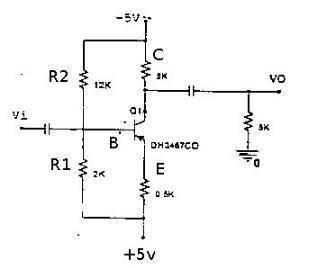
http://www.physicsforums.com/attachment.php?attachmentid=36036&stc=1&d=1306749925
and i want to find the ripple of voltage in outout :
i will use this equation :
V_{O(p-p)}=2I_{CQ} (R_L || R_C)
but why i put R_L || R_C not R_L || R_C + R_E or how i conclude that this is the equivalent resistance at output .
is this connected with thevnin equivalent circuit at output if so !!how.
and is it right that i can here in this problem put one power source (10v) without any change on answers.
thanks .
p.s: this isn't a homwork.
ummm
thats not what I would consider a common emitter configuration.
common emitter ( base or collector) usually infers that that "leg" E, B or C is connected to 0V, either directly or via a resistor
Your cct isnt showing either of those 2 usual configurations, rather its working off a split supply + and - 5V
be interesting to see what more learned people say :)
Dave
Averagesupernova
May30-11, 10:09 AM
The input is the base, the output is the collector. What else could it be other than a common emitter? RL is in parallel with RC as far as and AC signal is concerned.
ummm
thats not what I would consider a common emitter configuration.
common emitter ( base or collector) usually infers that that "leg" E, B or C is connected to 0V, either directly or via a resistor
Your cct isnt showing either of those 2 usual configurations, rather its working off a split supply + and - 5V
be interesting to see what more learned people say :)
Dave
They call it common emitter because the emitter is common to both the input and output, that doesn't imply that the emitter must sit at ground.
and i want to find the ripple of voltage in outout :
By that do you mean the small signal(AC) component of the output?
but why i put
RL||RC
not
RL||RC+RE
or how i conclude that this is the equivalent resistance at output .
You should really draw the small signal model of this amplifier and show us what you come up with, if you're doing that wrong this may the source of your confusion. On the other hand, if you're not drawing the small signal model that may be the source of your confusion.
After doing so it should be obvious that,
R_{out} = R_{c}//R_{L}
They call it common emitter because the emitter is common to both the input and output, that doesn't imply that the emitter must sit at ground.
ahhhhh ok, appreciate that, we live and learn. I guess my misunderstanding comes from always seeing common E, B or C when one of them is tied to GND (0V) in either of the 2 manners I commented on.
The emitter tied to a V rail threw me a curve ball
thanks jegues and averagesupernova
Dave
green-fresh
May31-11, 04:40 AM
By that do you mean the small signal(AC) component of the output?
yes this is what i mean.
You should really draw the small signal model of this amplifier and show us what you come up with, if you're doing that wrong this may the source of your confusion. On the other hand, if you're not drawing the small signal model that may be the source of your confusion.
After doing so it should be obvious that,
R_{out} = R_{c}//R_{L}
yea exactly this is what i must do and like what i asked:
is this connected with thevnin equivalent circuit at output
i find after googling about small signal model that i must at AC concider every capacitor as "short circuit" and also the power source so R_L and R_C have two commen point (one at C and one at GRD)so
R_{out} = R_{c}//R_{L}.
confusion solved thanks very much:
davenn,jegues,Averagesupernova
and i want to find the ripple of voltage in outout :
i will use this equation :
V_{O(p-p)}=2I_{CQ} (R_L || R_C)
BTW. That is neither the output ripple nor is it the small signal output. It is an approximation to the maximum possible peak to peak output voltage assuming a mid point bias. That comes from a large signal analysis. Start by trying to understand the small signal analysis and basic bias point calculations first.
vBulletin® v3.8.7, Copyright ©2000-2012, vBulletin Solutions, Inc.