6Stang7
- 212
- 0
I have a fixed-end fixed-end beam with two roller supports as well and a load applied in the center of the beam, as shown below.
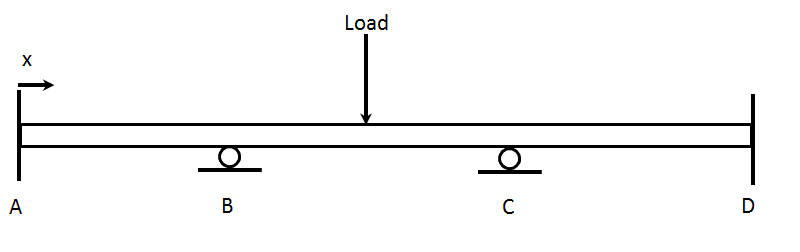
I've chosen my redundant forces to be the force at B (point up), the force at C (pointing up), the force at D (pointing up) and the moment at D (counter-clockwise).
I'm solving for these reactions using deflection and slope equations for a cantilever beam; specifically:
The sum of all the redundant force and the applied load will produce a net deflection at B=0
The sum of all the redundant force and the applied load will produce a net deflection at C=0
The sum of all the redundant force and the applied load will produce a net deflection at D=0
The sum of all the redundant force and the applied load will produce a net slope at D=0
using these equations: http://www.advancepipeliner.com/Resources/Others/Beams/Beam_Deflection_Formulae.pdf
I wrote up a worksheet in MathCAD and used matrix inversion to solve for the redundant forces. However, I am highly suspicious of the answers because the reactionary forces at B and C are not the same (as I'd assume they would be due to symmetry). Here is my worksheet:
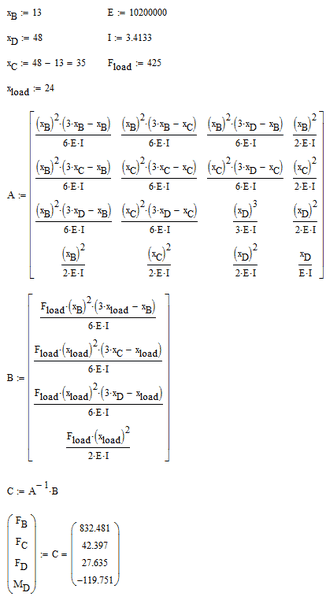
Anyone see any errors that I have made?
I've chosen my redundant forces to be the force at B (point up), the force at C (pointing up), the force at D (pointing up) and the moment at D (counter-clockwise).
I'm solving for these reactions using deflection and slope equations for a cantilever beam; specifically:
The sum of all the redundant force and the applied load will produce a net deflection at B=0
The sum of all the redundant force and the applied load will produce a net deflection at C=0
The sum of all the redundant force and the applied load will produce a net deflection at D=0
The sum of all the redundant force and the applied load will produce a net slope at D=0
using these equations: http://www.advancepipeliner.com/Resources/Others/Beams/Beam_Deflection_Formulae.pdf
I wrote up a worksheet in MathCAD and used matrix inversion to solve for the redundant forces. However, I am highly suspicious of the answers because the reactionary forces at B and C are not the same (as I'd assume they would be due to symmetry). Here is my worksheet:
Anyone see any errors that I have made?
 ; checking the general formula gives an equation that is the same as A(2,1) (as you pointed out). Making this adjustment gives me symmetric results that make sense.