Thread Closed

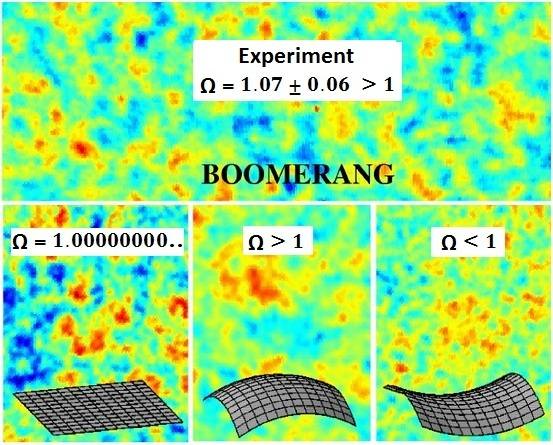
is this a misleading representation of boomerang results

 
Share Thread Thread Tools
Jun9-12, 03:23 PM   #1
 

is this a misleading representation of boomerang results


hi,
is it misleading to write omega = 1.0000... for the ideally flat space?
 
PhysOrg.com
PhysOrg
science news on PhysOrg.com

>> Hong Kong launches first electric taxis
>> Morocco to harness the wind in energy hunt
>> Galaxy's Ring of Fire
Jun9-12, 05:08 PM   #2
 
Recognitions:
Gold Membership Gold Member
Science Advisor Science Advisor
I like the illustration. It communicates a lot graphically without too much possible misinterpretation.

A picture can never tell the whole story and needs words to make sure the viewer gets the right message, but for a picture without words this does a good job, I think.

Nowadays the 2010 confidence interval for Omega is different:

0.9916 < Omega < 1.0133

So you see by modern 2010 standards the Boomerang confidence interval is WRONG.
But that is what they got, say in 1998 using Balloons in Antarctica. Now we have spacecraft in their own orbits around the sun a million miles farther out from the sun than the earth is. Of course we have better results than Boomerang. But it was an honorable well-executed attempt. And it is an excellent picture to communicate the idea.
 
Jun9-12, 05:25 PM   #3
 
Recognitions:
Gold Membership Gold Member
Science Advisor Science Advisor
The neat thing is that we know the actual sizes of those fluctuations, at least as a statistical distribution, how many of each various size. And we know how far away they were when they emitted the glow that we now see. So we can estimate what ANGULAR SIZES they should have, at least as a statistical distribution, which will depend on whether space is positive curved or zero or negative.

In a positive curved space the hot-cold fluctuation patches will look BIGGER, in angular size. Like looking thru a magnifying glass. Or looking at the patch of stars behind the sun, which appears spread out because of the "gravitational lens" effect of the sun's gravity curving the rays in towards us the viewers. Making parallel rays bend in and converge.

I've seen this graphic before but I don't have a link to it. Could you give us the link? I'd like to have it handy as an illustration.

Also I have a personal reason. I think that the importance of Andrew Lange's contribution to cosmology has not been fully appreciated. He was one of the main people in charge of BOOMERANG. The concept and instrumentation were elegant. The data was surprisingly high resolution for the time (1998).
 
Jun9-12, 07:48 PM   #4
 
Mentor

is this a misleading representation of boomerang results


I don't think that the OP is questioning the veracity of the result from the BOOMERANG data (in the top panel).

It seems like the OP is asking if the Ω = 1.00000000.. statement in the lower left panel is misleading. My answer would be no, and I wonder why you think it might be. Ω is supposed to be exactly 1 for the flat case, given that you are talking the total density parameter.
 
Jun9-12, 07:58 PM   #5
 
Mentor
Hey marcus,

Found this on the BOOMERANG website:

http://cmb.phys.cwru.edu/boomerang/p...model_maps.jpg

I never met Andrew Lange, but I felt the effects of his passing through the impact it had on colleagues, and through the vacuum it left behind in leadership and direction for a time.
 
Jun9-12, 09:40 PM   #6
 
Recognitions:
Gold Membership Gold Member
Science Advisor Science Advisor
Thanks!

I started a little CMB-observation history thread (Boomerang to WMAP, or could be to Planck) a while back. Anyone who knows any details of the history, of any sort, feel welcome to add. I will put your link on that thread.
 
Jun10-12, 04:55 AM   #7
 
Recognitions:
Science Advisor Science Advisor
Quote by marcus View Post
So you see by modern 2010 standards the Boomerang confidence interval is WRONG.
I wouldn't say that. The Boomerang confidence interval was fully consistent with the current value today. We can just do better today, with many other observations.
 
Jun10-12, 11:31 AM   #8
 
Recognitions:
Gold Membership Gold Member
Science Advisor Science Advisor
Quote by Chalnoth View Post
I wouldn't say that. The Boomerang confidence interval was fully consistent with the current value today. We can just do better today, with many other observations.
I'm glad you know what the interval was. Could you give a link and say what it was? This would save me having to dig it up.

The graphic which Jerusalem gave us says their estimate was [1.01, 1.13].

Is that right? Did Boomerang actually say [1.01, 1.13]?

Is that what you mean by fully consistent with the current value today, which I'm taking from WMAP7 to be [0.9916, 1.0133]?
 
Jun10-12, 02:15 PM   #9
 
Quote by cepheid View Post
I don't think that the OP is questioning the veracity of the result from the BOOMERANG data (in the top panel).

It seems like the OP is asking if the Ω = 1.00000000.. statement in the lower left panel is misleading. My answer would be no, and I wonder why you think it might be. Ω is supposed to be exactly 1 for the flat case, given that you are talking the total density parameter.
thank you cepheid,

quote: "I wonder why you think it might be"

I had an argument with some one who claimed that Ω = 1.000000.. gives a false impression about the precision of the instruments. I need to convince him that the statement in the lower left panel has nothing to do with the results of the experiment. it just states that Ω is supposed to be exactly 1 for the ideally flat space.

Quote by marcus View Post
I'm glad you know what the interval was. Could you give a link and say what it was? This would save me having to dig it up.

The graphic which Jerusalem gave us says their estimate was [1.01, 1.13].

Is that right? Did Boomerang actually say [1.01, 1.13]?

Is that what you mean by fully consistent with the current value today, which I'm taking from WMAP7 to be [0.9916, 1.0133]?
check this marcus arxiv.org/pdf/astro-ph/0011469v1.pdf ,, Ω = (1.07 ± 0.06)

no doubt that WMAP confidence interval is far better than boomerang confidence interval.

but my question was about the lower left panel, I wrote Ω = exactly 1 with no margin of error, since it doesn't represent the result of the experiment.
 
Jun10-12, 04:26 PM   #10
 
Recognitions:
Gold Membership Gold Member
Science Advisor Science Advisor
Quote by jerusalem View Post
...I need to convince him that the statement in the lower left panel has nothing to do with the results of the experiment. it just states that Ω is supposed to be exactly 1 for the ideally flat space.
...
You are quite right AFAICS. The aim of the graphic panel is to illustrate the ideally flat case where Omega is exactly 1.
At no time did I get any other impression, such as that you were saying something about the precision of the instruments.

The other person's objection does not seem reasonable or appropriate to me. I hope he can be convinced to see it in a better light.
=====================

But just as a stylistic matter you could change it to read Omega = 1
That can logically be taken to read "Omega = 1 exactly"

It communicates the essential point and it is cleaner than saying
"Omega = 1.0000000..."

When you first presented it, I did not realize that YOU had superimposed the equations on top of the Boomerang graphics. Now something you said makes me think you did, so you have control. I wonder what you are trying to get across to your audience by putting on all the zeros. Could it be communicated just as well by saying "Omega = 1 exactly"?
 
Jun11-12, 03:17 AM   #11
 
we were arguing about what Dr.Michio Kaku said here:
The inflation was so enormous, in fact, that the balloon seems flat in our vicinity, a fact that has been experimentally verified by the WMAP satellite. In the same way that the earth appears flat to us because we are so small compared to the radius of Earth, the universe appears flat only because it is curved on a much larger scale.
books.google.ca/books?id=6rCw34JCLnsC&pg=PA13#v=onepage&q&f=false
Dr. Tom Murphy :
The universe looks pretty flat: it doesn’t deviate by more than 2% from being flat. But, the possibility exists that the universe is still curved on much larger scales. It’s just like the fact that the earth looks flat locally, over small scales, but is curved on the whole. The universe could be closed into a sphere, but on a much larger scale than what we can see.
physics.ucsd.edu/~tmurphy/phys10/universe.pdf

ie: we should not rule out the possibility of a closed universe in a larger scale.
since we only mesure the observable universe:
So when we say "WMAP provides strong evidence that the universe is flat", we really mean "WMAP provides strong evidence that the observable universe is flat".
curious.astro.cornell.edu/question.php?number=171
 
Jun11-12, 11:12 AM   #12
 
Recognitions:
Gold Membership Gold Member
Science Advisor Science Advisor
Thanks for the clarification! I happen to agree with what you highlight in red.
As I recall from the WMAP5 report, they do not even claim the observable universe is flat. They use words like "nearly flat". The data is consistent (within uncertainty bounds) with the perfectly flat model. And also it is consistent with a overall slightly curved model.

The Cornell "Ask an astronomer" site is primarily for pre-college young people, I think. Some of the language is oversimplified or not carefully enough qualified, so you have to be cautious about taking it literally sometimes. What you quoted is a case of that:
So when we say "WMAP provides strong evidence that the universe is flat", we really mean "WMAP provides strong evidence that the observable universe is flat".
curious.astro.cornell.edu/question.php?number=171
WMAP does NOT provide strong evidence that the observable universe is EXACTLY flat.
It provides wonderfully strong evidence that Omega is in the range
0.9916 < Omega < 1.0133 (talking about the universe as a whole, assuming uniformity)

And what that translates to, in the picture of a very large balloon that looks flat to creatures living on it, is that if the curvature is at the upper limit you have a circumference of 750 billion light years (again the universe as a whole.)

That is one way of gauging the "near flatness". When you say "nearly" you suppose some way of quantifying curvedness. Most people don't grok Omega. It doesn't do anything for them to say "within one percent of unity". So you can translate that into the large balloon picture and say that the most distant matter is AT LEAST 375 billion LY away (half the circumference).

The radius of the portion we can now observe is some 45 billion LY. So the whole balloon is AT LEAST ten times bigger than what we can see---in the vague way that 375 is bigger than 45. The most distant stuff is an order of magnitude (factor of 10) farther than the most distant stuff we can see.

Or you could talk in terms of the "RADIUS OF CURVATURE" of the local patch of universe we currently see. It is one way a mathematician might quantify curvedness. Divide the circumference of 750 by 2 pi. Is that about 120?

I think I'm just repeating, but maybe that doesn't hurt. We don't have, in our common everyday language, good ways to talk about degrees of curvedness. But to give an honest account of what is known (WMAP and also BAO and SN data) we have to have a way. We can't just say "flat" and give the listener the idea of EXACTLY flat. We have to say nearly, and that supposed a concept of amount of flatness or curvedness.

If you like the idea of a "radius of curvature" then 2010 WMAP report says that RoC of the patch of universe we can see is, with 95% confidence, at least 120 billion LY

that is the radius of the fitting hypersphere, if the observable patch were laid on the 3D "surface" of a fitting 4D hypersphere.
 
Jun11-12, 09:41 PM   #13
 
Recognitions:
Science Advisor Science Advisor
Quote by marcus View Post
I'm glad you know what the interval was. Could you give a link and say what it was? This would save me having to dig it up.

The graphic which Jerusalem gave us says their estimate was [1.01, 1.13].

Is that right? Did Boomerang actually say [1.01, 1.13]?

Is that what you mean by fully consistent with the current value today, which I'm taking from WMAP7 to be [0.9916, 1.0133]?
Actually, I don't remember the specific parameters off the top of my head. I was, in part, going by the numbers posted earlier in this thread. I know, however, that no experiment to date has detected a statistically-significant deviation of spatial curvature from zero.

If you're curious, though, here is their paper on cosmological paramters for their latest flight (2003):
http://arxiv.org/pdf/astro-ph/0507503v1.pdf

There are multiple ways to combine the data, but the curvature always deviates from zero at less than two standard deviations.
 
Jun11-12, 11:41 PM   #14
 
Recognitions:
Gold Membership Gold Member
Science Advisor Science Advisor
As I recall, boomerang allowed a generous range for omega - ranging from about 0.8 to 1.3. The 1.01+ thing was merely a best guesstimate.
 
Jun12-12, 12:24 AM   #15
 
Recognitions:
Science Advisor Science Advisor
Quote by Chronos View Post
As I recall, boomerang allowed a generous range for omega - ranging from about 0.8 to 1.3. The 1.01+ thing was merely a best guesstimate.
Well, you generally don't get a very tight range using only CMB data. But combine Boomerang with other data and the constraints close to a couple percent (as shown in the paper I linked above).

Still that's rather old. We have better data today. Boomerang was just one experiment among a great many.
 
Jun12-12, 01:01 PM   #16
 
Mentor
Quote by Chronos View Post
As I recall, boomerang allowed a generous range for omega - ranging from about 0.8 to 1.3. The 1.01+ thing was merely a best guesstimate.
I don't think that is the case. I'm pretty sure that the constraints are somewhat tighter than that. As described here:

http://arxiv.org/abs/astro-ph/0104460

and in the paper they reference by Lange, 2001, they do a likelihood analysis, and the best estimate of the parameter is obtained from the peak of the likelihood function, with the uncertainties obtained by integrating over this function out to the 1-sigma limits. Maybe this is what you meant by best guesstimate, I don't know. They have values reported in table 5 such as 1.02 +/- 0.06, or 0.98 +0.04, -0.05, depending on their choice of prior.
 
Jun13-12, 10:55 AM   #17
 
Quote by cepheid View Post
I don't think that is the case. I'm pretty sure that the constraints are somewhat tighter than that. As described here:

arxiv.org/abs/astro-ph/0104460

and in the paper they reference by Lange, 2001, they do a likelihood analysis, and the best estimate of the parameter is obtained from the peak of the likelihood function, with the uncertainties obtained by integrating over this function out to the 1-sigma limits. Maybe this is what you meant by best guesstimate, I don't know. They have values reported in table 5 such as 1.02 +/- 0.06, or 0.98 +0.04, -0.05, depending on their choice of prior.
is there a degree of precision, if reached, we can say for sure that we are living in an infinite euclidean space?
Quote by marcus View Post
WMAP does NOT provide strong evidence that the observable universe is EXACTLY flat.
It provides wonderfully strong evidence that Omega is in the range
0.9916 < Omega < 1.0133 (talking about the universe as a whole, assuming uniformity)

And what that translates to, in the picture of a very large balloon that looks flat to creatures living on it
well my interlocutor refused this possibility and claimed that (boomerang and wmap..) measure the shape of the ENTIRE universe because the photon we detect started its journey since the beginning (380000 after BB). Did you ever heard such interpretation ? In my opinion this make sense only if the speed of light is greater than the expansion of the universe.
 
Thread Closed
Thread Tools


Similar Threads for: is this a misleading representation of boomerang results
Thread Forum Replies
How does a boomerang work? Classical Physics 4
Another misleading observer example, or not? Quantum Physics 5
What causes a boomerang return? General Physics 16