| New Reply |
What is Space outside of the universe and infinity according to Physics? |
Share Thread |
| Sep27-12, 07:41 AM | #1 |
|
|
What is Space outside of the universe and infinity according to Physics?
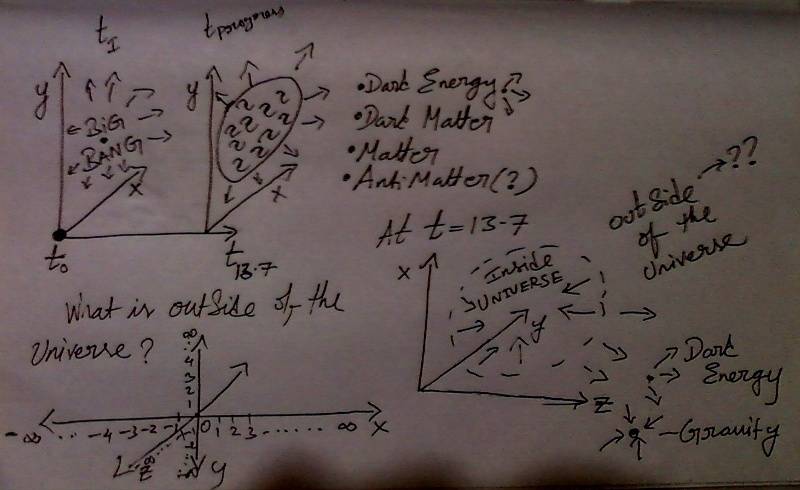
Space: So far for me it's 3D along with Time T. say 3D+T=4D (spaceTime), from the bigbang we have considered Time (t sub I) as well, considering Time from the start of bigbang to 13.7 Billion years after the bigbang. Since our universe is accelerating due to Dark energy, expansion is speeding up.
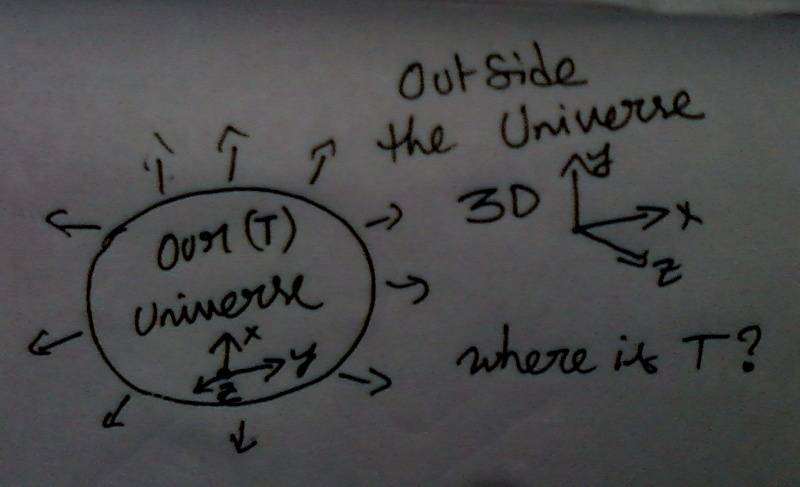
Now we are inside the universe, what do we call out side of the universe? How can we consider time when we do not have anything to measure in empty space? can we consider time outside the universe when there is nothing to measure or progress (Since Time is a dimension, must tag along always with space, according to special and general theory of relativity). However, What do we call empty space outside our universe say space before taken over by our universe? or what do we call gaps between multiverse ? Further more, what is outside of multiverse (if we think about going as far as we can thinking crazy far). I have just drawn rough diagram here to make you understand what I am trying to say. ![]() t sub I is Time at the Bigbang, T-Progress is progress of acceleration of the universe as now. Do not know what happened to Anti matter? can I safely say SpaceTime outside the universe ? Can I move up and down, left and right, forward and back at a point in outside of the universe if it is spaceTime ? How can I understand it ? According to real number line in mathematics, can we consider that space is infinite outside of our universe?
|
| Sep27-12, 11:48 AM | #2 |
|
|
I'm a layman, so don't take anything I'm about to say seriously. Nonetheless, I'd like to share my thoughts. If the multiverse theory is correct, then space is infinite and there is nothing for it to expand into. As to the gaps between other universes, there apparently would not be a gap; you would just keep traveling until you encountered a collection of matter that was nearly identical to the collection of matter you have been traveling away from; in other words, a parallel universe. There would be no "outside" of the multiverse because, again, it is supposedly infinite in its expanse. As to the measurement of time, since there are apparently no gaps between universes, there would always be some collection of matter that changes over time, even if it's nothing other than atomic decay, not to mention your own body slowly changing as you aged while traveling.
|
| Sep27-12, 12:50 PM | #3 |
|
|
There is no satisfactory answer to this question. If the big bang was infinitely large, as some believe, then the universe is, and has always been infinite. So, the question becomes what lies beyond infinity? - in other words, it's irrelevant. The observable universe is a temporally finite sphere about 93 billion light years in diameter [comoving distance] with an age of about 13.7 billion years. Obviously, we can't observe anything more ancient than the universe itself, so again, the question is moot. Only if you assume the universe is a finite entity embedded in some arbitrarily large [or infinitely large] prexisting space is the question meaningful. The obvious answer is it is embedded in a vast/infinite sea of absolute emptiness - which is not wildly popular among scientists. Another idea is the multiverse, which is speculative and admits to no known experimental test.
|
| Sep27-12, 02:03 PM | #4 |
|
|
What is Space outside of the universe and infinity according to Physics?
No, the problem is that the question isn't valid. There's no such thing as 'outside' the universe. The universe may be finite in size, but it certainly does not have an edge. Think of the surface of the earth - finite, yet you won't find an edge. Take a look at this article for some clarification:
http://www.mso.anu.edu.au/~charley/p...DavisSciAm.pdf |
| Sep27-12, 02:25 PM | #5 |
|
|
The Earth does not have an edge but it is embedded in the surrounding space. So there is the question of whether or not the universe, even if it curves back on itself, is embedded in something.
|
| Sep27-12, 03:09 PM | #6 |
|
|
|
| Sep27-12, 04:33 PM | #7 |
|
|
|
| Sep27-12, 05:45 PM | #8 |
|
|
There is not a definite border to the universe. However, any photon or particle or whatever that is on a tragetory which will cause it to never ever interact with the timeline of any other photon or particle or whatever is outside of the universe in my book.
|
| Sep27-12, 06:11 PM | #9 |
|
|
|
| Sep27-12, 07:32 PM | #10 |
|
|
If that is how you always think of space, or of spacetime, you might find quite a bit of physics after 1850 puzzling. Year 1850 was when Georg Riemann gave us a mathematical representation of space that was more versatile than xyz. Called the manifold. For example a 3D manifold has LOCAL xyz coordinates and you can do all the usual calculations that you do with xyz---curves functions areas volumes tangents derivative... BUT a 3D manifold can be boundaryless and yet have finite volume, and it can be AUTONOMOUS and completely described by internal relationships. It does not have to be embedded inside a higher dimension manifold in order to exist. Furthermore doing geometry with manifolds is simple once you get used to it. Nothing mysterious about it. For example a 2D manifold has LOCAL XY coordinate charts, like the surface of the earth has local maps. And it can be boundaryless and still have finite "volume" ie area. And it can be completely determined by internal relationships (angle-sum in geodesic triangles, length of great circle routes, etc.) which 2D beings would experience moving around in it. And it can exist as an autonomous mathematical object of study WITHOUT being embedded in any higher dimension manifold. Riemann taught us to imagine various possible spaces this way, as manifolds, and to work with them and calculate that way, instead of merely with xyz. So there is a kind of "watershed" or "continental divide". Your pictures make me think you like to think concretely and physically and that you like mathematics, but they are all on the "xyz" side of the divide. All on the 1637 Descartes side. Not on the post-1850 Manifold side. It would be easy for you to come over, I think. Learn to model space as a manifold, something I don't think you would find at all hard. There does not have to be "space outside of space". Nor does there have to be a spatial boundary to the universe. Geometry (including curvature) can be determined by internal relationships, like how different triangles add up and how round volumes grow with radius.These are things that interest cosmologists, in fact! they try, by their observations, to measure curvature in these or similar ways, and to discover universe geometry by experiencing it from within. After all one cannot get out
|
| Sep27-12, 11:44 PM | #11 |
|
|
In Fact there is outside, if there is no out side what universe is accelerating into ? String theorists and other physicists show that we live in multiverse which are not attached to one another like membrin like a bread got sliced up. sum of the slices of breads is multiverse just an analogy. If you say nothing outside are we living in a box or sphere or something with closed surface? |
| Sep27-12, 11:57 PM | #12 |
|
|
even if universe is infinite and where would you start bang when you can consider any point in space as mid point in infinite space? There should be some name given to outside or(if exist) emptyspace ... how would I calculate time out side of the space? |
| Sep28-12, 12:18 AM | #13 |
|
|
However, I would prefer more visual explanation since we are dealing with dimensions and shapes. We say we live in space with 4D's so I was drawing with x y z and T time. I could not draw higher D for Time so I considered universe as 2d and Time as 3ed D. If space say again old version of René Descartes, (I can take about new one after I learn it, still need lot of work to do in math..).. if x y and z along with T , say xyz must be infinite because they are dimensions ! Don't you think? we cannot consider it as limited with respective to our universe expansion. Theoretically speaking Dimensions exceed infinity right? We live in Dimensions say Xyz it has to be infinite because they are Dimensions. By the way like in mathematics real number line, in the physical world can we really have infinity space? not considering our universe. |
| Sep28-12, 12:55 AM | #14 |
|
|
|
| Sep28-12, 08:18 AM | #15 |
|
|
|
| Sep28-12, 02:20 PM | #16 |
|
|
If you are fortunate and have a good teacher it will not be difficult for you. I guessed earlier from your writing that you like mathematics and I am happy to hear this from you directly. When you come here and ask questions about physics and cosmology you will also be practicing using English, which is a good idea too, or so I think anyway. ================= I cannot explain why I am curious about this---for some reason I am curious: I would like to know, if you would not mind telling me, what is the word for DIMENSIONS in your first language? I am trying to understand why you imagine that dimensions must be infinite. When you study the modern geometry of manifolds you will understand (I think) that frame of xyz dimensions is only used to APPROXIMATE nature's geometry in some specified NEIGHBORHOOD. The xyz frame only works well in some limited LOCAL region. So to cover the whole manifold we need SEVERAL local maps. One map cannot say it all. It does not work well enough when one gets too far from the home base. So we need several maps. And the other thing that is new about manifolds is that where they OVERLAP the maps must be consistent with each other, perhaps allowing for a little distortion. One should be able to understand how to make them match up. The manifold idea gives us a new conception of space, and of spacetime. So now it is possible for space to have Dimension (LOCALLY) and for space to be without boundary and yet be finite. And for space to be independent and free of any surrounding space. This is what I meant by "autonomous". It does not need to be embedded in any larger space. It can exist on its own and all its geometry can be described by the experience from within the space. With manifolds we do not need "space outside of space", and space can have finite volume and finite circumference---or it can be infinite. Either one works, with manifolds. |
| Sep28-12, 03:49 PM | #17 |
|
|
I think the problem is that when you hear 'expansion' you think of an expanding balloon. However, when we talk about cosmological expansion, we refer to the growth of distances. If two bound systems (i.e. galaxies) are separated by some distance now (called the proper distance), then the proper distance at some later time will be larger. The galaxies themselves didn't move, just that there is now more distance in between them. And since this occurs in between every bound system, it follows that there is no center of the universe. To add to marcus's excellent explanation, the reason we must treat the universe as a manifold is because we describe it with our most successful theory of gravity, general relativity. GR treats spacetime as a manifold, and that the curvature of this manifold creates the fictitious force of gravity. Along with being a theory of gravitation, we can apply to cosmology. It will place the requirement that, as marcus has been explaining, we can't think of the universe as having an edge or boundary. Instead, expansion is metric, as I explained above. |
| New Reply |
| Tags |
| space time |
Similar discussions for: What is Space outside of the universe and infinity according to Physics?
|
||||
| Thread | Forum | Replies | ||
| On the infinity of the Universe | Cosmology | 45 | ||
| Zero to infinity....can we assume same for universe ?? | Cosmology | 16 | ||
| the space l infinity | Calculus & Beyond Homework | 15 | ||
| space medium or infinity | Special & General Relativity | 5 | ||
| Infinity in the Universe | Astrophysics | 11 | ||