| New Reply |
The Klein-Gordon equation with a potential |
Share Thread | Thread Tools |
| Nov21-12, 02:58 AM | #18 |
|
|
The Klein-Gordon equation with a potential[tex] \mathcal{L} = \mathcal{L_0} + \mathcal{L}_{\mathrm{int}} [/tex] Here [itex]\mathcal{L_0} = \partial^{\mu} \Psi^{\ast} \, \partial_{\mu} \Psi - m^2 \Psi^{\ast} \, \Psi[/itex] is the Lagrangian for the free complex scalar field. Varying w.r.t. [itex]\Psi^{\ast}[/itex], one obtains: [tex] \frac{\delta S}{\delta \Psi^{\ast}(x)} = -\left\lbrace \partial^2 + m^2 \right\rbrace \Psi(x) - \frac{\lambda}{2! 2!} 2 (\Psi^{\ast} \Psi) \, \Psi [/tex] Equate this variation to zero and you get: [tex] \left\lbrace \partial^2 + m^2 \right\rbrace \Psi = - \frac{\lambda}{2} (\Psi^{\ast} \Psi) \, \Psi [/tex] Apart from a wrong sign, the r.h.s. has the form I gave in my previous post. |
| Nov21-12, 03:05 AM | #19 |
|
|
I thought your first term also some sort of a lagrangian which is not possible.
|
| Nov21-12, 03:08 AM | #20 |
|
|
|
| Nov21-12, 04:50 AM | #21 |
|
|
Yes you are right with the correct potential form, though I assumed it was in relation to the Higgs boson as this is what the topic is on though I'm guessing a potential of this form is just an example to familiarise ourselves.
|
| Nov21-12, 07:30 AM | #22 |
|
|
|
| Nov21-12, 10:40 AM | #23 |
|
|
Hey I think the form of the potential was supposed to be this:
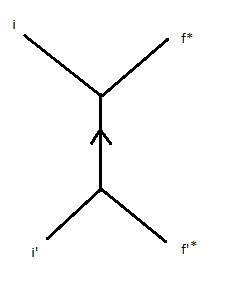
[tex]\lambda\Psi_{f'}^{*} \Psi_{i'}[/tex] such that: [tex](\frac{\partial^2 }{\partial t^2}-\bigtriangledown^2+m^2)\Psi=\lambda\Psi_{f'}^{*} \Psi_{i'}[/tex] Is this right? |
| Nov21-12, 11:41 AM | #24 |
|
|
For a complex scalar field theory you want a partition function of the form
[tex] Z = \int D\phi \exp \left[ i \int d^4 x \frac{1}{2} \{ \partial \phi \partial \phi^{\dagger} + m^2 \phi \phi^{\dagger} \} + V(\lambda , \phi, \phi^{\dagger}) + J^{\dagger}\phi + J\phi^{\dagger} \right] [/tex] you can then assume weak coupling and expand the potential order by order in lambda, and replace the moment integrals with variations with respect to J, [itex]\delta / \delta J [/itex], like [tex] \int dx \, x^2 e^{-\alpha x} = \frac{\partial^2}{\partial \alpha^2} \int dx \, e^{-\alpha x} [/tex] doing this, along with a regularization procedure, you can make all the connected green's functions and feynman diagrams. |
| Nov21-12, 03:01 PM | #25 |
|
|
Hmm I don't understand most of that - though it does sound like the route we are taking. Does the equation I just posted make sense at all though? Are you implying that it is and it's a complex scalar field?
I haven't actually had any substantial teaching of quantum field theory, we're supposed to be taking a simplified route so forgive me for not understanding most of the terms you speak of (i.e. the partition function - i've heard of that but not applied to this!) Thanks! |
| Nov21-12, 03:13 PM | #26 |
|
|
something doesn't seem right... If I understand you correctly you are writing
[tex] V(\Psi, \Psi^{\dagger}) = \lambda \Psi \Psi^{\dagger} [/tex] then the lagrangian would be [tex] \mathcal{L} = \frac{1}{2}\partial \Psi^{\dagger} \partial \Psi + \frac{1}{2}m^2 \Psi^{\dagger}\Psi - \lambda \Psi^{\dagger} \Psi [/tex] If you solve Lagrange's equations for [itex]\Psi[/itex] or [itex]\Psi^{\dagger}[/itex] you will not get what you have posted. If you want to get a vertex with three lines the potential needs to be cubic in field quantities. but with a complex field it will be asymmetrical too since you will write down a term like [itex]\Psi\Psi^{\dagger}\Psi[/itex] which is uneven in the two fields. For real fields it would be like [itex]\phi^{3}/3![/itex]. |
| Nov21-12, 03:31 PM | #27 |
|
|
Well it probably isn't right knowing me, my professor said we model the perturbation as the interaction between some 2 scalar particles which is of the form of some coupling strength lambda and the product of the complex conjugated final state wavefunction of particle 2 and the initial state wavefunction of particle 2...
I shall send him an email tomorrow and ask! I apologise if I'm not coherent/making sense. Thanks, Tom |
| Nov21-12, 03:41 PM | #28 |
|
|
please report back! :) I want to know too.
|
| Nov21-12, 03:46 PM | #29 |
|
|
haha will do!
|
| Nov22-12, 03:19 AM | #30 |
|
|
I think that interaction term posted by dickfore is the right one,it seems that in post #27 that is what is being said.
|
| Nov22-12, 10:41 AM | #31 |
|
|
Hey,
My professor says an equation of this form: [tex](\frac{\partial^2 }{\partial t^2}-\bigtriangledown^2+m^2)\Psi=\lambda\Psi_{f'}^{*} \Psi_{i'}\Psi[/tex] Will give a 4 particle interaction where I need to make the 'f'' state on the rhs an external (not sure what this means yet) and this useful for looking at the Higgs. Whereas an equation of form: [tex](\frac{\partial^2 }{\partial t^2}-\bigtriangledown^2+m^2)\Psi=\lambda\Psi_{f'}^{*} \Psi_{i'}[/tex] Is a 3 particle interaction where they meet at a junction and some internal scalar particle is propagated. |
| Nov22-12, 11:22 AM | #32 |
|
|
sure, I don't have a problem with that. But I don't think that is a consequence of a potential of the form [itex]V=\lambda \Psi^{\dagger}\Psi [/itex]. I think the potential must have a different form if the r.h.s of the equation looks like that.
|
| Nov22-12, 11:47 AM | #33 |
|
|
Well he included a delta sign next to the potential i.e. it was δV=λψ*ψ, are you supposing it should be δV=λψ*?
|
| New Reply |
| Thread Tools | |
Similar Threads for: The Klein-Gordon equation with a potential
|
||||
| Thread | Forum | Replies | ||
| Reconcile Geometric Form of Cross Product with Algebric Form | Calculus & Beyond Homework | 3 | ||
| How to convert velocity potential from polar form to Cartesian coordinate form! | Advanced Physics Homework | 4 | ||
| How do I derive the 1-dimensional form of the wave equation from the general form? | Classical Physics | 5 | ||
| Understanding Capacitors - Form & Function | General Physics | 4 | ||
| Understanding Perturbation Theory of GR | General Physics | 1 | ||