New Reply

Time paradox

 
Share Thread Thread Tools
Jan24-13, 07:38 PM   #205
 

Time paradox


Bear with me a little more here. I'm trying to get my head into your concept and use of Lorentz frames and simultaneous spaces.

Focus just on the stay-at-home twin. Is he in an inertial frame? Does he exist in a continuous sequence of simultaneous spaces, each one parallel to his X1 axis?
Jan24-13, 08:04 PM   #206
 
Mentor
Quote by bobc2 View Post
Focus just on the stay-at-home twin. Is he in an inertial frame?
He is in all inertial frames. Additionally, he is at rest in an inertial frame.

Quote by bobc2 View Post
Does he exist in a continuous sequence of simultaneous spaces, each one parallel to his X1 axis?
Simultaneity is a convention. You can certainly choose that convention if you like, but you don't have to.

Also, there is no empirically discernable sense in which he exists in one simultaneity convention and not in another. If he exists, then he exists regardless of which simultaneity convention you adopt.
Jan25-13, 06:38 AM   #207
 
Recognitions:
Gold Membership Gold Member
Quote by bobc2 View Post
Very good graphics, ghwellsjr. Your graphics make it very clear. Good job.
Thanks, I'm glad you like them.
...
Quote by bobc2 View Post
The sketch below gets messy, but it illustrates a couple of more details that one may or may not find interesting. Notice that the event A on the 2nd Red stay-at-home guy (displaced from the first red twin) is presented to the returning twin’s trip simultaneous space before it is presented to the outgoing twin’s simultaneous space. Notice that this does not in any way imply that the 2nd Red guy's time is flowing backwards for that Red guy sitting at rest in his own black inertail frame. It's just a feature of special relativity and is no more mysterious than the two twins having different ages after they reunite.

By the way, the blue dots on the travelling twin's worldline are placed with same proper time increments as the black worldline dots (one year intervals of proper time on both worldlines, in accordance with your preference). The hyperbolic calibration curves show the five year lapses.

I have attempted to replicate your drawing without the extra lines:


Now I transform to the IRF in which the traveling twin is stationary during the outbound portion of his trip:


And the transform to the IRF in which the traveling twin is stationary during the inbound portion of his trip:


Now how do you get information from these last two IRF's to draw the extra lines in the first IRF and to come to the conclusions that you do?
Attached Thumbnails
Twins 0.638 AB1.PNG   Twins 0.638 AB2.PNG   Twins 0.638 AB3.PNG  
Jan25-13, 01:58 PM   #208
 
Quote by ghwellsjr View Post
Thanks, I'm glad you like them.
...

I have attempted to replicate your drawing without the extra lines:

Now how do you get information from these last two IRF's to draw the extra lines in the first IRF and to come to the conclusions that you do?
Once again a very good job. You have presented all of the information in an easily understood picture that accounts very well for the difference in the twins' ages at the reunion. And this of course is exactly what was originally requested at the beginning of this thread. No additonal comments were really needed at that point.

I had originally simply tried to give the discussion a larger context by expanding the picture by adding frame coordinates for the outgoing and return trip frames. Of course subsequent comments (beginning with an observation by Vandam) led to the addition of a second Red guy in the rest frame with events A and B and the intersections of the blue X1 and X1' axes with that 2nd Red guy's worldline. My picture of the blue guy jumping frames (to use a phrase from Rindler's text book) then generated a series of push-backs from others.

But, to answer your question I've displayed my construction, sketch b) below, to show how my additional features would be added to your sketch a). I just wanted to show the coordinates associated with your frames (Rindler makes a distinction between "frames" and "frame coordinates"). So, I began by establishing the X4 and X4' coordinates along the direction of the inertial worldlines. Then, I used 45-degree green lines to represent photon worldlines. The simultaneous spaces for the two coordinate systems are then established by adding in the X1 and X1' axes. These X1 and X1' axes are of course placed such that the photon worldlines bisect the angles between the X4-X1 pairs.

The 2nd Red guy worldline was just added in to illustrate the interesting feature mentioned by Vandam.


[edit: Note the slight discrepancy in my sketch b). The green photon worldline is not exactly 45-degrees. I hope this does not distract from illustrating the basic concepts.
Jan25-13, 03:56 PM   #209
 
Recognitions:
Gold Membership Gold Member
Quote by bobc2 View Post
Once again a very good job. You have presented all of the information in an easily understood picture that accounts very well for the difference in the twins' ages at the reunion. And this of course is exactly what was originally requested at the beginning of this thread. No additonal comments were really needed at that point.
And once again, thanks.
Quote by bobc2 View Post
I had originally simply tried to give the discussion a larger context by expanding the picture by adding frame coordinates for the outgoing and return trip frames. Of course subsequent comments (beginning with an observation by Vandam) led to the addition of a second Red guy in the rest frame with events A and B and the intersections of the blue X1 and X1' axes with that 2nd Red guy's worldline. My picture of the blue guy jumping frames (to use a phrase from Rindler's text book) then generated a series of push-backs from others.
Maybe you're thinking of a different thread since Vandam got himself banned before this thread was started.
Quote by bobc2 View Post
But, to answer your question I've displayed my construction, sketch b) below, to show how my additional features would be added to your sketch a). I just wanted to show the coordinates associated with your frames (Rindler makes a distinction between "frames" and "frame coordinates"). So, I began by establishing the X4 and X4' coordinates along the direction of the inertial worldlines. Then, I used 45-degree green lines to represent photon worldlines. The simultaneous spaces for the two coordinate systems are then established by adding in the X1 and X1' axes. These X1 and X1' axes are of course placed such that the photon worldlines bisect the angles between the X4-X1 pairs.

The 2nd Red guy worldline was just added in to illustrate the interesting feature mentioned by Vandam.

I take it that you are applying angles to create your lines rather than having a computer program do it for you. That would explain why my diagram didn't line up with the axes as you had intended. But now that I understand what your intent was, I can redraw my diagrams to portray what you want. However, I need to move the second red guy out a little further because he is too close to the intersection of the X1 and X'1 axes to show what you want. So here is another set of drawings starting with the original and final rest frame of all the participants:


Now the rest frame for the traveler during the outbound:


You should know that I adjusted the coordinate time of event B in the first frame so that the event appears simultaneous with the common origin of all the frames. That is another way of forcing event B to be simultaneous with your X1 axis.

And the rest frame for the traveler during the inbound:


Again, I adjusted the coordinate time of event A in the first frame so that the event appears simultaneous with the traveling twin's turn-around event. That is another way to force event A to be simultaneous with your X'1 axis.

Now I think your interesting observation was that in the traveler's simultaneous space, event A occurs after event B. However, I think you can see that following your definition of simultaneous space, you really should say that the interesting observation is that in the traveler's simultaneous space, event A occurs both before and after event B. And now that I've pointed that out, you can easily go back to your original sketch or mark up mine to show this interesting observation.
Attached Thumbnails
Bob's 0.638 guys 4.PNG   Bob's 0.638 guys 5.PNG   Bob's 0.638 guys 6.PNG  
Jan25-13, 04:57 PM   #210
 
Mentor
Quote by ghwellsjr View Post
I think you can see that following your definition of simultaneous space, you really should say that the interesting observation is that in the traveler's simultaneous space, event A occurs both before and after event B.
Which is precisely why that particular simultaneity convention is not valid in that region.
Jan25-13, 07:53 PM   #211
 
Quote by DaleSpam View Post
Which is precisely why that particular simultaneity convention is not valid in that region.
After the twins are reunited and both at rest in the original stay-at-home rest system, do you consider both of them to share the same simultaneous space?
Jan25-13, 08:09 PM   #212
 
Mentor
Quote by bobc2 View Post
After the twins are reunited and both at rest in the original stay-at-home rest system, do you consider both of them to share the same simultaneous space?
Simultaneity is a matter of convention. You could pick a convention where they do, or you could pick a convention where they do not.
Jan25-13, 08:32 PM   #213
 
Quote by bobc2

Quote by bobc2


However, as the blue guy moves along his worldline, the event B is presented to his outgoing simlultaneous space first (right at the start of the outgoing trip). Then. event A is presented to blue's simultaneous space just after blue completes his turnaround.

Also, just before blue enters his turnaround path, event C is presented to blue's simlultaneous space. Then, event A is not presented to the blue simultaneous space until after the turnaround is complete.


Quote by PAllen View Post
And this is the core of disagreement. You speak of blue's simultaneous space as if it has some physical meaning. Further, since blue, after turnaround, has a different past than the past of the post turnaround inertial frame, any physical procedure defining simultaneity will come out different for the blue observer than for an observer always at rest in the post turnaround inertial frame. Finally, even as a mathematical convention, talking about blue's simultaneous spaces does imply an overall simultaneity convention for the blue world line. For this, there are mathematical requirements - any region where a proposed simultaneity convention for blue has intersecting surfaces is outside the domain of that convention. If you want to talk about a blue simultaneity for such a region, you must adopt a different convention that does not have intersecting surfaces - of which there are many.
Well you hit many salient points but i think I have a different perspective on core issues.
I think that this thread is basically misdirected and is missing the crucial point.
Which is the inherent problem with charting accelerated systems in Minkowski space. So I think that the problem is not with CMRF's and adopting their simultaneity but the fact that a system based such a series of frames is incorrectly charted in such a diagram.

I submit that, within certain limitations of acceleration magnitude and spatial extent , a chart correctly constructed with the synchronization of a sequence of CMRFs would be perfectly tractable throughout an extended domain.
That it would produce smooth continuity from a conventional inertial system through acceleration to a final inertial state without overlap or gap over an large spatial area. With no temporal ambiguities and complete agreement on events with Earth and all other inertial frames.That the overlap that occurs in the outward region in a Minkowski chart is neither inherent in nor an accurate representation of such a system but is purely an artifact of Minkowski graphing.

There is one resulting condition of such an implementation; the synchronous coordinate time generated would not have a uniform rate throughout the system.

Specifically,,if we assume the traveler location as the point of synchronization for the frame , then the coordinate time on clocks running back toward Earth would be slowed down by increasing degrees relative to the proper rate of a natural traveler clock there. Comparably the coordinate time outward from the traveler would have increasing rates.

Although the time rate would slow down towards Earth it would still proceed forward out to a distance dependent on the acceleration rate. Beyond that it would actually increment backwards. At low accelerations this would occur at very large distance which would decrease as acceleration increased.
Finally at maximal, instant acceleration, the extent of continuity would reduce to the single traveler point. With overlap increasing toward earth as clocks were set back to a previous reading and an increasing gap outward as the coordinate time was suddenly set forward.

Compare with the Minkowski diagram.

In this the traveler frame is portrayed as rotating clockwise, Resulting in temporal displacement. Into the Earth frame future back at Earth and into the Earth frame past outward from the traveler. With the resulting anomalies where the outward traveler frame intersects and overlaps itself , while the inward region jumps forward

I think the actuality is the opposite. The Earth line of equal time is rotated counter-clockwise. Into the traveler coordinate past at Earth and into the coordinate future outward from the traveler.

The difference is that the minkowski diagram produces a literally impossible picture which could not have frame agreement with inertial observers. I.e. NO inertial observer could be co-located with a traveler with a post turnaround clock reading and an Earth clock with a pre-turnaround Earth time reading at point A And no physical system could meet and overlap itself.

The second picture has a coordinate time discontinuity outward but no overlap , while the overlap actually occurs towards Earth but has no temporal implications whatsoever and is clearly simply a coordinate issue.
As far as that goes , while we prefer that coordinates are smoothly continuous this is not really a serious matter. it can be accomodated with a little relabeling,perhaps PS for post synchronization attached to the redundent times readings toward earth A little calculational stitching yes?
Forgive me if I have run on. I wanted to keep it as simple as possible but it may have gotten away from me ;-0
So i think the root of the problem is that the direct Minkowki graphing implements an implicit assumption of actual simultaneity within a frame at equal time readings I also think I can pinpoint how this is implemented and why it produces the incorrect results but this is too long already.
Jan25-13, 09:12 PM   #214
 
Mentor
Quote by Austin0 View Post
I submit that, within certain limitations of acceleration magnitude and spatial extent , a chart correctly constructed with the synchronization of a sequence of CMRFs would be perfectly tractable throughout an extended domain.
I would be very interested in such a transformation, particularly if you can do it without the sketches. Please post the math at your earliest opportunity!

Quote by Austin0 View Post
As far as that goes , while we prefer that coordinates are smoothly continuous this is not really a serious matter.
Well, they have to be continuous, but I agree that you can relax the requirement on smoothness.
Jan26-13, 01:56 AM   #215
 
Blog Entries: 1
Recognitions:
Gold Membership Gold Member
Science Advisor Science Advisor
Quote by Austin0 View Post


Well you hit many salient points but i think I have a different perspective on core issues.
I think that this thread is basically misdirected and is missing the crucial point.
Which is the inherent problem with charting accelerated systems in Minkowski space. So I think that the problem is not with CMRF's and adopting their simultaneity but the fact that a system based such a series of frames is incorrectly charted in such a diagram.

I don't follow what you're saying. I understand Minkowski space to be the flat manifold, independent of any coordinate chart. In SR, it is the only manifold under consideration, and is the only manifold to be charted - in any valid way.

Against an inertial chart (which covers the complete manifold), any valid alternative chart can be drawn, for whatever region of spacetime such a chart covers.

Do you disagree with any of this?
Quote by Austin0 View Post
I submit that, within certain limitations of acceleration magnitude and spatial extent , a chart correctly constructed with the synchronization of a sequence of CMRFs would be perfectly tractable throughout an extended domain.
That it would produce smooth continuity from a conventional inertial system through acceleration to a final inertial state without overlap or gap over an large spatial area. With no temporal ambiguities and complete agreement on events with Earth and all other inertial frames.That the overlap that occurs in the outward region in a Minkowski chart is neither inherent in nor an accurate representation of such a system but is purely an artifact of Minkowski graphing.
I agree that the sequence of CMRF simultaneity defines a perfectly reasonable chart covering a substantial region of spacetime. However, the region where the surfaces intersect is not an artifact. Two surfaces intersecting is a geometric fact. For this region, you can't simply use these slices to chart that region. Note that a while ago, I noted that you could imagine a (sideways) W shaped path for the traveling twin. For such a path, the CMRF slices would not be valid for covering the complete home twin world line in one coordinate chart.

[This brings up and option I have discussed on other threads, but didn't want to further complicate this thread: It is perfectly routine to use different, overlapping coordinate charts on a manifold. You just specify the mapping that identifies the same events for the overlapping region(s). Of course, this approach gives up on the basically meaningless question of what is 'the' simultaneity map between the stay at home world line and the traveling world line, from 'the point of view' of the traveler. It leaves you with: In patch 1, there is a partial mapping; in patch two there is another partial mapping that isn't and has no need to consistent with the other patch for the overlapping region.]
Quote by Austin0 View Post
There is one resulting condition of such an implementation; the synchronous coordinate time generated would not have a uniform rate throughout the system.

Specifically,,if we assume the traveler location as the point of synchronization for the frame , then the coordinate time on clocks running back toward Earth would be slowed down by increasing degrees relative to the proper rate of a natural traveler clock there. Comparably the coordinate time outward from the traveler would have increasing rates.

.......

Forgive me if I have run on. I wanted to keep it as simple as possible but it may have gotten away from me ;-0
So i think the root of the problem is that the direct Minkowki graphing implements an implicit assumption of actual simultaneity within a frame at equal time readings I also think I can pinpoint how this is implemented and why it produces the incorrect results but this is too long already.
I don't understand the rest of your post at all. What would help are either equations for transforming between home twin inertial coordinates and your proposed coordinates (you don't even need to specify the metric; I can figure that if you give the transform). Alternatively, I insist that against a complete chart like the inertial frame, any other coordinate chart can be diagrammed via drawing or charting its coordinate lines. The specification of units on them would be needed to finalize the metric, but I wouldn't need that to understand your proposal - the lines alone determine the metric to within scaling factors.
Jan26-13, 12:50 PM   #216
 
Recognitions:
Gold Membership Gold Member
Quote by bobc2 View Post
After the twins are reunited and both at rest in the original stay-at-home rest system, do you consider both of them to share the same simultaneous space?
Before I answer that question, let's consider a different issue: look at the first of my three diagrams in post #209. There you will see event A having a coordinate time of 4 years and being simultaneous with the earth twin when his clock reads 4 years, assuming that his clock read zero when his twin started on his trip. But even if it didn't, event A would still be simultaneous with the event of the earth twin four years after the start of the scenario. This is because simultaneity is defined for the coordinate system, not for any particular observers.

We often will talk about an observer being at rest in a particular Inertial Reference Frame (IRF) and we usually mean that his clock is synchronized to the coordinate time and it's in this sense that when we talk about the classic Twin Paradox, we assume that both of their clocks read zero when the one twin departs. And we can assume that prior to that time, both clocks and the coordinate time were all in sync with negative times on them.

So now we consider what happens after the twins are reunited. In this particular scenario, the time on the traveling twin's clock will read 10 years when the Stay-At-Home (SAH) twin's clock reads 13 years and also when the coordinate time is 13 years. So do the twins share the same simultaneous space? I would say yes, because as I said before, simultaneity is defined for the coordinate system, not for any particular observers. But since you asked the question, you probably are using a different definition of simultaneous space that is defined for observers and not for coordinate systems and because their clocks have different times on them, maybe you'll say no. What do you say?

But while we're on the subject, let's think about another issue: consider the question of the simultaneity between the traveling twin's turn-around event and the SAH twin. In the first IRF, this happens for the SAH twin when his clock reads 6.5 years (assuming zero at the start). But if we look at the next IRF that I drew, it happens at around 4.9 years and for the last IRF, it happens at around 9.1 years. So we see that the issue of simultaneity is IRF dependent.

However, if we ask a different question, namely when will the SAH twin see the traveling twin turn around, we can get the answer in the following way:

Look again at the first diagram from post #209:


Note that at the moment of turn-around, the traveling twin is about 4.1 light-years away from the SAH twin. Therefore, we conclude that it will take 4.1 years for the light from the turn-around event to reach the SAH twin and since his clock read 6.5 years at the moment of the turn-around event, he will see his twin turn around when his own clock reads 10.6 years. I have drawn in the blue signal going from the turn-around event to the SAH twin to illustrate this:


But here's what I consider to be the interesting observation. We can do the same thing for the other two IRFs and we get the same answer even though the IRF-dependent values are different. Let's look again at the second IRF diagram:
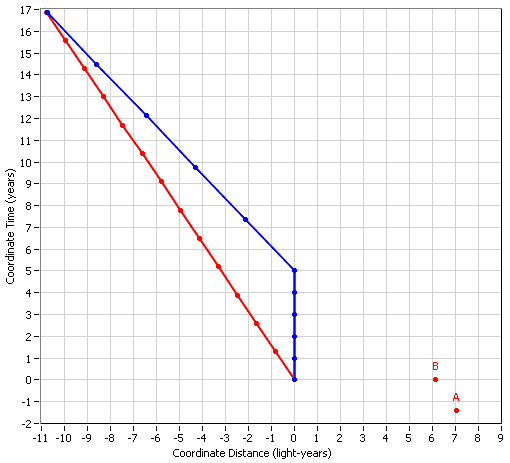


We see here that the turn-around event occurs at a coordinate time of 5 years but the Proper Time on the SAH twin's clock is about 3.9 years and the traveling twin is closer than before, only about 3.2 light-years away. (You have to count the red dots to determine what the Proper Time is on the SAH twin's clock.) But it doesn't take just 3.2 years for the image of the turn-around event to reach the SAH twin because he is moving away from it. We have to follow the path of light along a 45 degree angle to see where it intersects with the SAH twin. (Unfortunately, I didn't draw these diagram with the two axes having exactly the same scale so you have to pay attention to the grid lines when you define what 45 degrees means.) And here is the diagram showing the blue signal path for the second IRF. Again, you have to count the red dots to see that the SAH twin sees the turn-around event when his own clock reaches 10.6 years:


Now let's look again at the third IRF diagram:


Now the turn-around event occurs at a coordinate time of 11.8 years and the Proper Time on the SAH twin's clock is at about 9.1 years. And just like in the second IRF, the distance between the SAH twin and the traveling twin is only about 3.2 light-years away but it doesn't take 3.2 years for the SAH twin to see the traveling twin turn around because he is traveling towards him. In fact, it takes only about 1.5 years and once again, in this IRF, the SAH twin sees the turn-around event when his own clock reaches about 10.6 years. Here's a diagram showing the blue signal path for this IRF:


Don't you agree that this is an interesting observation? No matter what IRF we use, it doesn't change the observations that the observers make.
Attached Thumbnails
Twins 0.638 AB7.PNG   Twins 0.638 AB8.PNG   Twins 0.638 AB9.PNG  
Jan26-13, 12:53 PM   #217
 
Recognitions:
Gold Membership Gold Member
Lest you think that these issues come about because of the non-inertial nature of the traveling twin, I want to focus our attention on the two red guys who remain inertial throughout the scenario. In their common rest frame, they remain 8 light-years apart.

So let's ask ourselves the same question as before: how long does it take for the image of event A to reach the Stay-At-Home (SAH) twin? Well, in their common Inertial Reference Frame (IRF), event A occurs at a Coordinate Time of 4 years and since it is 8 light-years away, then it will take 8 more years to reach the SAF twin at which point his clock will read 12 years. Here's the IRF diagram with the red path of the signal going from event A to the SAH twin:


Please note that this signal happens to pass through the traveling twin at his Proper Time of 8 years (count the blue dots).

Now let's look at the same situation in the second and third IRF's:


As we can see, even though the Coordinate Distances are different than in the first IRF and even though the Coordinate Times are all different, still the signal going from event A passes right through the traveling twin at his Proper Time of 8 years (count the blue dots) and arrives at the SAH twin at his Proper Time of 12 years (count the red dots).

So if you want to consider any type of non-inertial frame or any frame that is a combination of IRF's, you need to be able to show that each observer continues to observe exactly what he observes in any IRF, plus you have to show the paths of the light signals remain consistent. And you have to do this for the entire scenario including all observers and all signals.

My question to those of you who are enamored by taking on this challenge: why does this appeal to you? What do you hope to learn? What do you think these other frames will show you that you cannot also see from any IRF?
Attached Thumbnails
Twins 0.638 AB10.PNG   Twins 0.638 AB11.PNG   Twins 0.638 AB12.PNG  
Jan26-13, 01:14 PM   #218
 
Recognitions:
Gold Membership Gold Member
If someone tells you that it takes 8 minutes and 20 seconds for light to get from the sun to the earth, you should realize that they are assuming (whether they know it or not) the common sun-earth inertial rest frame to be able to make that statement. Furthermore, that statement relies on the definition of a frame in Special Relativity such that it takes the same length of time for light to get from the earth to the sun as it does for the light to get from the sun to the earth. Unless we make an assumption like this, we cannot and should not think that there is intrinsic in nature a meaning to the idea of simultaneous space that stretches between the earth and the sun or between any other locations.

When we see an event on the sun such as a solar flare and note the time on our clock, we know that any definition of a frame or any theory that attempts to explain how light propagates will affirm that we did see that flare at that time but any claim that the solar flare actually happened 8 minutes and 20 seconds earlier is nothing more than a concept of simultaneity that we put into nature, not one that we take out of nature.
Jan27-13, 01:12 AM   #219
 
Recognitions:
Gold Membership Gold Member
Quote by ghwellsjr View Post
... but any claim that the solar flare actually happened 8 minutes and 20 seconds earlier is nothing more than a concept of simultaneity that we put into nature, not one that we take out of nature.
We assume that cosmological principle is attributable to nature i.e. we take it from the nature not the other way around. And simultaneity is a way how we can arrange our observations in a model that conforms with cosmological principle.
Jan27-13, 06:23 AM   #220
 
Mentor
Quote by zonde View Post
We assume that cosmological principle is attributable to nature i.e. we take it from the nature not the other way around. And simultaneity is a way how we can arrange our observations in a model that conforms with cosmological principle.
How does simultaneity come from the cosmological principle?
Jan27-13, 08:24 AM   #221
 
Recognitions:
Gold Membership Gold Member
Quote by DaleSpam View Post
How does simultaneity come from the cosmological principle?
Cosmological principle means certain requirement of objectivity. Simultaneity is a way how to implement this objectivity into our models. We can view simultaneity as correspondence between different observers that does not single out any observer as special.

If you use single observer centered model you can't really demonstrate that your model is objective.
New Reply
Thread Tools


Similar Threads for: Time paradox
Thread Forum Replies
Time paradox (?) Special & General Relativity 7
Time paradox? Special & General Relativity 2
Name for a particular time travel paradox General Discussion 1
waiting time paradox Set Theory, Logic, Probability, Statistics 1
silly time paradox General Discussion 17