| New Reply |
Born-Oppenheimer approximation |
Share Thread | Thread Tools |
| Feb3-13, 07:56 AM | #1 |
|
|
Born-Oppenheimer approximation
I am confused with a couple of terms usually used in the context of non-radiative transitions. I believe that I understand the concept of diabatic and adiabatic states described in
http://en.wikipedia.org/wiki/Adiabatic_theorem. The basic finding is that the coupling terms in the Hamiltonian matrix (in the basis of the diabatic states) result in an avoided crossing. I want to transfer this finding to the case of the Born-Oppenheimer approximation, which is said to break down in the region around a level-crossing. And this is actually the point where I come across my first problem. When neglecting the first and the off-diagonal elements (closely related to the non-adiabacity operator), do I get diabatic states (case A) or adiabatic states (case B)? If the case A is valid, the situation as depicted below would seem logical. ![]() Here we face a level crossing, which is regarded as the breakdown of the Born-Oppenheimer approximation. As soon as the off-diagonals elements taken into account again, the avoided crossing would be obtained then. ![]() But from my literature search I get the impression that Born-Oppenheimer approximation leads to adiabatic states. But what is the breakdown of the Born-Oppenheimer approximation then? And what are the non-adiabatic transitions resulting from the non-adiabacity operator in the last figure? I hope anybody can resolve my problems with this stuff! |
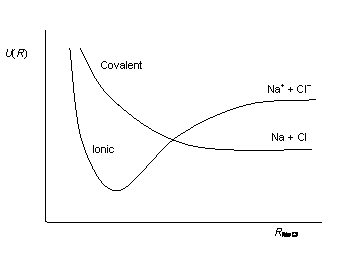
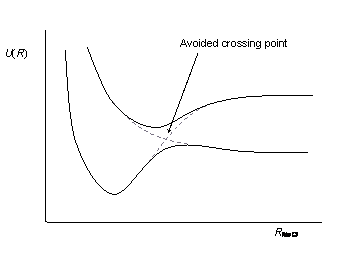
| Feb4-13, 01:30 AM | #2 |
|
Recognitions:
|
|
| Feb4-13, 04:43 AM | #3 |
|
|
Thanks for your interest!
Just to make sure that there aren't any misunderstandings, I will also repeat the main definitions. As usual, the total wavefunction [itex]\Psi({\bf r},{\bf R})[/itex] expanded as a series of electronic wavefunctions [itex]\chi_k({\bf r};{\bf R})[/itex] [itex]\Psi({\bf r},{\bf R}) = \sum\limits_k \chi_k({\bf r};{\bf R}) \eta_k({\bf R})[/itex]. The electronic Hamiltonian [itex]{\cal H}_\mathrm{e}[/itex] is expressed as [itex]{\cal H}_\mathrm{e}=T_\mathrm{e}+V_\mathrm{ee}+V_\mathrm{en}+V_\mathrm{nn}[/itex], which satisfy the electronic Schrödinger equation [itex]{\cal H}_\mathrm{e} \chi_k({\bf r};{\bf R}) = E_k({\bf R}) \chi_k({\bf r};{\bf R})[/itex]. The full Hamiltonian is defined as [itex]{\cal H}=T_\mathrm{n}+E_k({\bf R})[/itex], whose matrix elements should be calculated in the basis of [itex]\eta_k({\bf R})[/itex]. Then the Hamiltonian reads [itex] {\cal H} = \left(\begin{array}{ccc} T_\mathrm{n}+E_1({\bf R}) & 0 & 0 & \cdots\\ 0 & T_\mathrm{n}+E_2({\bf R}) & 0 & \cdots\\ 0 & 0 & T_\mathrm{n}+E_3({\bf R}) & \cdots\\ \vdots & \vdots & \vdots & \ddots \end{array}\right) + \underbrace{\left(\begin{array}{ccc} \tilde{H}_{11} & \tilde{H}_{12} & \tilde{H}_{13} & \cdots\\ \tilde{H}_{21} & \tilde{H}_{22} & \tilde{H}_{23} & \cdots\\ \tilde{H}_{31} & \tilde{H}_{32} & \tilde{H}_{33} \cdots\\ \vdots & \vdots & \vdots & \ddots \end{array}\right)}_\text{Non-adiabacity operator} [/itex]. The non-adiabacity operator contains the following several elements. [itex] \tilde{H}_{ij} = -\frac{\hbar}{2M}\Big( \underbrace{2\left\langle\chi_i({\bf r};{\bf R})\left|\nabla_\mathrm{n}\right|\chi_j({\bf r};{\bf R})\right\rangle \nabla_\mathrm{n}}_\text{first order} + \underbrace{\left\langle\chi_i({\bf r};{\bf R})\left|\nabla_\mathrm{n}^2\right|\chi_j({\bf r};{\bf R})\right\rangle}_\text{second order} \Big) [/itex] If [itex]i\neq j[/itex], the elements of [itex]\tilde{H}_{ij}[/itex] only appear as off-diagonal elements and are neglected in the Born-Oppenheimer approximation. So my question is whether the [itex]E_k({\bf R})[/itex] is already the adiabatic potential energy surface with an avoided crossing OR does the avoided crossing occur only when the off-diagonals are accounted for (which seems to be analogous to the concept of the adiabatic theorem)? |
| Feb4-13, 06:35 AM | #4 |
|
Recognitions:
|
Born-Oppenheimer approximation
The ##E_k(R)## are already the Born-Oppenheimer PES which show avoided crossings. There is a minor distinction between the Born-Oppenheimer PES and the adiabatic ones: The latter include the diagonal part ##\tilde{H}_{ii}(R)##.
The diabatic states are obtained by looking for a unitary transformation which diagonalizes the non-adiabaticity operator for a subset of states (e.g. states 1 and 2). Conceptually easier are the crude-adiabatic states for which the whole non-adiabatic matrix is diagonal. This is obtained by using electronic states ##\chi_k(r;R_0)## referring to one fixed nuclear position R_0. There is a famous theorem by Wigner that even adiabatic (or BO-) PES will cross when the space of nuclear displacements is more than onedimensional. In two dimensions, this happens at a point and the PES can be shown to have the form of a conus whence one speaks of a conical intersection. Nonadiabatic couplings become very large there or singular. This is what is meant with the breakdown of the BO approximation. The best known examples occur in Jahn-Teller systems although conical intersections have turned out to be important in almost any photochemical process. |
| Feb4-13, 04:08 PM | #5 |
|
|
Thanks for your help! You have given me the needed impetus so that I can go deeper into this stuff now.
|
| New Reply |
| Thread Tools | |
Similar Threads for: Born-Oppenheimer approximation
|
||||
| Thread | Forum | Replies | ||
| Born-Oppenheimer approximation confusion | Atomic, Solid State, Comp. Physics | 7 | ||
| born oppenheimer approximation vs adiabatic approximation | Quantum Physics | 4 | ||
| Born Oppenheimer Approximation and Product Asnatz | Atomic, Solid State, Comp. Physics | 34 | ||
| Born-Oppenheimer approximation | Advanced Physics Homework | 1 | ||