How Do You Calculate Current and Voltage in Series and Parallel Circuits?

Click For Summary
SUMMARY

The discussion focuses on calculating current and voltage in series and parallel circuits, specifically using a circuit with a total resistance of 15.04 kOhms and a total voltage of 16.5 volts. The total current calculated using Ohm's Law is 1.0971 x 10⁻³ A. Participants clarify that the voltage drop across the 10.5 kOhm resistor is actually 11.5 volts, not 5 volts, which affects the current calculations through the parallel resistors. The correct approach involves using the voltage drop of 11.5 volts to find the current through the 10.5 kOhm resistor, confirming that the total loop current remains consistent.

PREREQUISITES
  • Understanding of Ohm's Law (V=IR)
  • Knowledge of series and parallel circuit configurations
  • Familiarity with calculating equivalent resistance in parallel circuits
  • Ability to perform basic electrical calculations involving voltage, current, and resistance
NEXT STEPS
  • Study the calculation of equivalent resistance in complex circuits
  • Learn about Kirchhoff's Voltage Law for analyzing circuit loops
  • Explore the use of multimeters for measuring current and voltage in circuits
  • Investigate the impact of resistor values on current distribution in parallel circuits
USEFUL FOR

Electrical engineering students, hobbyists building circuits, and anyone interested in understanding the principles of current and voltage in electrical systems.

tony873004
Science Advisor
Gold Member
Messages
1,753
Reaction score
143
In the circuit shown, find the current in each resistor and the values of the potential at points A, B, and C.
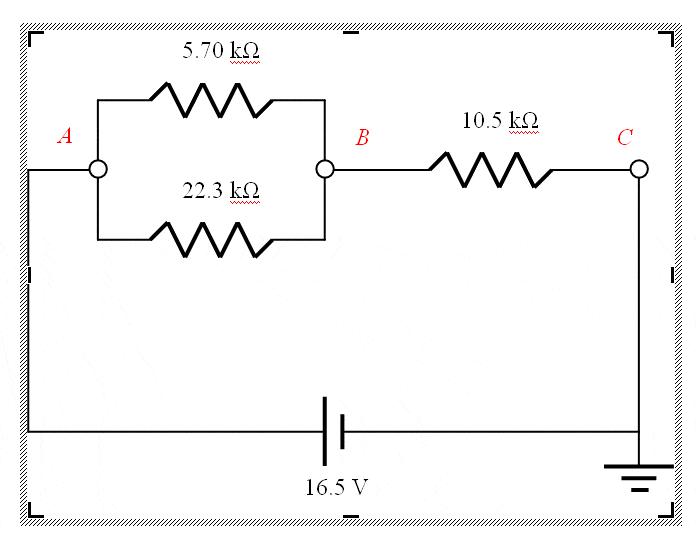
26_43.GIF


First I computed the combined resistance of the parallel resistors and got 4.54 kOhms. Then I added this to 10.5 to get 15.04 kOhms total resistance.

So from Ohm's law, the total current is I=V/R = 16.5 / 15040 = 1.0971 x 10⁻³ A.

I get potentials at A, B, and C of 16.5, 11.5, and 0 volts.

I think this is correct so far.

To find the current through each resistor:

For the 10.5 kOhm resistor, since it is in series, it makes sense to me that the current through this resistor must be equal to the total current: 1.0971 x 10⁻³ A. And that the current running through the parallel pair must also be 1.0971 x 10⁻³ A. But the voltage across this resistor is 16.5-11.5, or 5v. Using Ohm's law, I=V/R, I get 5/10500 = 0.000476 A

Which way is correct?
Thanks
 
Physics news on Phys.org
The currents through the two resistors in parrallel will be different. you have to work out the current from the voltage drop across each of the resistance's, which is 5V for both according to your calculations, and the resistance. This will give you the current in each element. It will add up to the total loop current.

Your using the wrong voltage. 5V isn't dropped across the 10.5kOhm, 11.5V is. As it's 11.5V at one side and 0V at the other.
 
Mike Cookson said:
...Your using the wrong voltage. 5V isn't dropped across the 10.5kOhm, 11.5V is. As it's 11.5V at one side and 0V at the other.

Thanks! That's where I messed up. 11.5/10.5E3 = the same as the total loop current.

Thanks for the explanation.
 

Similar threads

  • · Replies 3 ·
Replies
3
Views
835
Replies
20
Views
2K
Replies
3
Views
2K
  • · Replies 14 ·
Replies
14
Views
1K
Replies
6
Views
2K
  • · Replies 3 ·
Replies
3
Views
2K
Replies
2
Views
929
Replies
4
Views
2K
Replies
10
Views
1K
  • · Replies 6 ·
Replies
6
Views
2K