Discussion Overview
The discussion revolves around the operation and output characteristics of center-tap rectifiers, particularly focusing on the effects of switching the orientation of diodes within the circuit. Participants explore theoretical implications, practical concerns, and simulation approaches related to rectifier design.
Discussion Character
- Exploratory
- Technical explanation
- Debate/contested
- Mathematical reasoning
Main Points Raised
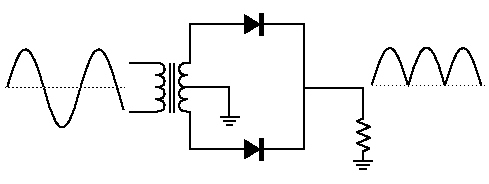
- One participant queries whether reversing the orientation of a diode in a center-tap rectifier will yield the same output wave or result in a half-wave rectifier.
- Another participant warns that switching either diode could short the secondary of the transformer for one half of the AC cycle, potentially leading to damage.
- A different participant asserts that reversing the diode would effectively short the transformer secondary, resulting in zero voltage and possible transformer damage.
- One suggestion is made to analyze the circuit by considering the current flow in both positive and negative cycles, recommending a systematic approach to solve for each case.
- A participant proposes simulating the circuit using LTspice to observe the effects practically.
- Discussion includes a comparison between full wave bridge and full wave center-tap rectifiers, noting differences in voltage, current, and power loss in diodes.
- Another participant mentions simulating a center-tap rectifier using synchronous rectifiers to reduce power loss compared to traditional Schottky diodes.
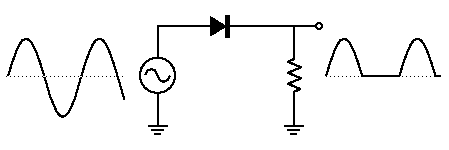
- It is suggested that deleting one of the two diodes could convert the circuit into a half-wave rectifier.
Areas of Agreement / Disagreement
Participants express differing views on the implications of switching diode orientations, with no consensus reached on the resulting output wave or the best approach to analyze the circuit.
Contextual Notes
Participants discuss various assumptions regarding diode behavior and transformer operation, but these assumptions are not fully explored or resolved within the thread.
Who May Find This Useful
Individuals interested in rectifier design, electrical engineering students, and those looking to understand the practical implications of diode orientation in rectifier circuits may find this discussion relevant.