Understanding the Benefits of a C02 Tank for Tire Filling

  • Thread starter Thread starter Good4you
  • Start date Start date
  • Tags Tags
    Tank Tire
Click For Summary
SUMMARY

The discussion highlights the advantages of using a CO2 tank for tire filling, specifically noting that a 10# CO2 tank can fill four 35" tires approximately four times. CO2 is favored due to its ability to store a larger volume of gas in a smaller tank compared to nitrogen or air, and it maintains a constant pressure as it transitions from liquid to gas. The conversation also touches on the operational pressures of scuba tanks and the phase transition properties of CO2, clarifying that its liquefaction occurs at relatively low pressures, unlike nitrogen.

PREREQUISITES
  • Understanding of gas laws, particularly Boyle's Law
  • Knowledge of gas storage and pressure concepts
  • Familiarity with CO2 properties and its phase transitions
  • Basic knowledge of tire inflation techniques
NEXT STEPS
  • Research the properties of CO2 and its applications in tire inflation
  • Learn about the differences between CO2 and nitrogen for tire filling
  • Investigate the pressure requirements for scuba tanks and their applications
  • Explore the permeability rates of different gases through rubber materials
USEFUL FOR

Automotive enthusiasts, tire maintenance professionals, and anyone interested in efficient tire inflation methods using CO2 technology.

Good4you
Messages
37
Reaction score
0
I use a C02 tank to fill up the tires on my truck. C02 is used because it can store a larger volume of gas in a smaller tank than most other gases. But i have no idea why this would be true. I can actually fill all four 35" tires about four times flat to full with one 10# tank.

Nitrogen would be better because it could also charge my shocks, but from what i understand it would not hold as much. Also, i have heard that scuba tanks have to use insanely high pressures to keep a decent amount of air.

One reason i have heard is that C02 keeps a constant pressure in the tank regardless of how full it is, and the liquid C02 just boils off. And this seems to be true from the chart below. But wouldn't this violate Boyle's law?

Also, i assume Nitrogen or air isn't used because it takes more pressure to turn to a liquid at room temperature. Is that true?
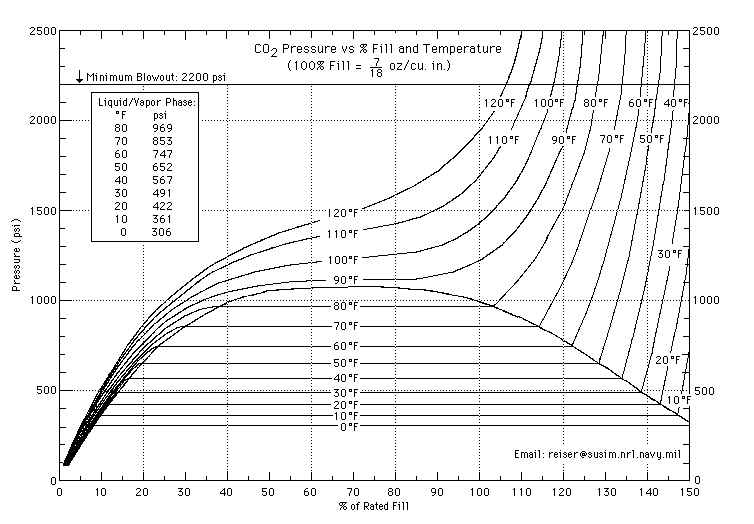
co2pv.gif
 
Chemistry news on Phys.org
Boyle's law doesn't take into account phase transition, so there is no contradiction here - you are just beyond its applicability.

Scuba tanks operate around 200/300 atm. Whether it is insane or not - hard to tell :wink:

Carbon dioxide liquefies at relatively low pressure, so it can be kept as a liquid and doesn't require high pressures for that. This is not much different from LPG (autogas).

That's interesting. Using carbon dioxide for pumping tires can be easy, at the same time carbon dioxide has much higher permeability rate through the rubber than other gases.
 

Similar threads

  • · Replies 8 ·
Replies
8
Views
4K
Replies
32
Views
7K
Replies
2
Views
2K
  • · Replies 6 ·
Replies
6
Views
2K
  • · Replies 32 ·
2
Replies
32
Views
6K
  • · Replies 109 ·
4
Replies
109
Views
8K
  • · Replies 5 ·
Replies
5
Views
2K
  • · Replies 67 ·
3
Replies
67
Views
6K
  • · Replies 14 ·
Replies
14
Views
3K
  • · Replies 2 ·
Replies
2
Views
2K