Physics - optics - apparent depth

Click For Summary

Homework Help Overview

The discussion revolves around the concept of apparent depth in optics, particularly how light refracts when moving from water to air and how this affects the perceived position of an object submerged in water.

Discussion Character

  • Conceptual clarification, Assumption checking

Approaches and Questions Raised

  • Participants explore the reasons behind the apparent depth of an object in water, questioning how light refracts at the water-air interface and how this affects perception. Some participants provide diagrams to illustrate their points, while others express confusion about the relationship between the angles of incidence and refraction.

Discussion Status

There is an active exchange of ideas, with some participants offering clarifications on the behavior of light in different media. Questions remain about the interpretation of diagrams and the underlying principles of refraction, indicating a productive exploration of the topic without a clear consensus.

Contextual Notes

Some participants mention the need for visual aids to better understand the concepts being discussed, and there are references to specific diagrams that are crucial for comprehension. Additionally, there is an acknowledgment of the complexity of the topic, as participants express varying levels of understanding.

preet
Messages
96
Reaction score
0
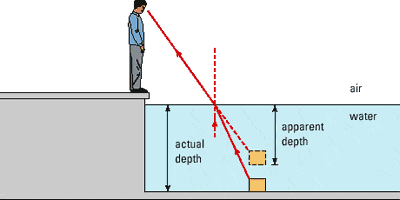
My physics textbook has a diagram that illustrates Apparent Depth... but I can't understand it.
phys.gif


Specifically, why does the image appear where it is (at apparent depth)? I understand that as the light from the object moves from water to air, refraction occurs... but I'm thinking, shouldn't the angle at which the person's eyes receive the light go all the way to the bottom of the pool or something? It seems as if the light is still reaching the person's eyes the same horizontal distance from the object? Is that true?

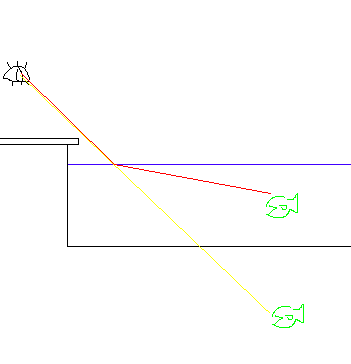
So then, is the the following image true for when the light will bend towards the normal, where the end of the yellow line to the top of the surface will be apparent depth? (would explain increased apparent depth)...
phys2.gif


TiA.
 
Physics news on Phys.org
preet said:
My physics textbook has a diagram that illustrates Apparent Depth... but I can't understand it.

phys.gif


Specifically, why does the image appear where it is (at apparent depth)? I understand that as the light from the object moves from water to air, refraction occurs... but I'm thinking, shouldn't the angle at which the person's eyes receive the light go all the way to the bottom of the pool or something? It seems as if the light is still reaching the person's eyes the same horizontal distance from the object? Is that true?
To make it easier to see, I've redrawn the picture with the lines more spread out.
http://www3.telus.net/public/darich1/science/refract_beholder.jpg

The pink line shows where you think the light is going. The blue line shows where the light really is going. If you put a ruler to your screen, and your resolution is 1024x768, you'll notice that both blue and pink lines starting from the water level are about 2.5 inches in length; that means light is reflected from an object that is 2.5 inches from where the light touches the water. The difference of perception comes from the angle. Your brain thinks the light travels in a straight line, so the pink line continues at the same angle as the angle of incidence.
 
Last edited by a moderator:
Its simply that light moving from a rarer to a denser medium bends towards the normal and (as a result) light moving from a denser to a rarer medium bends away from the normal. As the speed of light in the medium can be qualitatively considered to describe its "optical density" we have [tex]c_{water} < c_{air}[/tex].

Now if an object is located at a depth below the free surface of water, light rays traveling from it when refracted at the water-air interface are refracted (as you have correctly analyzed). But any such light ray (except the one that passes normally and undeviated) bends away from the normal. When such a light ray reaches the eye and forms an image, we are naturally inclined to retrace it back to where it (apparently) comes from and regard that place as the object that is forming the image. The terms real and apparent depth can be expressed as mathematical quantities which are related to the relative refractive index of the medium (in this case that of water wrt air).

Yes indeed from the diagram it is clear that the retraced object is on the same vertical line as the original object. However, the incident ray and the emergent ray are different.

In the latter diagram therefore, the fish that is below is the object and the one above is the retraced object. So its better if you draw the lower fish in the pond itself :-p

Hope that helps...

Cheers
Vivek
 
ShawnD that's a brilliant representation. Three cheers for the brain :smile:
 
Hi I also have difficulty understanding as to why the point is the result of an intersection of a vertical line from the bottom point and the extended dotted line of the refracted beam (well I get that, I just don't get where that vertical line comes from). I read the thread but there's an image missing in ShawnD's post.

Also sorry for bumping an old thread...
 

Similar threads

  • · Replies 1 ·
Replies
1
Views
2K
Replies
29
Views
3K
  • · Replies 1 ·
Replies
1
Views
3K
Replies
8
Views
4K
Replies
1
Views
4K
  • · Replies 5 ·
Replies
5
Views
3K
  • · Replies 3 ·
Replies
3
Views
2K
  • · Replies 4 ·
Replies
4
Views
2K
  • · Replies 1 ·
Replies
1
Views
5K
Replies
8
Views
3K