Convert Circular motion into 8 shaped loop

  • Thread starter Thread starter philns
  • Start date Start date
Click For Summary
SUMMARY

The discussion focuses on converting circular motion from an electric motor into an 8-shaped loop using mechanical systems. Participants recommend utilizing two co-planar gears meshed to counter-rotate in a 1:1 ratio, allowing for the creation of Lissajous figures. The necessity of achieving a precise 1:2 ratio is emphasized, with suggestions to use stepped belts for simplicity and accuracy. The conversation also highlights the importance of maintaining a fixed point above other mechanical elements to avoid overlap during operation.

PREREQUISITES
  • Understanding of mechanical gear systems and ratios
  • Familiarity with Lissajous figures and their mathematical principles
  • Basic knowledge of Blender for visual modeling
  • Experience with mechanical design and prototyping
NEXT STEPS
  • Research mechanical gear design principles for creating Lissajous figures
  • Learn about stepped belts and their applications in mechanical systems
  • Explore Blender for creating and animating mechanical models
  • Investigate methods for maintaining precise synchronization between multiple motors
USEFUL FOR

Engineers, mechanical designers, artists working on kinetic sculptures, and hobbyists interested in mechanical motion design will benefit from this discussion.

philns
Messages
4
Reaction score
2
TL;DR
For a project I'm starting now, I'd need to convert a circular motion generated from an electric motor into a loop shaped as , through any combination of gears, leverages or mechanical intermediation . So that at a certain level, one fix point on any of those gear would draw an 8 shaped loop. Then defining which elements defines the sizes of the 8 shape. Finally that point should possibly be always on top of any other mechanical element. Maybe there's an easy solution but I can't figure it out.
For a project I'm starting now, I'd need to convert a circular motion generated from an electric motor into a loop shaped as an ∞ , through any combination of gears, leverages or mechanical intermediation . So that at a certain level of the system, one fix point attached onto any of those gears would draw a ∞ shaped loop. Then understanding which elements (size/shape) define the sizes of ∞ movement.
Finally that point should possibly be always on top of any other mechanical element so that during the overall system revolutions it doesn't get overlapped by others.
Maybe there's an easy solution but I can't figure it out on the spot.
 
Engineering news on Phys.org
An old-school pen plotter could produce Lissajous figures, and one of the first pictures in the Examples section of the Wiki page is a figure of eight. Does that work?
 
Great hint and suggestion with the Lissajous figures and the formula which stands behind. Very thankful.

Through some more investigation defines that I hardly could achieve it with a single motor but I needed two to generate the two indipendent movement to then combine.

I really needed to translate it into a more mechanical model and so your @Ibix suggestion led me to this video which is very close to what I meant.

Rather simple besides the ratio precision which won't be easy to be achieved just mechanically.

mechanical Lissajous plot

I still wonder if anything similar would be achievable through a single motor and more complex mechanics joints, as that would remove the complexity of achieving very precise two motors synch and precision.

I really wanted to keep all this project electronically simple and purely mechanical without introducing stepping motors and Arduino software controls.

But hey thanks . Very close to the solution .

Philns
 
  • Like
Likes   Reactions: Ibix
Welcome to PF. :smile:

One idea would be to use 2 co-planar gears meshed so that they counter-rotate in the ratio 1:1. Have some sort of object holder on each that can hand off the object to the other gear at each full rotation when the holders meet each other at the gear mesh point. I can envision several ways to make the holders so that they can hand the object back and forth each time they meet.

BTW, is this project for schoolwork? Or maybe a personal art project?
 
philns said:
Through some more investigation defines that I hardly could achieve it with a single motor but I needed two to generate the two independent movement to then combine.
You need a ratio of exactly two, so one motor can turn one gear that generates x, while a second gear, meshed with the first, generates the y position. Chains, or cheap stepped belts, are another way of generating the exact ratio of two.
 
berkeman said:
Welcome to PF. :smile:

One idea would be to use 2 co-planar gears meshed so that they counter-rotate in the ratio 1:1. Have some sort of object holder on each that can hand off the object to the other gear at each full rotation when the holders meet each other at the gear mesh point. I can envision several ways to make the holders so that they can hand the object back and forth each time they meet.

BTW, is this project for schoolwork? Or maybe a personal art project?
Thanks Berkeman
I'd think though handing off an object between 2 moving gears is a rather ingenious solution but full of complexity in avoiding getting it stuck. I'm so curious about what you envisioned there.

Getting back to your question I'd define my project as personal art. It gets close to that definition I suppose.
And I'm so happy I've found this place, as I'm learning so much from this widespread knowledge.
 
  • Like
Likes   Reactions: berkeman
Baluncore said:
You need a ratio of exactly two, so one motor can turn one gear that generates x, while a second gear, meshed with the first, generates the y position. Chains, or cheap stepped belts, are another way of generating the exact ratio of two.
Thanks Baluncore

Indeed, to get the 8 shaped move I'll need the 1:2 ratio. And that solution of one motor two gears with proper ratio and a stepped belt would achieve simplicity, mechanical solution and precision all together.

I think I'll evolve onto this path. Let me see what comes out from a simple prototype.
 
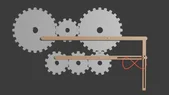
Two methods I came up with from tracing out figure 8s. The first produces a somewhat uneven one as is, but you can slightly adjust the shape by fiddling with the lengths of the Arms at bit, and might get something better.
FIGEIGHT1.gif


The second method produces a more symmetrical path. It's overall shape can be varied by where you put the pivot points for the rods on the gears.

figeight2.gif
 
  • Love
  • Like
Likes   Reactions: berkeman and Ibix
Nice. The second one is essentially the Lissajous figure approach I suggested, I think. Though you've obviously thought it tgrough in more detail. :smile:

Are those diagrams done in Blender?
 
  • #10
Ibix said:
Nice. The second one is essentially the Lissajous figure approach I suggested, I think. Though you've obviously thought it tgrough in more detail. :smile:

Are those diagrams done in Blender?
Yes, done with Blender.
 
  • Like
Likes   Reactions: berkeman and Ibix
  • #11
Janus said:
Yes, done with Blender.
I think I can see how to do all of it with simple animation and "copy x/y coordinate" constraints except for the red path. Is that manually calculated, or did you get Blender to generate it somehow?

(Sorry for the digression, OP. I'll stop hijacking after this post.)
 

Similar threads

Replies
58
Views
8K
  • · Replies 3 ·
Replies
3
Views
4K
  • · Replies 3 ·
Replies
3
Views
6K
  • · Replies 11 ·
Replies
11
Views
2K
  • · Replies 7 ·
Replies
7
Views
2K
Replies
1
Views
2K
  • · Replies 74 ·
3
Replies
74
Views
9K
Replies
30
Views
6K
  • · Replies 17 ·
Replies
17
Views
2K
  • · Replies 4 ·
Replies
4
Views
4K