SUMMARY
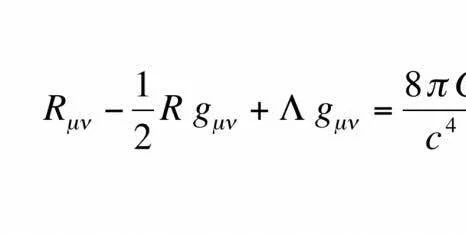
Einstein’s field equations (EFEs) in general relativity do not equal a single numeric value such as 12. The EFEs represent a set of 16 coupled nonlinear partial differential equations indexed by ##\mu## and ##\nu##, describing the relationship between spacetime curvature and stress-energy. Solutions to the EFEs are infinite and depend on the stress-energy tensor and boundary conditions, including well-known metrics like Schwarzschild and Kerr. The claim that the EFEs equal 12 is a misunderstanding or trolling, as equations are not "equal to" fixed numbers but express relationships between variables. The discussion also references the cultural joke of "42" from The Hitchhiker’s Guide to the Galaxy as a humorous counterpoint.
PREREQUISITES
- Einstein’s field equations (EFEs) formalism in general relativity
- Lorentzian manifolds and metric tensors (M, g)
- Stress-energy tensor (T) and its role in spacetime curvature
- Index notation for tensors (e.g., indices ##\mu## and ##\nu## ranging over 0 to 3)
NEXT STEPS
- Study specific exact solutions to EFEs such as Schwarzschild and Kerr metrics
- Learn tensor calculus and index notation used in general relativity
- Explore the mathematical structure of Lorentzian manifolds in differential geometry
- Understand the physical interpretation of the stress-energy tensor in Einstein’s equations
USEFUL FOR
Physics students, researchers, and enthusiasts interested in general relativity, differential geometry, and the mathematical foundations of spacetime physics. Also valuable for educators clarifying misconceptions about the nature of Einstein’s field equations and their solutions.