Science Advisor
Gold Member
- 2,858
- 12,749
- TL;DR
- As the first self-sustaining chemical systems matured, the catalysts underlying metabolic reactions transitioned from naturally occurring metal catalysts to enzymes and cofactors. In addition, an understanding of how these early systems could accessed phosphate has been figured out. Phosphate is central to biological energy metabolism. Thus, another problem of understanding early metabolism is possibly resolved.
This paper just showed up:
Intermediate stages in the origin of metabolism at a phosphorylating hydrothermal vent
It is open access and can be found here.
in Science Advances, 5 Aug 2026, Vol 12, Issue
It is my origin of life paper of the year so far.
The article describes (based upon comparative genomics) and a fuller understanding of the availability of naturally occurring metal catalysts and an abiotic source of phosphate (from phosphite). Phosphate availability (as an energy currency) is often cited as a limitation for theories of early metabolism.
The best supported scenario for how life has it taking place in alkaline hydrothermal vents. These vents are also known as white smokers or serpentinizing hydrothermal vents. Unlike the magma driven black smokers found at plate spreading regions, white smokers are driven by the gentler heat from serpentinization reactions that occur between water and malfic basaltic rock. These vents are found at some distance from where tectonic plates separate. After the seafloor plates have spread to these locations, the rocks have cooled. The serpentizing reactions in the seafloor release H2 and CO2, which provide the chemical basis for a primitive hydrogen based metabolism. Carbonate dissloved in the vent fluids is deposited when the vent fluids meet with the sea water. This builds large chimneys containing many small chambers made by thin (sub-millimeter) walls separating the vent fluids and ocean water. This is referred to as a mircoporous substrate. It has many cavities and lots of surface area. A variety of dissolved metals are also deposited in the chimney walls as they form. The metals can act as natural catalysts for metabolic reactions. Reactions there can form simple organic molecules, a first step in assembling living chemical systems. These same metals are often found at the active sites of enzymes that catalyze the same reactions This paper looks at how rapidly and at what stage the natural catalysts were replaced by protein enzymes or cofactors (non-protein organic chemical catalysts often found associated with enzymes in modern metabolisms). After the moon forming impact, the Earth eventually cooled down so that liquid water could form over much (or all) of the surface, serpentizing reactions would have been occurring all over the seafloor because the magma derived rock would not have yet reacted with water. It is estimated that between 0.3 to 1.0 of the current volume of the oceans is now locked up in the crust by reactions. There were probably a lot of these prebiotic reactions going on when living processes were thought to have been first assembled.
Metabolism had to form before nucleic acid based genetics could appear. This is disputed by some, but the need for a supply of nucleic acid precursors for nucleic acid synthesis seems obvious. On the other hand, genetic processes had to evolve before enzymes encoded in nucleic acid sequences could be made. It is assumed that before enzymes, a lot of reactions were catalyzed by naturally occurring metal catalysts. These were gradually replaced by genetically encoded protein enzymes once translation (the process of producing encoded proteins) was established. That replacement, according to this study, started before LUCA (the Last Universal Common Ancestor) and spanned the later transitions to LACA (the Last Archeal Common Ancestor) and LBCA (the Last Bacterial Common Ancestor), the prokaryotic descendants of LUCA.
Many metal catalyzing capabilities of metabolic reactions are now known from lab experiments. By comparing the sets of enzymes among the ~400 metabolic reactions attributed to LUCA with those attributed to LACA and LBCA, the times when various enzymes evolved could be determined relative to the separation of the archeal and bacterial lineages from their LUCA ancestor.
In addition, how phosphate could be accessed by these early systems has just recently been determined. This solves a long standing issue of early metabolism worked.
Not much commented on in this paper is the RNA world hypothesis. Originally, the RNA arose world claim was that RNA first (RNA molecules randomly assembled in some way from naturally occurring precursors) and by its catalytic capabilities created metabolism. The concept has since evolved to more of a "dirty" concept where RNA is combined with other chemicals (the dirty parts) and possibly being inside of a membrane bound vesicle in order to have its hypothesized early effects. There is no doubt that early on RNA was and continues to be important biologically, since there are many processes around today that rely on it. Ribosomes, along with transfer RNA (tRNA) and messenger RNA (mRNA) are required for translation (the process required for producing DNA encoded proteins). In addition, RNAs are involved in mechanisms (the Signal Recognition Particle process) targeting newly produced proteins to different topological regions (inside, in membrane, outside, and in the inside and outside facing surfaces of the membrane) of the cell (living chemical system). RNAs are also involved in a variety genetic control mechanisms and splicing mechanisms. However, it seems to have left no sign of having been significant for metabolic reactions (as ribozymes).
Prior to the appearance of enzymes, various metabolic steps are currently thought to have been catalyzed by naturally occurring metal catalysts from environmental sources, like Fe (iron). Some catalyzing of chemical reactions is thought to have been initially required to make a complete functioning metabolism for a simple self-sufficient chemical system.
Normally, reactions will go in their thermodynamically favored direction. However, there are work-a-rounds for this limitation that can affect metabolic reactions. Rapid removal of products by subsequent reactions can allow otherwise disfavored reactions to proceed because the product's concentrations are kept low. Mass action would drive the reaction go "in reverse". In addition, a disfavored reaction could be coupled with a highly exergonic reaction, such as adenosine 5′-triphosphate (ATP) hydrolysis. This uses an expenditure of chemical energy (ATP --> AMP + PP) to drive the thermodynamically disfavored reaction. These approaches may alleviate some need for catalysts.
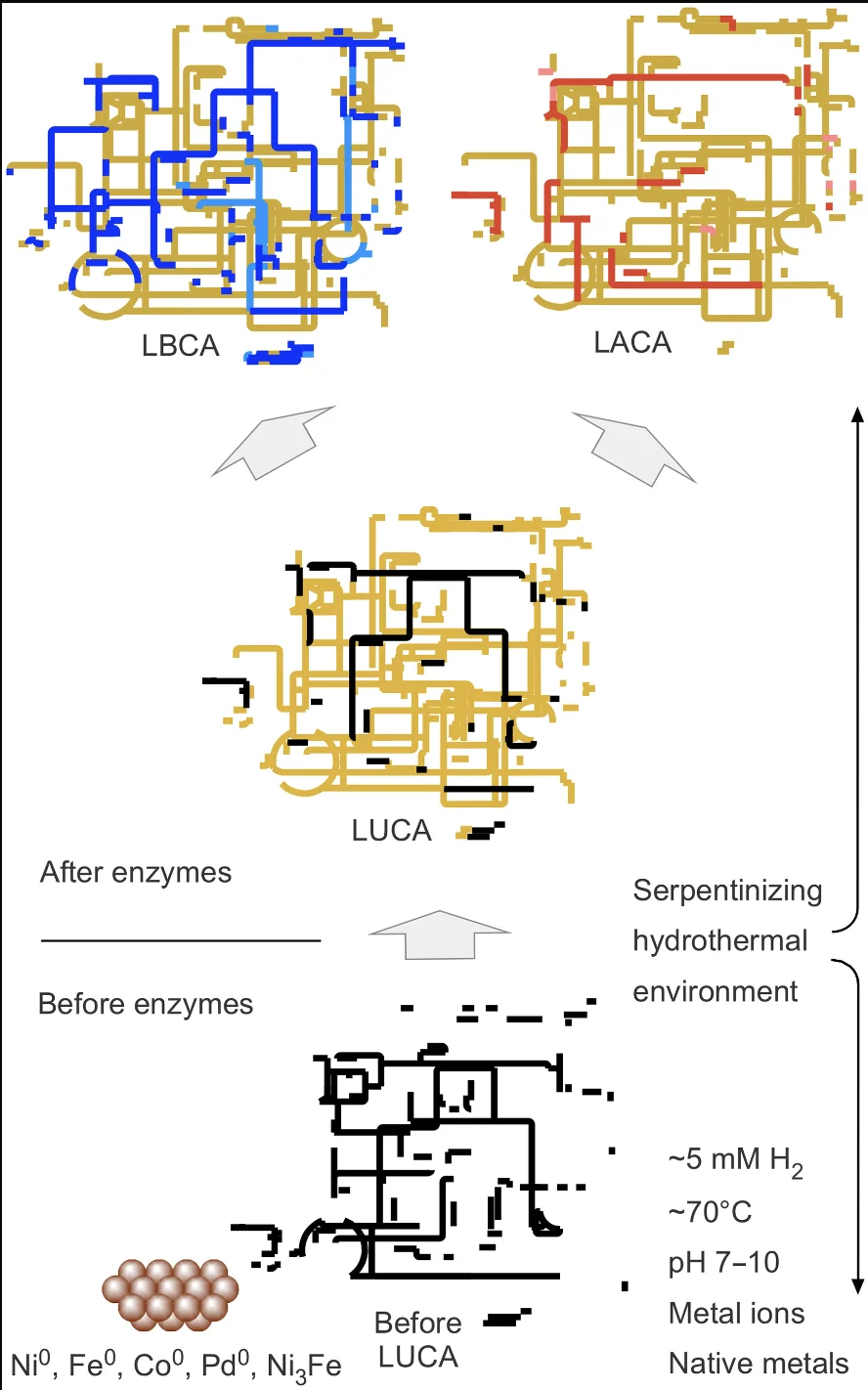
Much of metabolism would have been operating before LUCA, presumably using metal catalysts. Of ~400 basic metabolic reactions: 166 enzymes effecting core metabolism have been traced to LUCA. Many of the remaining reactions were presumably catalyzed by naturally occurring metal catalysts. 89 more enzymes were added to the lineage leading to LBCA for synthesizing of amino acids, cofactors, and nucleobases, while 38 other enzymes were independently added to the LACA lineage for the same purpose.
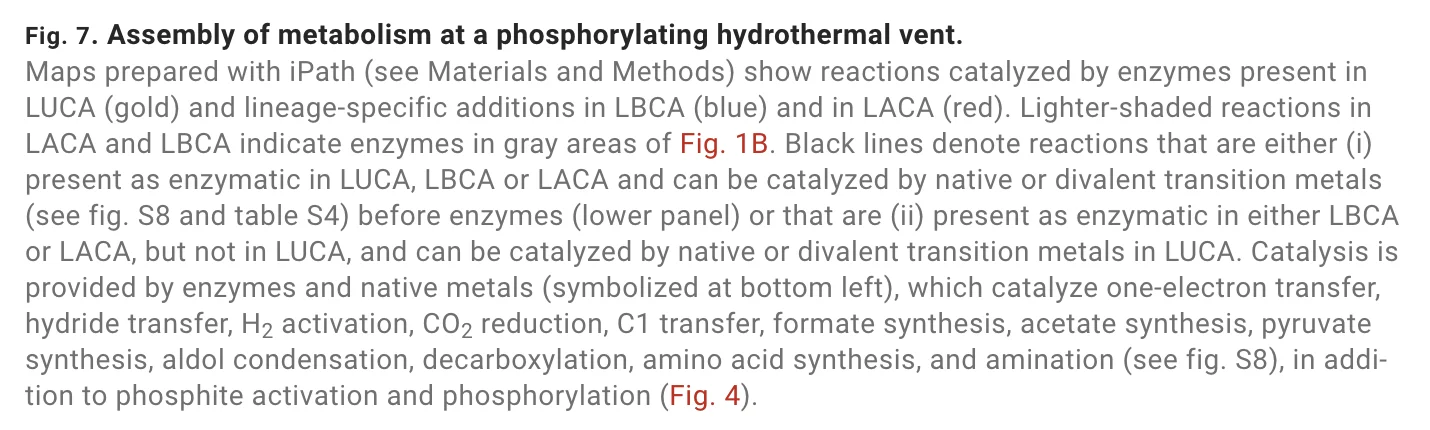
A summary figure maps the presence of metal catalyzed reactions (Black Lines) at a pre-LUCA stage. The enzyme takeover of metabolic catalysis at the LUCA stage is indicated by gold lines. At the LACA stage, this is indicated by red lines and at LBCA stage by blue lines. These are mapped onto an unlabeled (making it difficult to know which specific chemicals are where) metabolic map.
The metabolisms catalyzed by these sets of metabolic enzymes indicate a continued reliance on environmental hydrogen and carbon dioxide through both the LABA and LACA stages. Thus their environment may not have changed much during that time.
More robust cell walls and flagellar structures (that power movement) were independently evolved in both the archeal and bacterial lineages. They independent acquired these features that could provide greater tolerance of different possible osmotic conditions (in new locations) and a mechanism for active movement.
Here are some other threads with posts I have made that are relevant to this subject:
Intermediate stages in the origin of metabolism at a phosphorylating hydrothermal vent
It is open access and can be found here.
in Science Advances, 5 Aug 2026, Vol 12, Issue
It is my origin of life paper of the year so far.
The article describes (based upon comparative genomics) and a fuller understanding of the availability of naturally occurring metal catalysts and an abiotic source of phosphate (from phosphite). Phosphate availability (as an energy currency) is often cited as a limitation for theories of early metabolism.
The best supported scenario for how life has it taking place in alkaline hydrothermal vents. These vents are also known as white smokers or serpentinizing hydrothermal vents. Unlike the magma driven black smokers found at plate spreading regions, white smokers are driven by the gentler heat from serpentinization reactions that occur between water and malfic basaltic rock. These vents are found at some distance from where tectonic plates separate. After the seafloor plates have spread to these locations, the rocks have cooled. The serpentizing reactions in the seafloor release H2 and CO2, which provide the chemical basis for a primitive hydrogen based metabolism. Carbonate dissloved in the vent fluids is deposited when the vent fluids meet with the sea water. This builds large chimneys containing many small chambers made by thin (sub-millimeter) walls separating the vent fluids and ocean water. This is referred to as a mircoporous substrate. It has many cavities and lots of surface area. A variety of dissolved metals are also deposited in the chimney walls as they form. The metals can act as natural catalysts for metabolic reactions. Reactions there can form simple organic molecules, a first step in assembling living chemical systems. These same metals are often found at the active sites of enzymes that catalyze the same reactions This paper looks at how rapidly and at what stage the natural catalysts were replaced by protein enzymes or cofactors (non-protein organic chemical catalysts often found associated with enzymes in modern metabolisms). After the moon forming impact, the Earth eventually cooled down so that liquid water could form over much (or all) of the surface, serpentizing reactions would have been occurring all over the seafloor because the magma derived rock would not have yet reacted with water. It is estimated that between 0.3 to 1.0 of the current volume of the oceans is now locked up in the crust by reactions. There were probably a lot of these prebiotic reactions going on when living processes were thought to have been first assembled.
Metabolism had to form before nucleic acid based genetics could appear. This is disputed by some, but the need for a supply of nucleic acid precursors for nucleic acid synthesis seems obvious. On the other hand, genetic processes had to evolve before enzymes encoded in nucleic acid sequences could be made. It is assumed that before enzymes, a lot of reactions were catalyzed by naturally occurring metal catalysts. These were gradually replaced by genetically encoded protein enzymes once translation (the process of producing encoded proteins) was established. That replacement, according to this study, started before LUCA (the Last Universal Common Ancestor) and spanned the later transitions to LACA (the Last Archeal Common Ancestor) and LBCA (the Last Bacterial Common Ancestor), the prokaryotic descendants of LUCA.
Many metal catalyzing capabilities of metabolic reactions are now known from lab experiments. By comparing the sets of enzymes among the ~400 metabolic reactions attributed to LUCA with those attributed to LACA and LBCA, the times when various enzymes evolved could be determined relative to the separation of the archeal and bacterial lineages from their LUCA ancestor.
In addition, how phosphate could be accessed by these early systems has just recently been determined. This solves a long standing issue of early metabolism worked.
Not much commented on in this paper is the RNA world hypothesis. Originally, the RNA arose world claim was that RNA first (RNA molecules randomly assembled in some way from naturally occurring precursors) and by its catalytic capabilities created metabolism. The concept has since evolved to more of a "dirty" concept where RNA is combined with other chemicals (the dirty parts) and possibly being inside of a membrane bound vesicle in order to have its hypothesized early effects. There is no doubt that early on RNA was and continues to be important biologically, since there are many processes around today that rely on it. Ribosomes, along with transfer RNA (tRNA) and messenger RNA (mRNA) are required for translation (the process required for producing DNA encoded proteins). In addition, RNAs are involved in mechanisms (the Signal Recognition Particle process) targeting newly produced proteins to different topological regions (inside, in membrane, outside, and in the inside and outside facing surfaces of the membrane) of the cell (living chemical system). RNAs are also involved in a variety genetic control mechanisms and splicing mechanisms. However, it seems to have left no sign of having been significant for metabolic reactions (as ribozymes).
Prior to the appearance of enzymes, various metabolic steps are currently thought to have been catalyzed by naturally occurring metal catalysts from environmental sources, like Fe (iron). Some catalyzing of chemical reactions is thought to have been initially required to make a complete functioning metabolism for a simple self-sufficient chemical system.
Normally, reactions will go in their thermodynamically favored direction. However, there are work-a-rounds for this limitation that can affect metabolic reactions. Rapid removal of products by subsequent reactions can allow otherwise disfavored reactions to proceed because the product's concentrations are kept low. Mass action would drive the reaction go "in reverse". In addition, a disfavored reaction could be coupled with a highly exergonic reaction, such as adenosine 5′-triphosphate (ATP) hydrolysis. This uses an expenditure of chemical energy (ATP --> AMP + PP) to drive the thermodynamically disfavored reaction. These approaches may alleviate some need for catalysts.
Much of metabolism would have been operating before LUCA, presumably using metal catalysts. Of ~400 basic metabolic reactions: 166 enzymes effecting core metabolism have been traced to LUCA. Many of the remaining reactions were presumably catalyzed by naturally occurring metal catalysts. 89 more enzymes were added to the lineage leading to LBCA for synthesizing of amino acids, cofactors, and nucleobases, while 38 other enzymes were independently added to the LACA lineage for the same purpose.
A summary figure maps the presence of metal catalyzed reactions (Black Lines) at a pre-LUCA stage. The enzyme takeover of metabolic catalysis at the LUCA stage is indicated by gold lines. At the LACA stage, this is indicated by red lines and at LBCA stage by blue lines. These are mapped onto an unlabeled (making it difficult to know which specific chemicals are where) metabolic map.
The metabolisms catalyzed by these sets of metabolic enzymes indicate a continued reliance on environmental hydrogen and carbon dioxide through both the LABA and LACA stages. Thus their environment may not have changed much during that time.
More robust cell walls and flagellar structures (that power movement) were independently evolved in both the archeal and bacterial lineages. They independent acquired these features that could provide greater tolerance of different possible osmotic conditions (in new locations) and a mechanism for active movement.
Here are some other threads with posts I have made that are relevant to this subject:
- https://www.physicsforums.com/threads/thoughts-on-the-early-formation-of-life.985189/#post-6320150
- https://www.physicsforums.com/threa...t-to-the-origin-of-life.1064311/#post-7104999
- https://www.physicsforums.com/threa...eaction-and-abiogenesis.1012711/#post-6604543
- https://www.physicsforums.com/threa...opagation-of-human-life.1083676/#post-7295737; starting at post #22.