Science Advisor
Gold Member
- 2,855
- 12,705
- TL;DR
- Possible mechanism for homing pigeon navigation.
Animal navigation, long mysterious, may about to become better understood.
An unexpected mechanism in homing pigeons appears to sense magnetic fields and transmit the signal to the nervous system in ill defined way.
Ferritin containing macrophages were found in the liver near nerve cells which might transmit signals to the brain. Ferritin is a form of iron used to move it around in animal bodies in a controlled manner. The macrophages presumably get the ferritin when recycling old blood cell components. There are several not fully understood steps in this overall process.
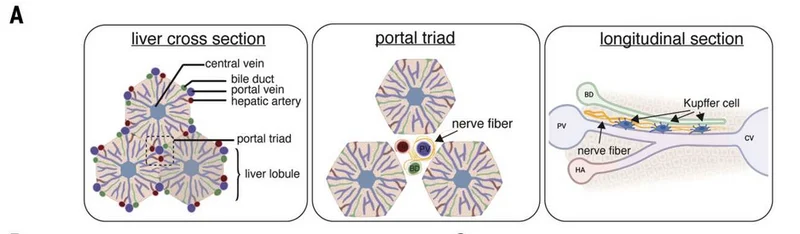
There are three duct systems in the liver, artery, vein and bile duct. Nerves frequently run with blood vessels through the body. The macrophages are associated or close to the nerves.
Here is a Science summary article. It discusses how this was discovered and has a video of homing pigeon paths in various experimental conditions, such as pharmacological killing of the macrophages.
Here is the Science research article.
Other proposed mechanisms include:
There will be more experiments to further characterize this.
An unexpected mechanism in homing pigeons appears to sense magnetic fields and transmit the signal to the nervous system in ill defined way.
Ferritin containing macrophages were found in the liver near nerve cells which might transmit signals to the brain. Ferritin is a form of iron used to move it around in animal bodies in a controlled manner. The macrophages presumably get the ferritin when recycling old blood cell components. There are several not fully understood steps in this overall process.
There are three duct systems in the liver, artery, vein and bile duct. Nerves frequently run with blood vessels through the body. The macrophages are associated or close to the nerves.
Here is a Science summary article. It discusses how this was discovered and has a video of homing pigeon paths in various experimental conditions, such as pharmacological killing of the macrophages.
Here is the Science research article.
esearchers tested whether these iron-rich macrophages act as magnetic compasses for the pigeons through a simple, elegant experiment: knocking out the macrophages with a drug called clodronate liposomes. The team trained 34 homing pigeons, a variety bred for their skilled wayfinding, to fly a 19-kilometer route due east. During the day, pigeons use the position of the Sun to orient themselves. But when it’s cloudy and completely overcast, they rely on their magnetic sense to get their bearings. Near Lake Constance, the team injected 18 birds with clodronate and, 24 hours later, released them one by one when dense clouds completely blocked the Sun. The birds were outfitted with GPS transmitters, so the team could track the birds in real time.
Other proposed mechanisms include:
Exactly how this sense works has been hotly debated. An early hypothesis was that minute crystals of magnetite embedded within the animals’ tissues somehow act like compass needles. A more recent idea is that proteins in the retina, called cryptochromes, react to magnetic fields; this would allow migrating songbirds to fly in the right direction even in the dim glow of twilight. Last year, researchers studying homing pigeons discovered another mechanism. Laboratory experiments revealed that varying magnetic fields induces electric currents in their inner ears, stimulating nerves that lead to the brain. All 18 birds got hopelessly lost, only returning home after the skies had cleared. In contrast, 16 birds released after getting sham injections immediately flew straight home. “For me that was the first indication that there’s something really exciting going on,” Wikelski says. To rule out the possibility that the drug had disoriented the birds or caused other side effects to make them lose their way, the researchers released drugged birds on sunny days. They flew home just fine.
There will be more experiments to further characterize this.
