LZ sees one event that is a dark matter candidate

  • Context: Undergrad 
  • Thread starter Thread starter mfb
  • Start date Start date
Join the discussion
Registration is free. Ask a follow-up in this thread, or start your own.
15 replies · 2K views
Messages
37,531
Reaction score
14,416
TL;DR
LUX-ZEPLIN has found one event that is in the signal region for their dark matter search.
Article: LZ Sees Surprising Result in Search for Dark Matter
Slides
Paper should follow shortly. Edit: Paper (PDF)

A single event is not enough to claim a discovery, and an extremely weird background fluctuation cannot be ruled out, but it's still a very intriguing event.
This analysis covers all data collected until April 2024, they are working on the analysis of a larger dataset, we'll see if we get more events.

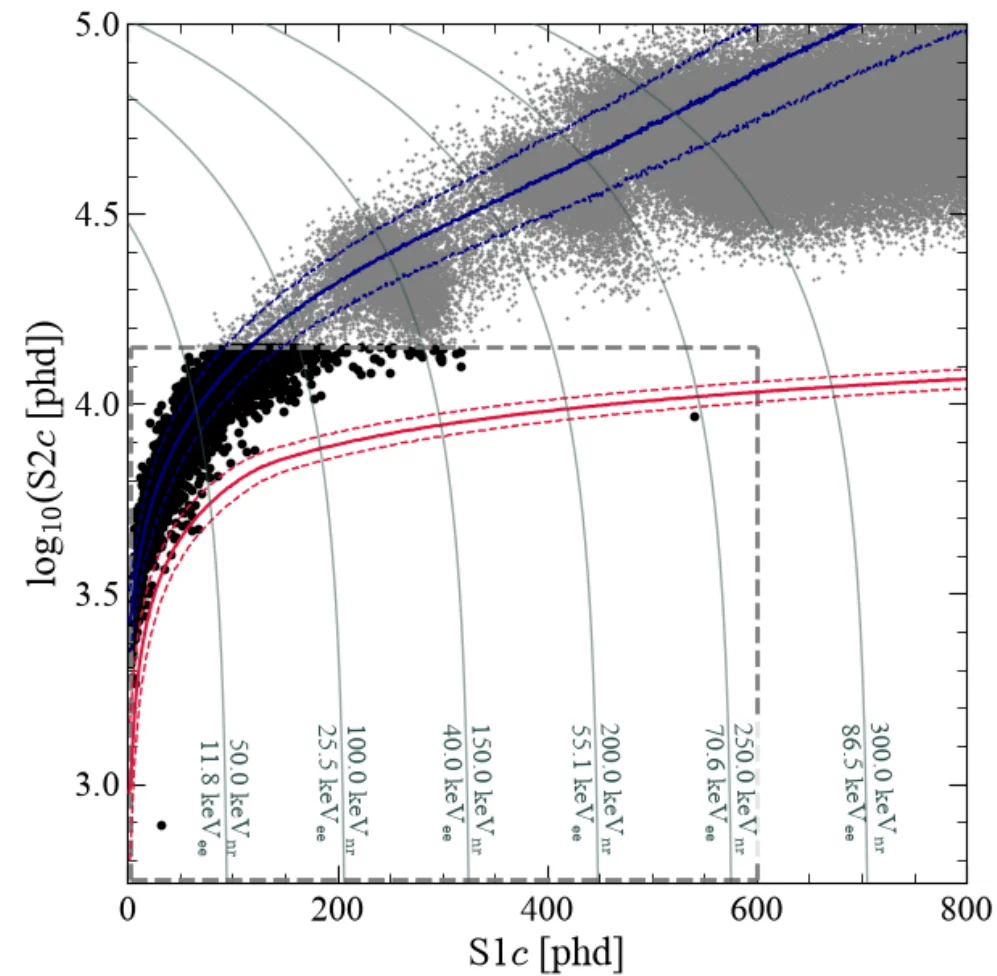
The main plot (slide 18):

1788277992623.webp
 
Last edited:
  • Like
  • Informative
Likes   Reactions: pinball1970, ohwilleke, Matterwave and 4 others
Physics news on Phys.org
Exciting!

Can they tune experiment parameters to improve the chances of production? Or could they if we knew more about it? Or do they just have to gather another 220+ days of data and see if they see another one?
 
The chance of a recoil event only depends on the dark matter properties and the active volume. A much larger volume would help but that means a new experiment. They reject events that happen close to the edge of the detector, as these places are more likely to have background events. You could shrink that region, but that's unlikely to improve the overall sensitivity. You don't want to add 10% signal if that means having twice the background.

So effectively the best thing is to take data for a longer time while making sure backgrounds stay tiny. LZ has 7 tonnes of liquid xenon, around 5 tonnes in the active volume. XENONnT has ~8 tonnes, but larger backgrounds. PandaX wants to build a 30 tonne experiment.
 
  • Like
  • Informative
Likes   Reactions: pinball1970, ohwilleke and Ibix
What would even be a standard for credible detection here? 3 events? 10? When would they start calling Stockholm?
 
Dale said:
With this detector does that mean that the dark matter candidate would interact with the weak nuclear force?
Or some novel fifth force that has a cross-section of interaction much weaker (by factors of millions or billions or so) than the SM weak force.

The DM cross-section of interaction of atomic nuclei (and hence the weak force charge of DM particles) would have to be profoundly weaker than that of neutrinos if it is a weak force interaction, which would be surprising since every SM particle with weak force interactions has the same weak force charge.
 
Last edited:
Bandersnatch said:
What would even be a standard for credible detection here? 3 events? 10? When would they start calling Stockholm?
Not sure, does the paper say what statistical significance this event has?

UPDATED: The paper estimates the global statistical significance at 2.6 sigma, with a local statistical significance of up to 3.4 sigma. But the number of events probably isn't sufficient to determine the significance. It also depends, in part, about the details of each event and how far those details are from the expected background events on the chart in the OP. END UPDATE

But given the amount of searching that has been done with multiple direct dark matter detection experiments that are all roughly similar to each other, the significance after the look elsewhere effect should be much lower than the local statistical significance.

You'd probably need a local significance of something like 10 sigma to get a global significance that meets the 5 sigma discovery threshold. Also, it isn't just 5 sigma, you also need a theoretical framework to attach the result to and replication, to be a true discovery.

So, you'd need (1) to do a lot of analysis with outside peer reviewers to rule out extremely faint backgrounds that weren't considered in the original analysis or other possible non-DM sources of this outlier data point, and (2) you'd need another experiment in addition to LZ to see it.

But, this makes funding direct dark matter detection experiments similar to LZ for the purpose of replicating this result and tuned to the parameters space where this was seen a no brainer.
 
Last edited:
Another issue is that even if the event is some non-SM particle, it doesn't necessarily follow that it is a significant component of DM.

Direct DM experiments are based upon the assumptions that the total DM mass flux and DM particle momentum can be pretty well determined from Milky Way dynamics, so you are looking at a parameter space in which DM particle mass and DM particle cross-section of interaction with nucleons trade off against each other for any given result.

This outlier data point, if it is real, points to a fairly high DM particle mass (some arXiv phenomenology papers are speculating in the 1 TeV order of magnitude). But anything much above 10 keV of mass presents real problems as a major component of DM since inferred DM distributions which are "cored" rather than "cuspy" suggest that you need much smaller DM masses to reduce the core-cusp problem, and plausible self-interaction strengths of heavy DM particles still don't solve that problem in simulations.

So, even if it is DM, it might be a type of DM particle that makes up, for example, only 1% of DM, as a DM analog to something like carbon atoms in interstellar space, while the predominant component of particle DM, as a DM analog of something like hydrogen atoms, might be too light for LZ to detect significantly due to neutrino backgrounds.

Analysis of this result in other preprints include:
https://arxiv.org/abs/2609.01475
https://arxiv.org/abs/2609.01504
https://arxiv.org/abs/2609.01592
https://arxiv.org/abs/2609.02608
https://arxiv.org/abs/2609.02775
https://arxiv.org/abs/2609.02868
https://arxiv.org/abs/2609.02823
https://arxiv.org/abs/2609.02807

POST SCRIPT: If there are multiple kinds of DM particles and this is only a rare and heavy member of that set, this implies that the cross-section of interaction can be much higher (and thus, much closer to the neutrino-nucleon cross section of interaction). This is because the cross-section of interaction calculations assume that there is only one kind of DM particle, so that the actual events recorded comes from interactions with 100% of the DM flux through LZ. But if this assumption is wrong and only, for example, 1% of DM particles are massive enough for LZ to detect, then the actual cross-section of interaction implied by a given number of events is 100 times greater in that example.

If DM particles of this mass are extremely rare (the DM analog to uranium or lead, perhaps, making up only one in a million or billion DM particles) within the universe of DM particles, then perhaps the cross-section of interaction could be equivalent to the strength of the weak force interaction of SM particles.

The effective lower bound of DM particle mass that LZ can detect is about 0.2-0.5 GeV, and the signal to noise ratio starts to degrade meaningfully for DM particle masses below 10 GeV. And, there are, to repeat, strong suggestions from the inferred shape of DM distributions, that the predominant share of DM particles (assuming that they exist) should be about 10 keV or less, which is about 20,000 times less massive than DM particles that can give rise to events detected by LZ which are distinguishable from background events, and about 1,000,000 times less massive than DM particles that LZ can detect with maximum efficiency.
 
Last edited:
  • Like
Likes   Reactions: pinball1970 and Dale
mfb said:
TL;DR: LUX-ZEPLIN has found one event that is in the signal region for their dark matter search.

Article: LZ Sees Surprising Result in Search for Dark Matter
Slides
Paper should follow shortly. Edit: Paper (PDF)

A single event is not enough to claim a discovery, and an extremely weird background fluctuation cannot be ruled out, but it's still a very intriguing event.
This analysis covers all data collected until April 2024, they are working on the analysis of a larger dataset, we'll see if we get more events.

The main plot (slide 18):

View attachment 373947
What are these units of [phd] in the graph?
Never heard of this measure..
 
'photons detected'
The linked paper explains this in detail.
 
  • Like
  • Informative
Likes   Reactions: berkeman, ohwilleke and loop quantum gravity
ohwilleke said:
But given the amount of searching that has been done with multiple direct dark matter detection experiments that are all roughly similar to each other, the significance after the look elsewhere effect should be much lower than the local statistical significance.

You'd probably need a local significance of something like 10 sigma to get a global significance that meets the 5 sigma discovery threshold. Also, it isn't just 5 sigma, you also need a theoretical framework to attach the result to and replication, to be a true discovery.
The normal distribution is very steep that far out. From 3.4 sigma -> 2.6 sigma we can infer a trials factor of ~15. Applying the same for a global significance of 5.0 sigma would only need a local significance of ~5.5 sigma. There are some more subtle effects but it's in that range.

If this is a real signal then the statistical significance can cross 5 sigma eventually but general acceptance will likely need another experiment to see a signal, too. Systematic uncertainties and errors are not following a normal distribution, as OPERA has demonstrated.
loop quantum gravity said:
What are these units of [phd] in the graph?
Never heard of this measure..
PhDs students expended photons detected.
S1 is the prompt signal and S2 is the delayed signal.
 
mfb said:
The normal distribution is very steep that far out. From 3.4 sigma -> 2.6 sigma we can infer a trials factor of ~15. Applying the same for a global significance of 5.0 sigma would only need a local significance of ~5.5 sigma. There are some more subtle effects but it's in that range.
I generally agree with your analysis, but I also think that the look elsewhere effect has been underestimated and really ought to include essentially all of the direct detection experiments and not just LZ.
 
If you add another factor 10 then we need 5.9 sigma local significance.

Asking for 10 sigma local significance would imply the existence of ~1015 dark matter experiments.
 
Any chance we could get a 5-year old's understanding of what we're seeing here:

My questions - and my updates from browsing, in blue:
  1. What are the axes?

    - phd = photons detected
    - "Position-corrected values, denotedS1c and S2c, allow for scale factors to correlate the signals to the original number of photons and electrons produced."


  2. What is the red line?

    "..represents the NR ... band ..." [Neutron Recoil? Non-Relativistic?]
  3. Is the datapoint of interest the one in the upper right of the dashed box? Or the lower left perhaps?

    "The event of interest appears at (540.1phd, 103.98phd) [i.e. upper right outlier]. The event below log10(S2c)=3 [i.e. lower left outlier] is consistent with accidental background..."

  4. Can I assume the vast majority of data points are observations from zillions of tests representing the gamut of mundane results?

    "...Black points show the WIMP search data from the full "science" sample which pass all data selections and are not tagged by the veto detectors..."

mfb said:
1788822439557.webp


I got fed up... :-p


AI summary of Fig 4:

Figure 4 displays the WIMP search data from the full science sample in the LUX-ZEPLIN (LZ) experiment, plotted in the space of corrected prompt scintillation signal (S1c) versus the logarithm of the corrected delayed electroluminescence signal (log10(S2c)). Key features of the figure include:

  1. Data Points and Regions:
    • Black points represent events passing all data selections and not tagged by veto detectors.
    • The dashed gray line outlines the WIMP search region of interest (WS ROI).
    • Red and blue lines indicate the nuclear recoil (NR) and electron recoil (ER) bands, respectively, as defined by calibration data.
  2. Event of Interest:
    • A single event stands out in the NR band at (S1c = 540.1 phd, S2c = 9268 phd) [upper right outlier], corresponding to a reconstructed nuclear recoil energy of 248 ± 23 (stat) ± 23 (sys) keV.
    • This event is 1.5σ below the median of the NR band and 6.7σ below the median of the ER band, making it highly NR-like and unlikely to be an ER background.
  3. Backgrounds and Features:
    • The event below log10(S2c) = 3 is consistent with accidental background.
    • Spectral features in the ER band above 25 keVee are mainly due to 125I and 133Xe decays, which appear slightly below the beta-decay ER band because of increased recombination from Auger cascades.
  4. Interpretation:
    • The figure visually demonstrates the separation between NR and ER events, with the event of interest clearly isolated in the NR band at high energy, where background rates are low.
    • This supports the statistical significance of the observed event as a potential dark matter candidate or a rare background process.
Overall, Figure 4 highlights the exceptional nature of the observed high-energy nuclear recoil event in the context of the experiment's background and signal expectations.
 
Last edited:
  • Like
Likes   Reactions: ohwilleke and Paul Colby
DaveC426913 said:
I got fed up... :-p
FWIW this AI description matches what I was able to pull from the detector description in the paper. The Xe gives off light if a Xe nuclei collides with something. The entire Xe detector is surrounded by other detectors that reject backgrounds like neutrons and charged particles from the data. I’ve always wondered how detecting something like a WHIMP would work. This is actually quite direct.
 
MOND astrophysicist Stacy McGaugh blogs about the experimental result.

He initially thinks that this is more fairly considered a 1 sigma result, not a 2.6 sigma result, but later walks that back in an addendum to his post.

In the addendum he does, however, make the point that I made earlier, that even if this is real, it isn't a very good candidate to account for the bulk of dark matter, if dark matter particles are a thing.

He notes a previous false alarm from a direct dark matter detection experiment in 2008-2009 that most of us had forgotten.

He also has a parting quote in a final footnote which is memorable:

Rutherford: “If your experiment needs statistics, you ought to have done a better experiment.” It is easy to conceive of a successful experiment in which there are so many detections that the [statistical] issue is moot.