Where are Voyager and Pioneer heading?

  • Context: Stargazing 
  • Thread starter Thread starter Cerenkov
  • Start date Start date
Join the discussion
Registration is free. Ask a follow-up in this thread, or start your own.
28 replies · 1K views
Cerenkov
Messages
386
Reaction score
100
TL;DR
https://arxiv.org/pdf/1912.03503 Future Stellar Flybys of the Voyager and Pioneer Spacecraft. Which constellations do the listed stars reside in? Are the spacecraft carrying the Sun's orbital motion velocity around the galactic centre with them? If so, what are the details of the velocities?
Hello,

I've been looking at this paper... https://arxiv.org/pdf/1912.03503 Future Stellar Flybys of the Voyager and Pioneer Spacecraft ...to get a better handle on where these four probes are heading, at a basic level as an amateur astronomer. Its been very helpful.

I'm trying to visualise their journeys in relation to my understanding of the Earth's celestial sphere. Looking up at the stars at night I can recognise and find my way around the sky and am familiar with the constellations. So I've been able to place all but three of the stars listed in Table 1 in their various constellations. But, even with AI assistance I can't place the three stars that are from GAIA's Data Release 2. The ones that appear as long strings of numbers. I've visited the ESA GAIA websites but can't make much headway there. It all seems to be pitched well above my level of understanding.

So, this is my first question. Could someone please tell me which constellations these three stars reside in? Thank you.

My second question has to do with the velocities of these four spacecraft in relation to the Milky Way galaxy and not in relation to Earth or the Sun. As far as I understand it the Sun is moving around the galactic centre at an estimated distance of 24 to 28,000 light years. Therefore I conclude that whatever velocity the Sun is moving at must be part of the velocities of the four spacecraft. If that conclusion is sound I was wondering if the various directions of the probes would have a significant impact, adding or subtracting from that velocity.

For example, a probe launched from Earth on a spin ward direction would have two complimentary components to its velocity - that caused by the Sun's motion and that caused by the rocket engines and gravitational slingshots of the probe itself. They would add together. Whereas a probe travelling in an anti-spin ward direction would subtract one velocity from another. So I suppose my second question really breaks down into two parts.

Is my thinking about adding and subtracting velocities correct?

Can anyone please supply the data about the velocities of the four spacecraft relative to the galactic centre?

Thank you,

Cerenkov.
 
Astronomy news on Phys.org
Proxima is in Centaurus constellation, Ross 248 is in Andromeda constellation. Is there any reason to think the subsequent encounters would not also be in those same constellations? Presumably, the lion's share of the each probe's movement is directly away from Sol, it would require a significant change in direction to end up in a different constellation, no?
 
Andy Resnick said:
I had good luck search the SIMBAD database:

https://simbad.u-strasbg.fr/simbad/sim-fbasic

While almost all of the Gaia DR2 IDs were recognized, not all of the DR2 ID numbers were- Gaia DR2 454473057495679385 was not recognized by Simbad or VizieR

Thanks for this Andy.

I concur.

When I put the numbers into the SIMBAD basic query box, this was the answer.

Identifier not found in the database : Gaia DR2 4544730574956793856

The same seemed to be true of VizieR.

Perhaps the DR2 data hasn't been properly integrated these databases?

Thanks,

Cerenkov.
 
DaveC426913 said:
Proxima is in Centaurus constellation, Ross 248 is in Andromeda constellation. Is there any reason to think the subsequent encounters would not also be in those same constellations? Presumably, the lion's share of the each probe's movement is directly away from Sol, it would require a significant change in direction to end up in a different constellation, no?

Hi Dave!

I really am just guessing here but perhaps we could roughly compare the trajectory of the Voyager and Pioneer probes to the path computed for 1I Oumuamua? After all both types of objects, natural and artificial, are heading away from the Sun.

So perhaps something like this...

https://www.researchgate.net/figure...n-from-Earth-The-relative-size_fig2_355730421

1789493354161.webp


...would also be true for those four spacecraft?

They would move across the celestial sphere from our p.o.v. traversing various constellations as they go, with the looping paths generated by the Earth's motion around the Sun diminishing in size as they recede deeper and deeper into interstellar space.

But that's just my naïve guess.

Thanks,

Cerenkov.
 
Cerenkov said:
As far as I understand it the Sun is moving around the galactic centre at an estimated distance of 24 to 28,000 light years. Therefore I conclude that whatever velocity the Sun is moving at must be part of the velocities of the four spacecraft.
Yes. The Sun is moving with approximately 230 km/s around the galactic center, making a galactic year come out at about 225 Myr (Mega year). The 230 km/s means that any probe (and most natural objects too) escaping from the Sun vicinity will to a large extend be traveling in the same direction in the Milky Way as the Sun is, no matter in which direction they left relative to the Sun. Thus, if a probe is leaving towards a specific star it will likely never end up near that star some fraction of a full orbit later, just like if a satellite in orbit around a planet were to maneuver directly towards another far off satellite it will most likely not actually end up there.
 
Cerenkov said:
They would move across the celestial sphere from our p.o.v. traversing various constellations as they go, with the looping paths generated by the Earth's motion around the Sun diminishing in size as they recede deeper and deeper into interstellar space.
Sure but the probes are already receding from our system, and are scores of AUs distant so what their path ought to look like is just the very last part of that diagram.
1789499449059.webp

As you can see, it stays within a given constellation for the rest of its journey (which, in your diagram, appears to be Pegasus).

Are you asking what those constellations might do over galactic timescales? Hard to say. The galaxy rotates every 260 million years. If one of those probes took 50,000 years to reach the nearest star, the galaxy will have rotated on its axis less than a tenth of a degree (40 arcminutes).

In that time, Sol will have travelled about 30 light years, as will, on average, the rest of the stars near us.
 
Last edited:
Table 1 of the paper you linked gives you the velocities of the spacecraft in the ICRF coordinate system, which is centered on the sun. This link has some good examples on how to transform these velocities into a galactocentric coordinate system. At these low relative velocities (relative to c) the velocities just add.

You could also transform to the Local Standard of Rest, which is a coordinate system rotating with the sun around the galactic center.

Note that this is all just an academic exercise, since the spacecraft will be long dead by the time they encounter anything of interest.
 
Sorry, I didn't read the whole paper because their batteries are/will be dead thousands of years before they reach anything. Pioneer batteries have been dead for years. Voyager batteries will only last another 9 years. Is there some reason to question where they will go in the next thousand years?
 
Filip Larsen said:
Yes. The Sun is moving with approximately 230 km/s around the galactic center, making a galactic year come out at about 225 Myr (Mega year). The 230 km/s means that any probe (and most natural objects too) escaping from the Sun vicinity will to a large extend be traveling in the same direction in the Milky Way as the Sun is, no matter in which direction they left relative to the Sun. Thus, if a probe is leaving towards a specific star it will likely never end up near that star some fraction of a full orbit later, just like if a satellite in orbit around a planet were to maneuver directly towards another far off satellite it will most likely not actually end up there.

Thank you Filip,

I suspected as much but wanted to get some expert advice on the matter.

Cerenkov.
 
DaveC426913 said:
Sure but the probes are already receding from our system, and are scores of AUs distant so what their path ought to look like is just the very last part of that diagram.
View attachment 374176
As you can see, it stays within a given constellation for the rest of its journey (which, in your diagram, appears to be Pegasus).

Are you asking what those constellations might do over galactic timescales? Hard to say. The galaxy rotates every 260 million years. If one of those probes took 50,000 years to reach the nearest star, the galaxy will have rotated on its axis less than a tenth of a degree (40 arcminutes).

In that time, Sol will have travelled about 30 light years, as will, on average, the rest of the stars near us.

Yes, I agree and can see what you're saying, Dave.

1I Oumuamua zipped quickly across most of that map but then receded in the general direction of a given constellation. In this case, Pegasus.

So I'm not really asking what the constellations themselves might do over large timescales. It's more a case of wanting to know which constellation the four probes are each headed towards. From the information given in that paper I linked to I couldn't work out that result.

Call me a hopeless dreamer but I just think it would be nice to look up at night and know that Voyager 1 is headed towards (insert constellation), that's all. And the same for the other spacecraft too.

Thanks,

Cerenkov.
 
phyzguy said:
Table 1 of the paper you linked gives you the velocities of the spacecraft in the ICRF coordinate system, which is centered on the sun. This link has some good examples on how to transform these velocities into a galactocentric coordinate system. At these low relative velocities (relative to c) the velocities just add.

You could also transform to the Local Standard of Rest, which is a coordinate system rotating with the sun around the galactic center.

Note that this is all just an academic exercise, since the spacecraft will be long dead by the time they encounter anything of interest.

Thank you for these links, phyzguy.

I can grasp the LSR information better because it is couched in a sufficiently simple way and also includes an analogy that I can easily understand.

The other one... Transforming Positions and Velocities to and from a Galactocentric Frame ...is beyond me I'm afraid. I'm an untrained amateur stargazer who looks at the night sky through binoculars and who is generally familiar with the basics of astronomy. Therefore, this is a resource I cannot utilise.

But thank you for your help anyway.

Cerenkov.
 
FactChecker said:
Sorry, I didn't read the whole paper because their batteries are/will be dead thousands of years before they reach anything. Pioneer batteries have been dead for years. Voyager batteries will only last another 9 years. Is there some reason to question where they will go in the next thousand years?

Well, for me it's not just about the data these probes can give us, FactChecker.

I believe that it was Carl Sagan who said that images like the Pale Blue Dot didn't provide a great deal of scientific information but did tell us (the human race) something about ourselves and our place in the immensity of the universe. This is more or less my take on the matter and the reason why I'm curious about where these probes are heading.

To have the privilege of looking up at a given constellation at night, knowing that a small emissary of the human species is there and proceeding on a very, very long journey indeed. For this to happen the batteries on these spacecraft do not need to be working. Their instruments do not need to be functioning. They don't need to be sending data back to us.

It's not just about the data. It's about wanting to know where our envoys are headed.

Thank you,

Cerenkov.
 
Cerenkov said:
It's not just about the data. It's about wanting to know where our envoys are headed.
Ok. I'll buy that. And I guess they are envoys if they contain things that might be discovered by others.
 
FactChecker said:
Ok. I'll buy that. And I guess they are envoys if they contain things that might be discovered by others.

I reckon so, FactChecker.

If we turned the whole idea around and one of these probes were an envoy from an intelligent alien civilisation passing through OUR solar system, just think how much that would mean to us. Even if the species that made it had long become extinct it would still tell us that we were not alone. That not only was there other life in the universe - it was more than single celled life - it was complex life that had evolved to reach conscious thought, self-awareness and the technological ability to launch their artefacts out into interstellar space.

Really, really big and profound answers to the biggest questions.

For a short while there was even a bit of bruhaha about 1I Oumuamua being just such an envoy. Eventually the data ruled that out (unless you're Avi Loeb) but the groundswell of excitement surrounding that event was quite telling. We as a species are curious about our place in the cosmos.

As an individual, so am I FactChecker. Hence this thread and my questions.

Thank you,

Cerenkov.
 
Cerenkov said:
It's not just about the data. It's about wanting to know where our envoys are headed.
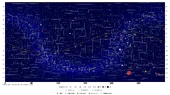
If that's what you want, that's pretty easy. In Table 1 of the paper you quoted in the OP, alpha and delta are the Right Ascension and Declination of their velocity vectors. Those you can just plot on a star map. On the attached, I did that, with Voyager 1 in magenta and Voyager 2 in yellow.
constellations_map_2011101102.webp
 
  • Like
Likes   Reactions: Cerenkov and Filip Larsen
What timescale are we talking about? Given that all the probes are traveling at a speed < escape velocity from the Milky Way, the probes will continue orbiting the center of the galaxy.
 
AlexB23 said:
What timescale are we talking about? Given that all the probes are traveling at a speed < escape velocity from the Milky Way, the probes will continue orbiting the center of the galaxy.
Of course. In the paper in the OP, they extrapolated ahead about 10 MYr, using the known positions and velocity vectors of the nearby stars, so that is all taken into account.
 
phyzguy said:
Of course. In the paper in the OP, they extrapolated ahead about 10 MYr, using the known positions and velocity vectors of the nearby stars, so that is all taken into account.
Yep. I am just curious why people want to know the exact positions. Encounters with other stars and gravity wells would mean no one would know where the probes would be exactly in 10 million years. If the positions and masses of stars are not known to an extreme degree of accuracy, the calculations would fail.
 
AlexB23 said:
Yep. I am just curious why people want to know the exact positions. Encounters with other stars and gravity wells would mean no one would know where the probes would be exactly in 10 million years. If the positions and masses of stars are not known to an extreme degree of accuracy, the calculations would fail.
I think @Cerenkov in his initial post just wanted to know approximately where they are headed. In terms of the motivation for writing the original paper, who knows? Maybe just for fun. The positions and velocities of nearby stars are known pretty accurately thanks to Gaia, and they took into account the motion in the galactic potential.
From the paper: "We then integrate the orbits of these stars and the spacecraft through a Galactic potential and identify close encounters."

Close encounters of stars are extremely rare and can probably safely be ignored.
 
phyzguy said:
I think @Cerenkov in his initial post just wanted to know approximately where they are headed. In terms of the motivation for writing the original paper, who knows? Maybe just for fun. The positions and velocities of nearby stars are known pretty accurately thanks to Gaia, and they took into account the motion in the galactic potential.
From the paper: "We then integrate the orbits of these stars and the spacecraft through a Galactic potential and identify close encounters."

Close encounters of stars are extremely rare and can probably safely be ignored.
I understand now. Has anyone modeled it themselves using Python and existing public data for the Voyager probe coordinates?
 
AlexB23 said:
I understand now. Has anyone modeled it themselves using Python and existing public data for the Voyager probe coordinates?
Why would anyone do that? Is there reason to doubt scientists from JPL and the Max Planck Institute? If you doubt them, you could try running your own simulation to check them.
 
phyzguy said:
Why would anyone do that? Is there reason to doubt scientists from JPL and the Max Planck Institute? If you doubt them, you could try running your own simulation to check them.
There is no reason to doubt. But, given that space and orbit modeling is easy to run on Python, it would be cool to see if a regular computer can match up to the officials at JPL. I did a bit of 2D gravity simulations in a class 6 years ago by modeling the solar system, and sending a probe to Mercury in Python.

Edit, actually 7 years ago.
 
phyzguy said:
If that's what you want, that's pretty easy. In Table 1 of the paper you quoted in the OP, alpha and delta are the Right Ascension and Declination of their velocity vectors. Those you can just plot on a star map. On the attached, I did that, with Voyager 1 in magenta and Voyager 2 in yellow.View attachment 374177

This is great Phyzguy. Thanks very much.

Voyager 1 is heading towards a region of space in the lower corner of Gemini, close to where it abuts Orion. When the winter constellations become visible here in the UK I'll be able to look up and know that it's out there. Which will be very satisfying.

Voyager 2 is well below my horizon, on the Horologium - Hydrus border. But should I travel to the Southern hemisphere at the right time of year and be able to orient myself among unfamiliar constellations, I'll know where to look.

I hope I don't sound like a gimme here, but is it possible for you to perform the same exercise for the two Pioneer probes please?

Your help is much appreciated.

Cerenkov.
 
AlexB23 said:
Yep. I am just curious why people want to know the exact positions. Encounters with other stars and gravity wells would mean no one would know where the probes would be exactly in 10 million years. If the positions and masses of stars are not known to an extreme degree of accuracy, the calculations would fail.

Hello Alex,

Phyzguy was right. It's the headings I'm interested in. From the popular-level reading I've done on this subject I do understand that there are a great many unknowns involved in the positions, motions and masses of stars.

I suppose it's a bit like weather forecasting. Tomorrow's forecast will always be more accurate than one for next week because the variables are smaller. In a similar way our knowledge of nearby stars is far better than that of distant ones.

Why am I interested in where the probes are headed?

Because when I look up at the planets I know that there are rovers and orbiters on and around Mars. That the Juno probe is currently circling Jupiter. That BepiColombo will be orbiting Mercury soon. And so on. With the help I received here I can now extend that knowledge beyond the solar system.

It's a purely personal thing - but quietly satisfying. :smile:

Thank you,

Cerenkov.
 
Cerenkov said:
I hope I don't sound like a gimme here, but is it possible for you to perform the same exercise for the two Pioneer probes please?
Surely given the alpha and delta coordinates in Table 1 of the paper you cited you can plot those points on the star map. If not, what don't you understand?
 
I can see that now thanks.

I therefore plot Pioneer 10's heading to be within the borders of Hercules (red symbol) and Pioneer 11's to be within Eridanus (green symbol).
 

Attachments

  • constellations_map_2011101102.webp
    constellations_map_2011101102.webp
    320.6 KB · Views: 1
Cerenkov said:
Hello Alex,

Phyzguy was right. It's the headings I'm interested in. From the popular-level reading I've done on this subject I do understand that there are a great many unknowns involved in the positions, motions and masses of stars.

I suppose it's a bit like weather forecasting. Tomorrow's forecast will always be more accurate than one for next week because the variables are smaller. In a similar way our knowledge of nearby stars is far better than that of distant ones.

Why am I interested in where the probes are headed?

Because when I look up at the planets I know that there are rovers and orbiters on and around Mars. That the Juno probe is currently circling Jupiter. That BepiColombo will be orbiting Mercury soon. And so on. With the help I received here I can now extend that knowledge beyond the solar system.

It's a purely personal thing - but quietly satisfying. :smile:

Thank you,

Cerenkov.
Yeah, I am more interested where the nearby probes are going. BepiColombo I will be keeping a close eye on. Same with Lucy and others in the solar system
 
AlexB23 said:
Yeah, I am more interested where the nearby probes are going. BepiColombo I will be keeping a close eye on. Same with Lucy and others in the solar system

Yes, I'm there too Alex.

If I had to pick one mission that interests me most it would be this.

https://en.wikipedia.org/wiki/Psyche_(spacecraft)

Ok, I'll have to wait until 2029, but I think it'll be worth it.

If the theories are right about the asteroid it'll be the metallic core of what was once a larger body. A catastrophic collision is theorised to have taken place long ago, stripping it of much (or all?) of its outer layers. Assuming that it went through an early process of internal differentiation, that is.

Thanks,

Cerenkov.