Neil Turok: all known physics fits into one equation

  • Context: Graduate 
  • Thread starter Thread starter g.lemaitre
  • Start date Start date
  • Tags Tags
    Physics
Click For Summary

Discussion Overview

The discussion centers around Neil Turok's claim that all known physics can be encapsulated in a single equation. Participants explore the implications of this assertion, the nature of the equation, its components, and its applicability across various physical laws and theories, including quantum mechanics and particle physics.

Discussion Character

  • Exploratory
  • Technical explanation
  • Debate/contested

Main Points Raised

  • One participant questions the name of the equation and its origins, expressing uncertainty about its predictive power and whether it encompasses all known physical laws, including classical ones like the ideal gas law.
  • Another participant provides a link to Turok's lecture for further reference.
  • It is noted that the equation involves exponentiating an action that includes various coupling types, referencing the Einstein-Hilbert action and components of the Standard Model (SM) action.
  • There is a question about whether the equation is Turok's own formulation.
  • A participant identifies the equation as the Feynman path integral for the moment-generating function Z.
  • Concerns are raised about the speculative nature of including gravity in the equation, with a suggestion that "all known physics" may actually refer only to particle physics, as it does not account for phenomena like dark matter.
  • Another participant discusses the components of the equation, linking it to the Standard Model and the Higgs field, while expressing skepticism about it being a theory of everything due to unresolved issues with dark energy and dark matter.
  • There is mention of how minimizing the exponent of the equation yields classical physics equations, although one participant expresses confusion about the concept of a classical fermion.
  • A participant suggests that understanding the equation may involve recognizing the smallness of h and drawing parallels to delta functions, indicating a relationship between classical and quantum mechanics.

Areas of Agreement / Disagreement

Participants express a range of views regarding the equation's implications, its completeness, and its relationship to various physical theories. There is no consensus on whether the equation can truly encompass all known physics, particularly in relation to gravity and dark matter.

Contextual Notes

Participants highlight limitations in understanding the equation's components and the speculative nature of its claims, particularly regarding gravity and its applicability to all physical laws.

g.lemaitre
Messages
267
Reaction score
2
In this lecture which is quite good in my opinion


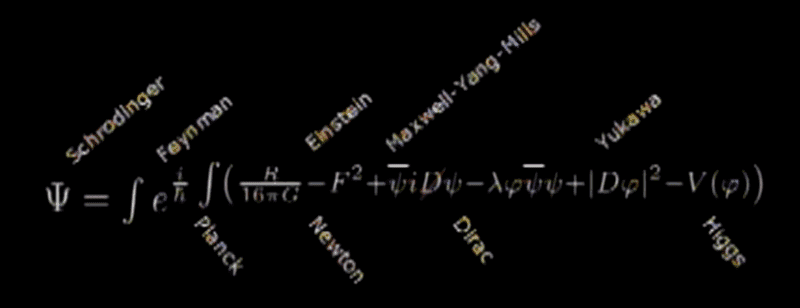
Neil Turok claims that all known physics fits into this equation:
Screenshot2012-07-20at113739PM.png


What is this equation's name? When was it cobbled together and by whom? How confident are you of its predictive power? Do all known physical laws reduce to this equation? Even such laws as the ideal gas equation, Bernoulli's equation and the law which causes liquid water to be denser than ice? I won't bother to understand the finer points of the equation since I barely understand QM much less QED.
 
Last edited by a moderator:
Physics news on Phys.org
The term being exponentiated is an action, containing representatives of all the currently used coupling types. You've got the Einstein-Hilbert action, plus the various component types of the SM action. He's just picked out one term of each type to illustrate the variety of couplings.

Exponentiating \frac{i}{\hbar} times the action gives you the path integral.
 
But this equation doesn't have a name? Is it his equation?
 
It is the Feynman path integral for the moment-generating function Z.
 
The addition of gravity there is a bit speculative - even if it works like this, no one has an idea how to work with it.

I think that "all known physics" refers to "all known particle physics" - this equation cannot be used to explain the properties of dark matter, for example.
 
Part of the equation you quote, i.e. all terms apart from the one containing R, is (when the terms are interpreted appropriately) the definition of the STANDARD MODEL of particle physics. The last two terms are associated to the very celebrated HIGGS, \varphi, and in fact there is a \varphi also in most of the other terms but it is not displayed explicitly. This is the theory that has been tested to remarkable accuracy in particle accelerators and beyond .. well apart from the unexplained 96% of "our" universe (dark energy and dark matter). Theory of everything? Nah, probably not then ... but who knows, there can be surprises. The other part of the equation, the one containing R, doesn't make much sense as it stands .. at the end of the day, to make sense of it is to make sense of quantum gravity. And it's not often that you see the words `sense' and `quantum gravity' in the same sentence .. By the way, when you minimize the exponent of this equation, you get classical physics: Maxwell's equations, Newtonian gravity, time dilation, and .. ehmm.. I'm not sure what a classical fermion is .. what is a classical fermion? Anyway, that's the exponent. The `big' integral upfront instructs one to sum over all conceivable paths when a particle goes, say, from a point A in spacetime to a point B. This `big' integral is what defines it as a quantum theory, in accordance with Feynman's formulation of quantum mechanics.
 
A trick to understand the equation is to be aware that h is small. If you remember delta functions, they have a very similar shape, as the limit with something goes to zero of a complex-valued exponential. In this case, the "delta function" is more of a "delta prime", and it codifies classical mechanics in its limit, while the h>0 case is quantum mechanics.
 

Similar threads

  • · Replies 15 ·
Replies
15
Views
23K
  • · Replies 1 ·
Replies
1
Views
3K
  • · Replies 21 ·
Replies
21
Views
4K
  • · Replies 17 ·
Replies
17
Views
3K
  • · Replies 4 ·
Replies
4
Views
3K
Replies
1
Views
3K
  • · Replies 8 ·
Replies
8
Views
2K
  • · Replies 6 ·
Replies
6
Views
3K
  • · Replies 5 ·
Replies
5
Views
12K
  • · Replies 7 ·
Replies
7
Views
7K