2-D Momentum Problem -- Elastic collision of two spheres

Click For Summary

Homework Help Overview

The discussion revolves around a two-dimensional momentum problem involving the elastic collision of two spheres, specifically focusing on the assumptions regarding the motion of ball A after the collision. Participants explore the implications of momentum conservation and the conditions under which ball A remains confined to a horizontal plane.

Discussion Character

  • Conceptual clarification, Assumption checking, Exploratory

Approaches and Questions Raised

  • Participants question the assumptions about the direction of momentum and the forces involved in the collision. There is a focus on whether ball A can have a vertical component of momentum after the collision and the implications of the "smooth" nature of the spheres.

Discussion Status

The discussion is active, with participants raising questions about the assumptions made in the problem. Some have offered insights into the nature of the collision and the forces at play, while others are still grappling with visualizing the scenario and the implications of the assumptions.

Contextual Notes

There are references to the idealized conditions of the problem, such as the assumption of frictionless contact and the specific definitions of the horizontal plane in question. Participants are encouraged to consider real-world implications and variations in the collision dynamics.

Jimmy87
Messages
692
Reaction score
19
Homework Statement
Determining velocity after a 2-D impact.
Relevant Equations
p = mv
Hi,

Here is the problem
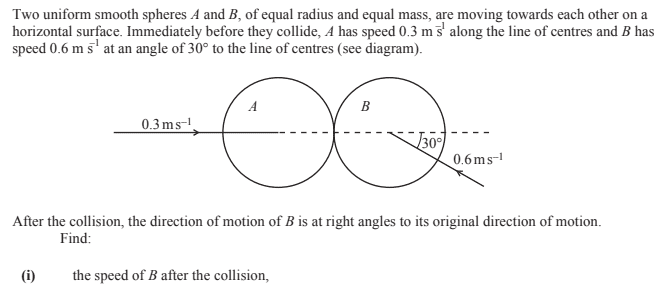
1679393005608.png


What is required to answer this question is two assumptions. Firstly, the component of the momentum normal to the centre line is the same before and after. Therefore, secondly, A must recoil entirely in the horizontal plane. This is the only way to answer this question and I can get the answer (0.34 m/s which I know to be correct). How do we know after this collision A is confined to the horizontal plane? Thanks.
 
Physics news on Phys.org
Jimmy87 said:
How do we know after this collision A is confined to the horizontal plane? Thanks
We don't. Snooker balls sometimes jump up off the table after a collision.

You just have to assume that doesn't happen in this case.
 
  • Haha
  • Like
Likes   Reactions: BvU and MatinSAR
PeroK said:
We don't. Snooker balls sometimes jump up off the table after a collision.

You just have to assume that doesn't happen in this case.
Ah sorry I wasn’t clear. The only way to answer this question is if ball A recoils along the centre line. How do we know it doesn’t have any vertical component after the collision (vertical in terms of the plane of the surface).
 
Jimmy87 said:
The only way to answer this question is if ball A recoils along the centre line. How do we know it doesn’t have any vertical component after the collision (vertical in terms of the plane of the surface).
The balls are "smooth". What is the direction of the force that B exerts on A?
 
  • Like
Likes   Reactions: Jimmy87
Jimmy87 said:
How do we know it doesn’t have any vertical component after the collision (vertical in terms of the plane of the surface).
A better term is lateral or tangential, rather than vertical.
 
  • Like
Likes   Reactions: Jimmy87
Jimmy87 said:
Ah sorry I wasn’t clear. The only way to answer this question is if ball A recoils along the centre line. How do we know it doesn’t have any vertical component after the collision (vertical in terms of the plane of the surface).
To acquire a vertical (tangential) component of momentum, a vertical force is needed during the collision. What entity could be the origin of that force? See post #4 by @TSny.
 
  • Like
Likes   Reactions: Jimmy87
kuruman said:
To acquire a vertical (tangential) component of momentum, a vertical force is needed during the collision. What entity could be the origin of that force? See post #4 by @TSny.
Yeh I’m still struggling to visualise it. Ball B changes direction by moving through an angle of 90 degrees yet ball doesn’t changes it angle at all.

If the velocity is at an angle of 30 degrees will there not be a component normal to the line imparted on ball A?
 
Ball A can only exert a force perpendicular to its surface which is the radial direction from the center of A to the point of the collision. This means that the velocity of ball B can change only in that radial direction. Draw a vector diagram of the momentum of ball B before and after the collision showing this.
 
Jimmy87 said:
Yeh I’m still struggling to visualise it. Ball B changes direction by moving through an angle of 90 degrees yet ball doesn’t changes it angle at all.

If the velocity is at an angle of 30 degrees will there not be a component normal to the line imparted on ball A?
It says "smooth" spheres in the question, which is introductory physics code for "no friction". In reality, there would be some friction between the surfaces and some exchange of lateral momentum. A super slow-motion film of the collision of two snooker balls would be interesting from this perspective. To see how much (if any!) lateral momentum is imparted to the object ball.
 
  • Like
Likes   Reactions: nasu
  • #10
kuruman said:
Ball A can only exert a force perpendicular to its surface which is the radial direction from the center of A to the point of the collision. This means that the velocity of ball B can change only in that radial direction. Draw a vector diagram of the momentum of ball B before and after the collision showing this.
Thanks I think I can visualise it now. So it’s because they collide exactly edge on with no friction. I guess if ball B collided with some of its radius within ball A’s radius it would impart a force perpendicular to the centre line into A? Is that right? Thanks
 
  • #11
Jimmy87 said:
Thanks I think I can visualise it now. So it’s because they collide exactly edge on with no friction. I guess if ball B collided with some of its radius within ball A’s radius it would impart a force perpendicular to the centre line into A? Is that right? Thanks
This problem makes the simplifying assumption that the spheres have a frictionless contact. If you want to take the next step, I'd look online for an experimental analysis of these sorts of collisions. Introductory physics is essential in teaching you the basics and getting experience with the mathematics, but it only takes you so far in terms of understanding the real world.
 
  • #12
Jimmy87 said:

What is required to answer this question is two assumptions. Firstly, the component of the momentum normal to the centre line is the same before and after. Therefore, secondly, A must recoil entirely in the horizontal plane. This is the only way to answer this question and I can get the answer (0.34 m/s which I know to be correct). How do we know after this collision A is confined to the horizontal plane? Thanks.
What horizontal plane are you referring to?
The plane on which the balls are sliding or rolling on, or the one perpendicular to the shown picture and containing the trajectory of A?
 
  • #13
Jimmy87 said:
Homework Statement:: Determining velocity after a 2-D impact.
Relevant Equations:: p = mv

0.34 m/s which I know to be correct
Should be 0.6 tan(30), which is nearer to 0.35, no?
 

Similar threads

  • · Replies 16 ·
Replies
16
Views
4K
  • · Replies 13 ·
Replies
13
Views
1K
Replies
20
Views
2K
  • · Replies 15 ·
Replies
15
Views
3K
Replies
5
Views
1K
  • · Replies 5 ·
Replies
5
Views
2K
Replies
19
Views
3K
  • · Replies 9 ·
Replies
9
Views
2K
  • · Replies 15 ·
Replies
15
Views
4K
  • · Replies 2 ·
Replies
2
Views
3K