2D momentum piece breaks problem

  • Thread starter Thread starter coldsteel
  • Start date Start date
  • Tags Tags
    2d Momentum
Click For Summary
SUMMARY

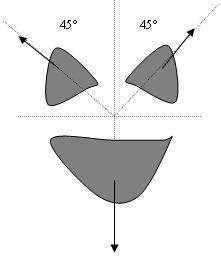
The discussion revolves around a physics problem involving momentum conservation after a piece of ice breaks into three parts. The larger piece, weighing 4 kg, moves downward at 4 m/s, while two smaller pieces, each weighing 2 kg, break off at 45-degree angles. The initial momentum is equal to the final momentum, leading to the conclusion that the speed of the smaller pieces can be calculated using vector components. The correct approach involves using trigonometric functions to resolve the velocities, resulting in a calculated speed of approximately 5.7 m/s for the smaller pieces.

PREREQUISITES
  • Understanding of momentum conservation principles
  • Familiarity with vector decomposition in physics
  • Basic knowledge of trigonometric functions
  • Ability to apply equations of motion
NEXT STEPS
  • Study momentum conservation in two-dimensional collisions
  • Learn about vector resolution and component analysis in physics
  • Explore trigonometric applications in physics problems
  • Practice solving real-world problems involving momentum and velocity
USEFUL FOR

Students studying physics, educators teaching momentum concepts, and anyone interested in solving two-dimensional motion problems.

coldsteel
Messages
10
Reaction score
0
1.A piece of ice falls on a frozen lake and breaks up into three pieces which go off in the directions shown in the diagram below. The mass of the bigger piece is 4 kg and it moves with a speed of 4 m/s straight down, If the two smaller pieces are 2 kg each and break off at 45 degrees each. What would be their speed right after the breakup?

icebreaks.jpg

2. momentum initial = momentum final.
Pi=Pf[
M*V+M*V=M*V+M*V


3. I think I need to find the x and y compenents of the smaller 2kg piece, but I don't know how to start because the bigger piece is at 90 degrees. this would make the x compenent 0 right? if i solve for the y direction... M*V+M*V=0 would I take half of the mass of the big ice chunk because it splits evenly? I used 4(2)+2(V)=0 to get a y compenent of 4. then use trig to get the vector velocity which I got to = 5.7 m/s. Is this right?
 
Last edited by a moderator:
Physics news on Phys.org
It is impossible to understand what you mean because equations like M*V+M*V=M*V+M*V make no sense. They are the same as 1 = 1: always true, but carry no information whatsoever. M*V+M*V=0 is hardly better, because it means V = 0, which cannot be true in this case. Please use notation that let's other people understand what you are doing. You can denote the little piece's mass as m, their velocities as v, and those of the large piece M and V.
 

Similar threads

  • · Replies 4 ·
Replies
4
Views
1K
Replies
7
Views
2K
  • · Replies 27 ·
Replies
27
Views
2K
  • · Replies 17 ·
Replies
17
Views
1K
  • · Replies 4 ·
Replies
4
Views
4K
Replies
3
Views
2K
Replies
10
Views
3K
  • · Replies 2 ·
Replies
2
Views
1K
  • · Replies 4 ·
Replies
4
Views
2K
Replies
7
Views
2K