2nd Order PDE Using Similarity Method

5 replies · 3K views · last reply
keropi452
Messages
3
Reaction score
0
Hi All,

Does anybody know how to solve the following PDE? I tried a similarity solution method where eta = y/f(x) (which I can do successfully without the C * U term) but was unsuccessful.
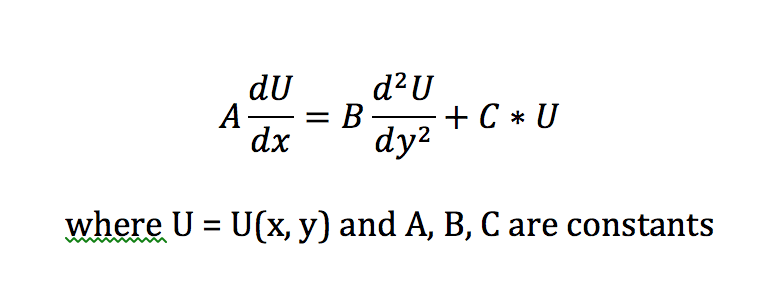
Equation A dU/dx = B d²U/dy² + C * U, followed by the line 'where U = U(x, y) and A, B, C are constants'.


Thank you very much in advance!
 
If it is a PDE, it will be ##A\frac{\partial U}{\partial x}=B\frac{\partial^2 U}{\partial y^2}+C\cdot U## ...
 
True - Sorry about that. Please take the d's to mean partial differential. Thank you for that catch.
 
If you assume that ##A\not=0## you can write your equation as ##\frac{\partial U}{\partial x}=\frac{B}{A}\frac{\partial^2 U}{\partial y^2}+\frac{C}{A}\cdot U## that is an example of diffusion reaction equation with ## R(U)=\frac{C}{A}U##, seehttps://en.wikipedia.org/wiki/Reaction–diffusion_systemwhere you call ##x=t## and ##y=x##, here the reaction term is simply ##\frac{C}{A}U##...

Ssnow
 
Thank you very much for your response and observation. Are you possibly aware of any closed form solutions to the diffusion reaction eq with R(U) = CU/A?
 
The substitution [itex]u = e^{Cx/A}v[/itex] results in a standard diffusion equation for [itex]v[/itex].