2nd Order Perturbation Theory Energy Correction

Click For Summary
SUMMARY

The forum discussion focuses on the proof of the second order energy correction in perturbation theory, specifically when substituting the first order wavefunction. Participants emphasize the importance of correctly handling Hamiltonian operators and the implications of complex conjugation in Dirac notation. Key points include ensuring that terms are not improperly taken out of summations and understanding the conditions under which complex conjugation merely swaps bra and ket terms. The discussion highlights the nuances of self-adjoint operators and their real eigenvalues in quantum mechanics.

PREREQUISITES
  • Understanding of perturbation theory in quantum mechanics
  • Familiarity with Dirac notation and its applications
  • Knowledge of Hamiltonian operators and their properties
  • Basic principles of complex conjugation in quantum mechanics
NEXT STEPS
  • Study the derivation of second order perturbation theory corrections
  • Learn about self-adjoint operators and their implications in quantum mechanics
  • Explore the properties of complex conjugates in Dirac notation
  • Review examples of Hamiltonians and their eigenvalue problems
USEFUL FOR

Students and researchers in quantum mechanics, particularly those focusing on perturbation theory and the mathematical formalism of Dirac notation.

electrogeek
Messages
14
Reaction score
1
Hi everyone,

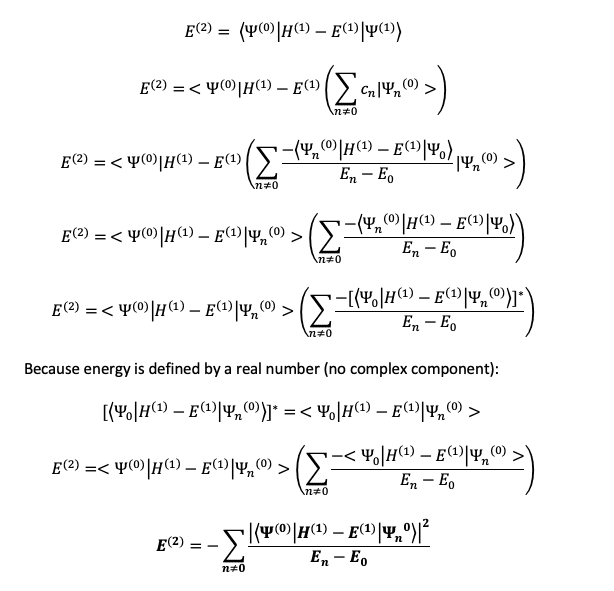
I'm struggling with the proof for the second order energy correction for perturbation theory when substituting in the first order wavefunction. I have attached an image of my current proof for it below, but I'm not sure whether this is the correct approach for it (the H's in the calculations below are hamiltonian operators)! I'm still quite new to using Dirac notation for these calculations so thought I should double-check it.

Cheers!
Screenshot 2020-03-28 at 13.10.16.png
 
Physics news on Phys.org
You seem to have the right idea. Be careful you don't take objects outside of sums when they have the sum index (you have done this in your derivation). Second, check your use of the complex conjugate.
##\langle\psi|\hat{A}|\chi\rangle^*=\langle\chi|\hat{A}^{\dagger}|\psi\rangle##
 
  • Like
Likes   Reactions: electrogeek and vanhees71
Thank you for the help! I've now got to this stage which I've attached below instead of taking the ket out of the summation like I did previously:

Screenshot 2020-03-28 at 15.39.06.png


But I'm confused why taking the complex conjugate of the first term in the numerator isn't just swapping around the terms in the bra and the ket?
 
Last edited:
Alright, good. I think you've ironed out the calculational problems.

electrogeek said:
But I'm confused why taking the complex conjugate of the first term in the numerator isn't just swapping around the terms in the bra and the ket?

When the operator sandwiched between the bra and ket is self-adjoint ##A^{\dagger}=A##, which is true for the Hamiltonians you are concerned with, then complex conjugating is "just swapping" the terms around. However, just because an operator is self-adjoint and has real eigenvalues that does not mean that a generic term ##\langle\psi|\hat{H}|\chi\rangle## is real.
 
Haborix said:
Alright, good. I think you've ironed out the calculational problems.
When the operator sandwiched between the bra and ket is self-adjoint $A^{\dagger}=A$, which is true for the Hamiltonians you are concerned with, then complex conjugating is "just swapping" the terms around. However, just because an operator is self-adjoint and has real eigenvalues that does not mean that a generic term ##\langle\psi|\hat{H}|\chi\rangle## is real.

Ah brilliant! Thank you very much for all the help. :)
 
  • Like
Likes   Reactions: Haborix
My pleasure, happy studying!
 

Similar threads

  • · Replies 3 ·
Replies
3
Views
1K
  • · Replies 5 ·
Replies
5
Views
1K
  • · Replies 10 ·
Replies
10
Views
2K
  • · Replies 1 ·
Replies
1
Views
1K
  • · Replies 3 ·
Replies
3
Views
2K
  • · Replies 2 ·
Replies
2
Views
2K
  • · Replies 14 ·
Replies
14
Views
2K
  • · Replies 18 ·
Replies
18
Views
4K
  • · Replies 7 ·
Replies
7
Views
3K
  • · Replies 1 ·
Replies
1
Views
749