Discussion Overview
The discussion revolves around the feasibility of using a CAT-5 LAN cable, specifically its 8 pairs, as an 800 ohm transmission line for a receiving antenna operating in the frequency range of 1 to 30 MHz. Participants explore theoretical implications, practical applications, and potential configurations for achieving this setup.
Discussion Character
- Exploratory
- Technical explanation
- Debate/contested
- Experimental/applied
Main Points Raised
- Some participants propose that wiring the 8 pairs of a CAT-5 cable in series could theoretically yield an 800 ohm impedance, but others express skepticism about the practical benefits of this arrangement.
- One participant clarifies that the CAT-5 cable consists of 4 twisted pairs, leading to a maximum impedance of 400 ohms if wired as suggested.
- Another participant discusses the intended use of the cable as a feed line for a receiving antenna, suggesting that a higher impedance feed line might reduce interference compared to a standard 50 ohm line.
- Concerns are raised regarding the internal configuration of the receiver, including the presence of a ferrite rod antenna and the implications for impedance matching.
- Some participants mention the importance of maintaining balanced transmission lines to minimize interference, while others question whether this balance can be achieved with the proposed setup.
- There is a discussion about the effect of capacitance from the new antenna and cable on the voltage, suggesting potential losses in signal strength.
- One participant suggests using coaxial cable with transformers to adapt impedance at both the antenna and receiver ends, while others propose using a counterpoise or ground plane to improve performance.
- Clarifications are made regarding the nature of transmission lines and their characteristic impedance, emphasizing that simply connecting multiple lines in series does not inherently change their impedance characteristics.
Areas of Agreement / Disagreement
Participants express a range of views on the effectiveness and practicality of using the CAT-5 cable as an 800 ohm transmission line. There is no consensus on whether this approach would yield better results than traditional methods, and several competing ideas and configurations are presented throughout the discussion.
Contextual Notes
Participants note limitations regarding the assumptions about impedance matching, the effects of nearby objects on transmission line performance, and the specific configurations of the receiver and antenna setup. The discussion remains open-ended with various unresolved technical details.
Who May Find This Useful
This discussion may be of interest to individuals involved in amateur radio, antenna design, or those exploring unconventional uses of standard networking cables in RF applications.
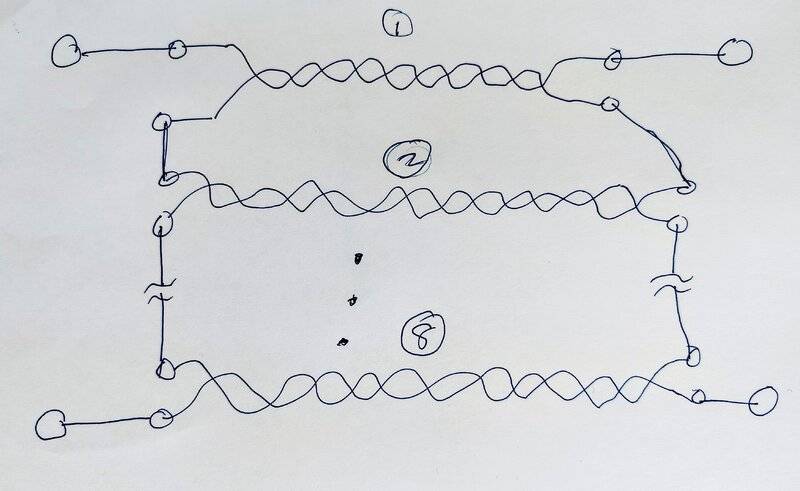

 . I didn't actually trace each wire from end to end, and I thought no one would.