Math Amateur
Gold Member
MHB
- 3,920
- 48
I am reading Susan Colley's book: Vector Calculus ... and am currently focussed on Section 8.1: An Introduction to Differential Forms ... ...
Colley, on page 491 in Example 3 gives a formula for a general 2-form as follows:
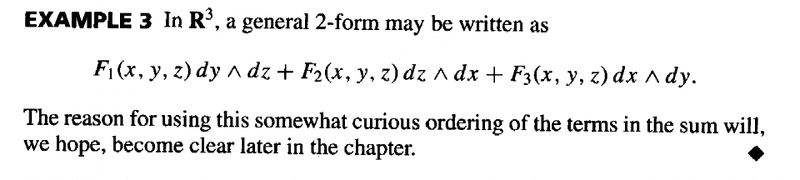 I am trying to understand what Colley describes as 'the somewhat curious ordering of the terms' ... ... with the terms [itex]dy \ \wedge \ dz , dz \ \wedge \ dx[/itex] and [itex]dx \ \wedge \ dy[/itex] occurring in that order ... ... ?... Now when Colley comes to defining a general differential k-form, not two pages further on from Example 3, we find (page 493):
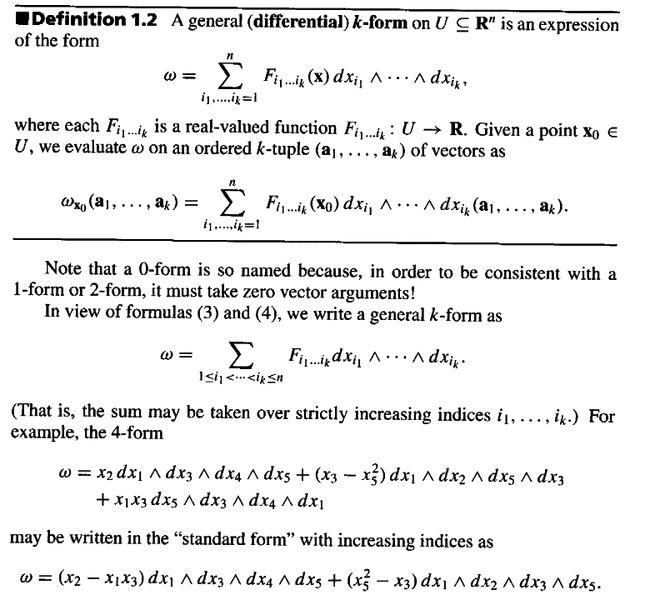 So ... from the general k-form above, for a general 2-form we have[itex]\omega = \sum_{ 1 \le i_1 \lt i_2 \lt 2 } F_{ i_1 i_2 } dx_{i_1} \ \wedge \ dx_{i_2}[/itex][itex]\omega = F_{12} \ dx_1 \ \wedge \ dx_2 \ + \ F_{13} \ dx_1 \ \wedge \ dx_3 \ + \ F_{23} \ dx_2 \ \wedge \ dx_3[/itex]or if we write [itex]x_1[/itex] as [itex]x[/itex], [itex]x_2[/itex] as [itex]y[/itex], and [itex]x_3[/itex] as [itex]z[/itex] then we have ... ...
[itex]\omega = F_{12} \ dx \ \wedge \ dy \ + \ F_{13} \ dx \ \wedge \ dz \ + \ F_{23} \ dy \ \wedge \ dz[/itex]How do we match this general form with that stated two pages earlier in Example 3 ...Hope someone can help ...
Peter
Colley, on page 491 in Example 3 gives a formula for a general 2-form as follows:
[itex]\omega = F_{12} \ dx \ \wedge \ dy \ + \ F_{13} \ dx \ \wedge \ dz \ + \ F_{23} \ dy \ \wedge \ dz[/itex]How do we match this general form with that stated two pages earlier in Example 3 ...Hope someone can help ...
Peter
Attachments


Last edited: