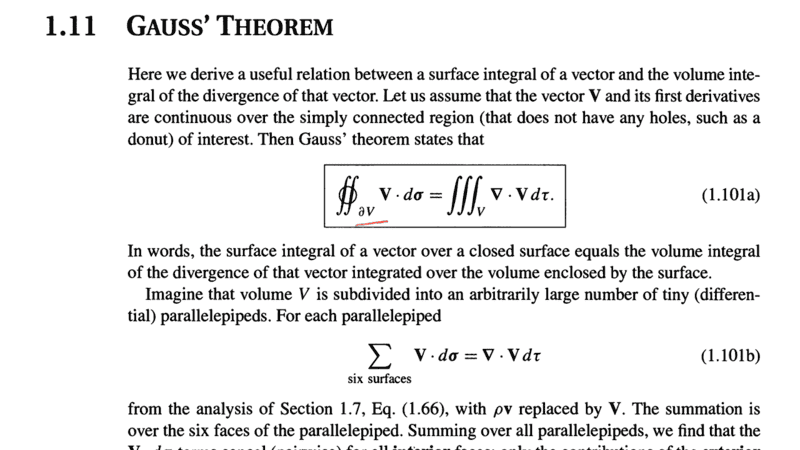
Why does Gauss' theorem use ∂V instead of S for the surface?

  • Context: High School 
  • Thread starter Thread starter Wrichik Basu
  • Start date Start date
  • Tags Tags
    Gauss Theorem
Join the discussion
Registration is free. Ask a follow-up in this thread, or start your own.
2 replies · 5K views
Science Advisor
Insights Author
Gold Member
Messages
2,188
Reaction score
2,694
I was reading the book "Mathematical Methods for Physicists", and in the first chapter, under Gauss's Theorem, the statement given was:

The surface integral of a vector over a closed surface equals the volume integral of the divergence of the vector over the entire closed surface.

But the in the mathematical form, ##\partial V## was used instead of ##S## to denote the surface integral.
20180427_130410.png


I could understand that ##\partial V## is the same as ##S##. Can anyone explain how?
 

Attachments

  • 20180427_130410.png
    20180427_130410.png
    35.8 KB · Views: 7,955
Physics news on Phys.org
Wrichik Basu said:
I was reading the book "Mathematical Methods for Physicists"
Always quote the author(s) as well as the book title when you quote something. There are many books with this title and similar and without the authors we cannot know which.

Wrichik Basu said:
The surface integral of a vector over a closed surface equals the volume integral of the divergence of the vector over the entire closed surface.
This is not correct. The integral of the divergence should be over the enclosed volume, not the surface.

For any volume ##V##, ##\partial V## denotes its boundary.
 
Orodruin said:
Always quote the author(s) as well as the book title when you quote something. There are many books with this title and similar and without the authors we cannot know which.

Authors are Arfken, Weber and Harris.

Orodruin said:
This is not correct. The integral of the divergence should be over the enclosed volume, not the surface
My mistake. In the book, it was written over the entire volume.

Orodruin said:
For any volume V, ∂V denotes its boundary.
Understood, thanks.