Lajka
- 68
- 0
Hi,
I have a problem understanding something
This is a snapshot of a book I am reading
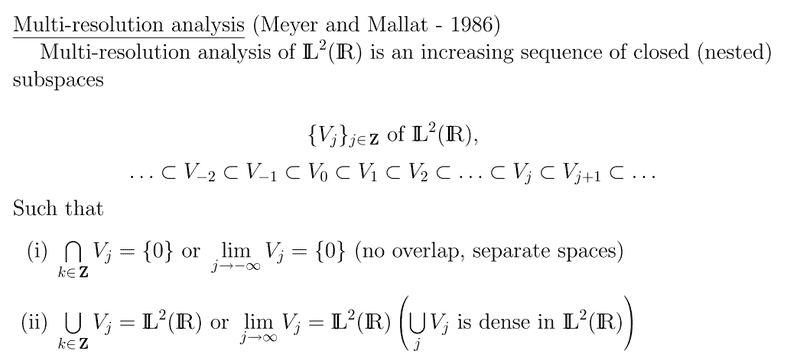
Point no. 2 concerns me, because it looks to me like it contradicts itself, with "this or this"
The first part says
[itex]\sum_{j}V_j = \mathbb{L^2(R)}[/itex] which, to me, looks completely equivavalent to
[itex]\lim_{j \rightarrow \infty}V_j = \mathbb{L^2(R)}[/itex]
given the nested nature of these subspaces.
However, the paper says

so what troubles me is this: is this countable union [itex]\sum_{j}V_j[/itex] equal to [itex]\mathbb{L^2(R)}[/itex] or is it only dense in [itex]\mathbb{L^2(R)}[/itex]?
I personally think it's the former, and I don't understand this "dense" part. Could someone perhaps clarify this for me?
Much obliged!
I have a problem understanding something
This is a snapshot of a book I am reading
Point no. 2 concerns me, because it looks to me like it contradicts itself, with "this or this"
The first part says
[itex]\sum_{j}V_j = \mathbb{L^2(R)}[/itex] which, to me, looks completely equivavalent to
[itex]\lim_{j \rightarrow \infty}V_j = \mathbb{L^2(R)}[/itex]
given the nested nature of these subspaces.
However, the paper says
so what troubles me is this: is this countable union [itex]\sum_{j}V_j[/itex] equal to [itex]\mathbb{L^2(R)}[/itex] or is it only dense in [itex]\mathbb{L^2(R)}[/itex]?
I personally think it's the former, and I don't understand this "dense" part. Could someone perhaps clarify this for me?
Much obliged!