A question about multiresolution analysis (from a topological point of view)

Click For Summary
SUMMARY

The discussion centers on multiresolution analysis in the context of topological spaces, specifically regarding the relationship between the countable union of subspaces \( \sum_{j}V_j \) and the space \( \mathbb{L^2(R)} \). Participants clarify that while \( \sum_{j}V_j \) is dense in \( \mathbb{L^2(R)} \), it does not equal \( \mathbb{L^2(R)} \) itself. The confusion arises from interpreting the limit of nested subspaces and the concept of density in functional analysis. Ultimately, the consensus is that the union of the subspaces approaches \( \mathbb{L^2(R)} \) but does not encompass it entirely.

PREREQUISITES
  • Understanding of multiresolution analysis
  • Familiarity with functional analysis concepts, particularly \( \mathbb{L^2} \) spaces
  • Knowledge of limits and convergence in mathematical analysis
  • Basic comprehension of topological spaces and their properties
NEXT STEPS
  • Study the properties of \( \mathbb{L^2(R)} \) spaces in detail
  • Learn about the concept of density in topological spaces
  • Explore the implications of nested subspaces in functional analysis
  • Investigate examples of multiresolution analysis in wavelet theory
USEFUL FOR

Mathematicians, students of functional analysis, and researchers interested in multiresolution analysis and its applications in signal processing and approximation theory.

Lajka
Messages
68
Reaction score
0
Hi,

I have a problem understanding something

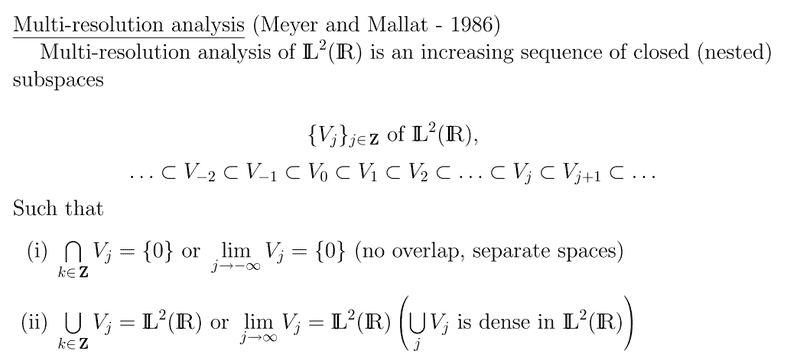
This is a snapshot of a book I am reading
NfBL7.png


Point no. 2 concerns me, because it looks to me like it contradicts itself, with "this or this"

The first part says

\sum_{j}V_j = \mathbb{L^2(R)} which, to me, looks completely equivavalent to
\lim_{j \rightarrow \infty}V_j = \mathbb{L^2(R)}
given the nested nature of these subspaces.

However, the paper says

1F4KF.png


so what troubles me is this: is this countable union \sum_{j}V_j equal to \mathbb{L^2(R)} or is it only dense in \mathbb{L^2(R)}?

I personally think it's the former, and I don't understand this "dense" part. Could someone perhaps clarify this for me?

Much obliged!
 
Physics news on Phys.org
Yes, it does. I had trouble understanding it, but I think I make some progress. I actually think now I may got it wrong from the very beginning.

E.g., if you have a family of functions {f_n} that has a limit f, I think it's okay to say that "lim(n→∞)=f" as well as "family {f_n} can approach arbitrarily close to f", because it's basically the same statement.

In the same manner, I now think it's equivalent to say "lim(n→∞) V_n = L2 (R)" or "union V_n can approach arbitrarily close to L2 (R)".
 

Similar threads

  • · Replies 20 ·
Replies
20
Views
4K
  • · Replies 8 ·
Replies
8
Views
3K
  • · Replies 0 ·
Replies
0
Views
322
  • · Replies 3 ·
Replies
3
Views
3K
  • · Replies 1 ·
Replies
1
Views
3K
  • · Replies 6 ·
Replies
6
Views
2K
  • · Replies 2 ·
Replies
2
Views
3K
  • · Replies 4 ·
Replies
4
Views
3K
  • · Replies 5 ·
Replies
5
Views
4K
  • · Replies 2 ·
Replies
2
Views
2K