oXDawidXo
- 5
- 0
Hi!
Well, I have a problem, I'm writing Extended Project For Applied Science about Death of the Universe, I am stuck. I am really desperate so I decided to put it on forum.
First:
The Universe is accelerating so, according to Lorentz's Factor, its mass should be increasing
[tex] m = \gamma m_{0} = \frac {m_{0}} { \sqrt{1-v^{2}/c^{2}} }[/tex]
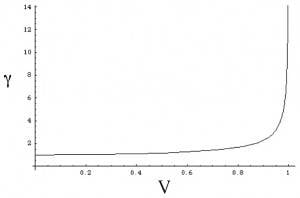
Because this graph is an asymptote, the mass of expanding universe starts to go up rapidly after about 0.95c (95% of the light's speed). Mass increases gravity forces between galaxies. The universe cannot expand faster than light, so I suppose as the universe continues expanding the mass eventually will reach a point where the relativistic mass creates so big gravity force that it will stop the universe from accelerating. Will the expansion slow down, will it just keep expanding with constant speed or what?
Second:
Dark energy is a form of potential energy which causes the accelerating universe, so the potential energy must be turning into kinetic one, so eventually all potential energy will be turned to the kinetic one and if there is no source in dark energy the gravity will be dominant force in the universe and that leads to big crunch, doesn't it?
The thing is that I can't find neither any resources to prove those theories nor any mistakes in them myself.
Any comments are welcome ;D
PS I'm sorry for errors, I'm not English
Well, I have a problem, I'm writing Extended Project For Applied Science about Death of the Universe, I am stuck. I am really desperate so I decided to put it on forum.
First:
The Universe is accelerating so, according to Lorentz's Factor, its mass should be increasing
[tex] m = \gamma m_{0} = \frac {m_{0}} { \sqrt{1-v^{2}/c^{2}} }[/tex]
Because this graph is an asymptote, the mass of expanding universe starts to go up rapidly after about 0.95c (95% of the light's speed). Mass increases gravity forces between galaxies. The universe cannot expand faster than light, so I suppose as the universe continues expanding the mass eventually will reach a point where the relativistic mass creates so big gravity force that it will stop the universe from accelerating. Will the expansion slow down, will it just keep expanding with constant speed or what?
Second:
Dark energy is a form of potential energy which causes the accelerating universe, so the potential energy must be turning into kinetic one, so eventually all potential energy will be turned to the kinetic one and if there is no source in dark energy the gravity will be dominant force in the universe and that leads to big crunch, doesn't it?
The thing is that I can't find neither any resources to prove those theories nor any mistakes in them myself.
Any comments are welcome ;D
PS I'm sorry for errors, I'm not English
Last edited: