Airplane question -- How to compensate for losing engine power on one wing....
Click For Summary
The discussion centers on the aerodynamic adjustments required when an aircraft loses engine power on one wing, specifically addressing the need for rudder, elevator, and aileron inputs. When the right engine fails, immediate corrective action involves applying left rudder to counteract yaw and potentially adjusting the elevator to maintain altitude. The conversation references the complexities of flight dynamics, particularly in scenarios similar to the Southwest Airlines Flight 1380 incident, where engine failure led to significant control challenges. Participants emphasize the importance of understanding the interactions between thrust loss and aircraft attitude to ensure safe flight operations.
PREREQUISITES- Understanding of basic flight dynamics and control surfaces
- Familiarity with aircraft systems, including rudder and elevator functions
- Knowledge of engine failure scenarios and their impact on flight
- Experience with flight simulation tools like X-Plane
- Research the aerodynamic principles of yaw and roll in multi-engine aircraft
- Study the flight data analysis from incidents like Southwest Airlines Flight 1380
- Learn about the operational procedures for engine-out scenarios in commercial aviation
- Explore flight simulation techniques to practice engine failure recovery
Aerospace engineers, flight instructors, pilots, and aviation enthusiasts interested in understanding aircraft control during engine failure scenarios.

- 11,326
- 8,754
- 6
- 0
- 23,792
- 11,227
I think if you talk through what happens to the plane when one engine loses power, it will help. So what, exactly, happens? I can think of two primary effects and one secondary.
- 2,001
- 612
- 6
- 0
- 23,792
- 11,227
I don't agree that that's the only response. In addition to creating a yaw, losing an engine means losing thrust. That means throttling up and up elevator to compensate.cjl said:...the only necessary immediate response would be left rudder.
Then as a secondary effect, the right yaw also causes right roll, which may need to be countered by left aileron.
It's a complicated series of interactions.
- 2,001
- 612
- 69,332
- 24,641
https://www.cnn.com/2018/04/18/us/southwest-emergency-landing/index.html
Attachments

- 11,326
- 8,754
berkeman said:It would be interesting to see the data from the Fight Data Recorder of Southwest Airlines Flight 1380 when its engine exploded.
Not quite Flight 1380, but here's a similar event. Pay no attention to the Russian labels, it is labelled in English on the left.
Note that the fan blade breaking did not immediately shut down the engine. I have not seen that detail yet on the 1380 news reports.
http://www.b737.org.uk/incident_vq-bjp.htm said:About 13 minutes into the flight, as the aircraft was climbing through 28,300 feet, a fan blade failed in the left engine, resulting in severe vibration and a series of engine stalls and surges. An outer portion of a fan blade had failed and separated, causing severe damage to the entire fan section. The fan blade failure was the result of a blade vibratory instability, referred to as blade flutter, which initiated in the engine fan blade at a specific combination of high thrust and flight conditions.
The aircraft immediately experienced a high level of airframe vibration which was felt in the flight deck by the crew and in the cabin by the flight attendants and passengers. The crew also smelled fire and air conditioning smoke in the flight deck. No visual or aural alerts accompanied the failure.
As a result of the fan blade failure, the left engine began operating erratically. The automatic throttle (auto-throttle) system was at this point still engaged and active, commanding the engine to maintain the target thrust that had been set for the climb. The flight data recorder (FDR) indicated fluctuations in the left engine parameters. The FDR also indicated that the right engine continued stable operation. The fan speed (N1) for the left engine fluctuated and indicated a lower value than the right engine. Exhaust gas temperature (EGT) for the left engine was about 100ºC higher than the right engine EGT, with an eventual peak difference of about 125ºC. Fuel flow for the left engine dropped and fluctuated. The airborne vibration monitor (AVM) for the left engine indicated five units, the maximum indication on the gage. While the right engine AVM was less than one unit and stable.
About eight seconds after the fan blade failure, the captain took control of the aircraft and disengaged the autopilot. During the investigation he stated that he had looked at the engine displays but did not gain any indication of the source of the problem
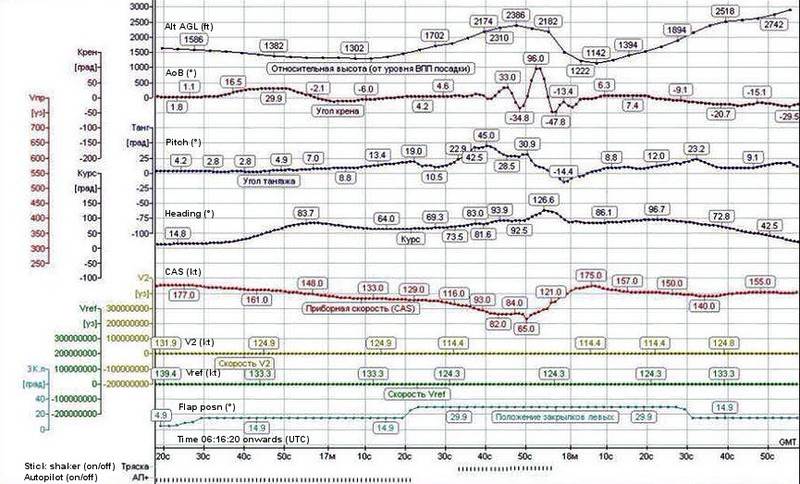
I don't know what the curve AoB(*) is. CAS means computed air speed.
Despite the similarities, the Flight 1380 evolution sounds very different than this one.
Attachments

- 334
- 208
anorlunda said:I don't know what the curve AoB(*) is. CAS means computed air speed.
It's always hard to tell with undefined acronyms but it is probably Angle of Bank. It jives with the changes in heading.
- 23,792
- 11,227
Good point. The OP was asking about maintaining straight and level flight, but depending on the specifics of the scenario that may not be possible/desirable. Still, I'm not sure how fast the plane will pitch over on its own vs the need to pitch-over faster, but for example in "The Miracle on the Hudson", they kept climbing for 18 seconds after impact and loss of both engines, in a situation where decending was ultimately necessary. I'm not sure if the lost of thrust was instantaneous, but that seems like a lot given that they were in a relatively low speed situation to begin with. They did end up dropping a little below their optimal glide speed though before finding the right attitude.cjl said:If anything, it means throttle up and down elevator - up elevator in response to a loss of thrust is just asking for a stall condition to develop.
And also due to loss of airspeed itself. I really don't know though how fast it will pitch-over on its own...unless X-Plane flight simulator is accurate...This is somewhat countered however by the fact that with underwing engines, the thrust is very loosely coupled to pitch, and a loss of thrust would naturally cause a pitch down moment anyways.
Fair enough.As you said, it is a complicated series of interactions, which is why I used the word immediate - I think you'd be pretty safe with an immediate left rudder, followed by a further evaluation and likely more inputs after that.
- 23,792
- 11,227
berkeman said:It would be interesting to see the data from the Fight Data Recorder of Southwest Airlines Flight 1380 when its engine exploded. It sounds like it banked pretty hard and quickly (not sure if it was just the loss of power that caused that, or maybe the shrapnel interfering with flight control surfaces...
I noticed that too, and the information we get from the media on this is frustratingly thin. They focus on the "human" stories (they wore the masks wrong!) and probably don't ask the right questions to find out what happened. We'll just have to wait for the official reportanorlunda said:Note that the fan blade breaking did not immediately shut down the engine. I have not seen that detail yet on the 1380 news reports.
I was surprised by the report that it banked 41 degrees and I'm very curious to find out why - as "emergencies" go, loss of an engine is actually a pretty mundane issue (depressurization is more serious). I wouldn't have expected the thrust differential/yaw to cause that much roll, but I don't really know. Damage to the control surfaces or just a loss of lift caused by damage is a possibility. Another, perhaps more serious possibility, could be the human/automation interface failing. Human-computer interaction (unclear automation level, data interpretation or rough hand-off) has been a contributing factor to a significant fraction of recent crashes (perhaps even most of them) -- similar to some of the issues recently with self-driving cars.
If the computer detects a problem and immediately decides it needs to hand over control to the pilots, the pilots may be pre-occupied in figuring out what is happening to the engine and miss the hand-off or take a couple of extra seconds to respond while they are assessing the situation, which is plenty of time for a 41 degree roll. Perhaps even worse, the assessments the people do may take seconds whereas the computer might have the issue figured out in miliseconds. So you may have a situation where a computer that knows what is going on - and how to deal with it(at least better than the human) - is nevertheless handing over control to someone who doesn't yet know what is going on!
I believe in The Miracle On the Hudson the pilots were in control through the whole event (possible exception; autothrottle) because they had just taken off, whereas I assume the Southwest plane was on full autopilot since it was cruising.
- 11,326
- 8,754
russ_watters said:I was surprised by the report that it banked 41 degrees
I agree. The reason is not obvious. But here's a speculation: there was damage to the leading edge of the wing on the side of the failed engine. That might have caused a spike in drag and decrease in airlift. A second speculation: some of that missing engine cowling might have remained fastened for one or two seconds, causing a deflecting force until it broke off. It might be very difficult for investigators to be certain of the exact details.
- 4,195
- 2,201
A nose down only steep dive and the planes wings tear off, or the passengers run out of oxygen.
How long do the oxygen bottles last for the drop down masks?
I would tend to think that the large banking comes from pilot training under these circumstances for depressurization.
- 23,792
- 11,227
Maybe, but it is itself a dangerous and stressful maneuver for a damaged airplane. I was surprised at how slow the descent was; I think I read 4,000 fpm. That's only about 4 degrees of down pitch at cruising speed.256bits said:isn't the bank a way to loose airspeed quickly for as fast a descent as possible and still keep the plane flying.
A nose down only steep dive and the planes wings tear off, or the passengers run out of oxygen.
About 15 min. They sound like the same solid chemical oxygen generators used by the Navy for escape purposes.How long do the oxygen bottles last for the drop down masks?
- 23,792
- 11,227
- 847
- 259
I wouldn't pull up as an initial response, but if remaining good engine(s) cannot supply enough thrust to maintain level flight then up elevator trim will halt the descent if you're able to stay above minimum control speed.cjl said:If anything, it means throttle up and down elevator - up elevator in response to a loss of thrust is just asking for a stall condition to develop.
- 2,055
- 989
russ_watters said:One significant issue is that unless I'm missing it, there is no turn and slip indicator, so I can't tell how fast its yawing until I level off
I believe slip indication is combined into the bank angle indicator on the ADI (the hollow up pointing triangle that indicates bank angle relative to the zero bank reference solid down triangle). Slip should be indicated as a horizontal offset from the pitch ladder. Slip angles are less at high (cruise) so slip indication it is barely noticeable, but if you try the experiment again at speeds nearer the stall limit it should be much more visible.
Also, readers of this thread may be interested to read about the concept of minimum control speed [1].
[1] https://en.wikipedia.org/wiki/Minimum_control_speeds
- 2,055
- 989
anorlunda said:CAS means computed air speed.
Actually, it means calibrated airspeed [1] which is sort of an intermediate corrected airspeed in between indicated (IAS) and true (TAS) airspeed. IAS and CAS numbers in reports usually means airspeed derived from air data alone, whereas TAS is derived from altitude and INS/GPS and can also be indicated in modern glass cockpits. Since most dynamical effects on an aircraft is related more to IAS and CAS than TAS, the latter is not that useful. The Mach ratio, however, is interesting at high speeds due to the effects of flutter, so usually CAS indication is good for low speeds and M indication is good for high (cruise) speeds.
[1] https://en.wikipedia.org/wiki/Calibrated_airspeed
- 11,326
- 8,754
Filip Larsen said:Actually, it means calibrated airspeed
I stand corrected. Thanks.
- 54
- 11
- 11,326
- 8,754
Tom Kunich said:Curious - aren't you aware that engines on aircraft are placed so that the failure of one engine (or in the case of four engine aircraft TWO on the same wing) can be balanced with ailerons and rudder?
I think that is what this whole thread is about ailerons/rudder/elevators/throttle.
- 54
- 11
I guess that what I was getting at is that your example of a pencil held above or below the center of mass was a little naive. It is more like the pencil laying on its side and the center of lift is also widely spaced. This forms a combination with a very slow rotation which is easily offset with only slight control surface actions. The larger and/or faster the aircraft the less control surface actions are required.anorlunda said:I think that is what this whole thread is about ailerons/rudder/elevators/throttle.
- 11,326
- 8,754
Tom Kunich said:I guess that what I was getting at is that your example of a pencil held above or below the center of mass was a little naive.
Huh? I just searched this thread. Neither I nor anyone else mentioned the word pencil. What are you talking about?
- 69,332
- 24,641

- 54
- 11
Commercial aircraft and military aircraft are designed to fly on a single engine. It isn't as if the Wright Bros. were last year.russ_watters said:Good point. The OP was asking about maintaining straight and level flight, but depending on the specifics of the scenario that may not be possible/desirable. Still, I'm not sure how fast the plane will pitch over on its own vs the need to pitch-over faster, but for example in "The Miracle on the Hudson", they kept climbing for 18 seconds after impact and loss of both engines, in a situation where decending was ultimately necessary. I'm not sure if the lost of thrust was instantaneous, but that seems like a lot given that they were in a relatively low speed situation to begin with. They did end up dropping a little below their optimal glide speed though before finding the right attitude.
And also due to loss of airspeed itself. I really don't know though how fast it will pitch-over on its own...unless X-Plane flight simulator is accurate...
Fair enough.
- 23,792
- 11,227
I'm aware...I'm not sure how that relates to what you quoted.Tom Kunich said:Commercial aircraft and military aircraft are designed to fly on a single engine. It isn't as if the Wright Bros. were last year.
- 91
- 22
You have lost force on one side. You will need opposite rudder to compensate.
In a prop plane you lose some lift from having the engine air moving over the wing. Probably need to bank away from the dead engine.
In a jet with under mounted engines the nose will drop some.
A prop plane without feathering props will have yet more drag.
Landing a two engine prop plane on one engine is exciting. The plane is moving crab wise. Much like landing in a really stiff cross wind.
Similar threads
- Replies
- 18
- Views
- 4K
- · Replies 81 ·
- Replies
- 81
- Views
- 12K
- Replies
- 6
- Views
- 2K
- · Replies 21 ·
- Replies
- 21
- Views
- 2K
- · Replies 27 ·
- Replies
- 27
- Views
- 2K
- · Replies 8 ·
- Replies
- 8
- Views
- 3K
- · Replies 25 ·
- Replies
- 25
- Views
- 5K
- · Replies 18 ·
- Replies
- 18
- Views
- 2K
- · Replies 3 ·
- Replies
- 3
- Views
- 2K
- · Replies 52 ·
- Replies
- 52
- Views
- 7K