Algebraic Extensions - Dummit and Foote, Propn 11 and 12 ....

  • Context: Undergrad 
  • Thread starter Thread starter Math Amateur
  • Start date Start date
Click For Summary

Discussion Overview

The discussion revolves around the interpretation of Propositions 11 and 12 from Dummit and Foote's Chapter 13 on Field Theory, specifically regarding algebraic extensions and the degrees of polynomials associated with algebraic elements. Participants seek clarification on how these propositions relate to each other and the implications for algebraic elements in field extensions.

Discussion Character

  • Technical explanation
  • Debate/contested

Main Points Raised

  • Peter questions the consistency between Proposition 11, which states that the degree of the extension ##[ F( \alpha ) : F ]## equals the degree of the minimum polynomial, and Proposition 12, which suggests that an algebraic element ##\alpha## satisfies a polynomial of degree at most ##n## over ##F##.
  • One participant explains that the proof of the finiteness of the extension does not require knowing the exact degrees, emphasizing that the key point is that ##\alpha## is algebraic over ##F## and satisfies some polynomial equation of degree ##n##, without needing it to be minimal or irreducible.
  • Another participant suggests that the confusion arises from the use of the same symbol ##\alpha## for different elements, proposing that a different symbol like ##\beta## could clarify that some elements in the extension have different degrees based on their relationship to ##F##.

Areas of Agreement / Disagreement

Participants express differing interpretations of the propositions, indicating that there is no consensus on how to reconcile the statements made in Propositions 11 and 12. The discussion remains unresolved regarding the implications of these propositions for algebraic elements in field extensions.

Contextual Notes

There is a potential ambiguity in the notation used for algebraic elements, which may lead to confusion about the degrees of the polynomials involved. The discussion highlights the importance of distinguishing between different elements in the context of field extensions.

Math Amateur
Gold Member
MHB
Messages
3,920
Reaction score
48
I am reading Dummit and Foote, Chapter 13 - Field Theory.

I am currently studying Section 13.2 : Algebraic Extensions

I need some help with an aspect of Propositions 11 and 12 ... ...

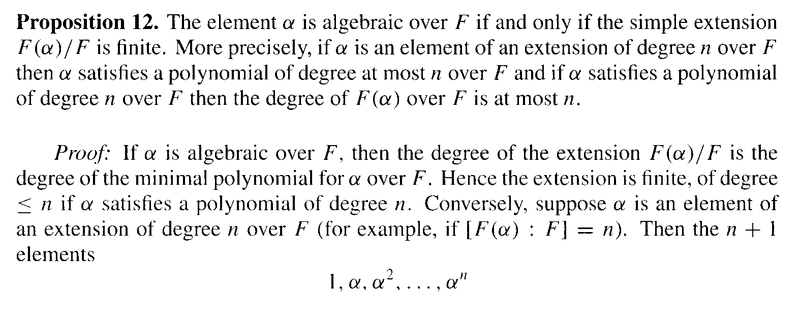
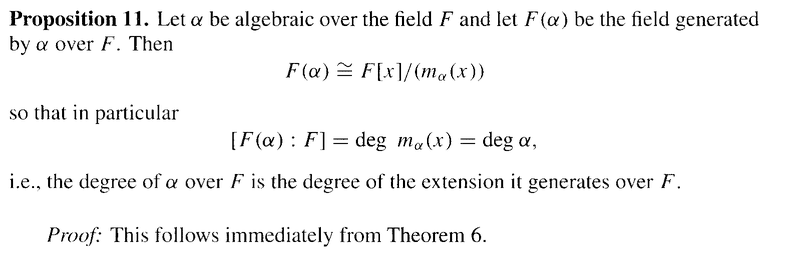
Propositions 11 and 12 read as follows:
?temp_hash=ac968ff0459293f20fcaa42ff7c4b239.png

?temp_hash=ac968ff0459293f20fcaa42ff7c4b239.png


Now Proposition 11 states that the degree of ##F( \alpha )## over ##F## is equal to the degree of the minimum polynomial ... ... that is

##[ F( \alpha ) \ : \ F ] = \text{ deg } m_\alpha (x) = \text{ deg } \alpha##... ... BUT ... ...... ... Proposition 12 states that ... "if ##\alpha## is an element of an extension of degree ##n## over ##F##, then ##\alpha## satisfies a polynomial of degree at most ##n## over ##F## ... ... "Doesn't Proposition 11 guarantee that the polynomial (the minimum polynomial) is actually of degree equal to ##n##?Can someone please explain in simple terms how these statements are consistent?Help will be appreciated ...

Peter
 

Attachments

  • D&F - Proposition 11, Chapter 13 ....png
    D&F - Proposition 11, Chapter 13 ....png
    18.6 KB · Views: 547
  • D&F - Proposition 12 and start of proof, Chapter 13 ....png
    D&F - Proposition 12 and start of proof, Chapter 13 ....png
    29.5 KB · Views: 437
Physics news on Phys.org
I read it as follows:
  1. In order to prove (##\alpha ## algebraic ##\Rightarrow \, F(\alpha) /F## finite), we don't care exact degrees.
  2. The authors mentioned, that ##\deg [F(\alpha):F] = \deg m_\alpha(x)##.
  3. In the direction of the proof which you quoted, all we have is that ##\alpha## is algebraic over ##F##. This means it satisfies some polynomial equation of degree ##n##. This polynomial doesn't need to be minimal, irreducible nor has ##\alpha ## to be outside of ##F##. That it is of finite degree is all that counts. We simply don't bother more than that.
 
  • Like
Likes   Reactions: Math Amateur
This one is easier than your usual challenges!

The trouble arises because the ##\alpha## in the second sentence is not necessarily the same as the one in the first sentence. It might have been clearer if they'd used ##\beta## instead of ##\alpha## in the second and subsequent sentences.

Let the extension of interest be ##F(\alpha) / F## where ##\alpha## is the root of an irreducible quadratic in ##F[x]##.
Consider a ##\beta## that is in ##F##. That ##\beta## is also in the extension. But it is a root of the degree-1 ##F[x]## polynomial ##x-\beta##.

On the other hand, ##\alpha## is also in the extension, and the minimal polynomial for that has degree two.

So some elements of the extension (the ones that are not already in ##F##) have degree two, and some (those that are in ##F##) have degree one.
 
  • Like
Likes   Reactions: Math Amateur
Thanks fresh_42 and Andrew ... appreciate your help ...

Still thinking over what you have said ...

Peter
 

Similar threads

Replies
2
Views
2K
  • · Replies 4 ·
Replies
4
Views
3K
  • · Replies 5 ·
Replies
5
Views
3K
Replies
2
Views
2K
  • · Replies 12 ·
Replies
12
Views
3K
  • · Replies 4 ·
Replies
4
Views
2K
  • · Replies 2 ·
Replies
2
Views
2K
  • · Replies 5 ·
Replies
5
Views
3K
Replies
2
Views
2K
Replies
6
Views
2K