Alien life, probabilities, and interstellar propagation of human life

  • Thread starter Thread starter mr3000
  • Start date Start date
Click For Summary
SUMMARY

The discussion centers on the improbability of life originating on Earth just once in 4.5 billion years, suggesting that abiogenesis may be rarer than the vast number of planets in the universe. Participants reference the Fermi Paradox, questioning the absence of evidence for extraterrestrial life despite the high likelihood of its existence. Key points include the lack of understanding of abiogenesis mechanisms and the possibility that life may be confined to Earth. Professor David Kipling's lectures are mentioned as a resource for further exploration of these concepts.

PREREQUISITES
  • Understanding of abiogenesis and its implications for the origin of life
  • Familiarity with the Fermi Paradox and its significance in astrobiology
  • Knowledge of the concept of panspermia and its role in life propagation
  • Basic awareness of theories regarding the origin of life, such as the RNA world hypothesis and deep-sea vent theories
NEXT STEPS
  • Research abiogenesis mechanisms and current theories in astrobiology
  • Explore the Fermi Paradox in depth, including its implications for extraterrestrial life
  • Investigate the RNA world hypothesis and its relevance to the origin of life
  • Examine the role of hydrothermal vents in the emergence of early life forms
USEFUL FOR

Astrobiologists, researchers in evolutionary biology, and anyone interested in the origins of life and the search for extraterrestrial intelligence will benefit from this discussion.

  • #151
DaveC426913 said:
Watercraft?
LOL. It looks like a copy-paste auto spell correct issue or something. Going to one of the links in that first page shows a more correct quote:
Under the circumstances, gram-scale spacecraft that rely on directed-energy propulsion (aka. lasers) appear to be the only viable option for reaching neighboring stars in this century. Proposed concepts include the Swarming Proxima Centauri, a collaborative effort between Space Initiatives Inc. and the Initiative for Interstellar Studies (i4is) led by Space Initiative's chief scientist Marshall Eubanks. The concept was recently selected for Phase I development as part of this year's NASA Innovative Advanced Concepts (NIAC) program.
https://www.universetoday.com/artic...al-to-swarm-proxima-centauri-with-tiny-probes
 
Physics news on Phys.org
  • #152
DaveC426913 said:
"At present, the only method for travelling from one star system to the next within a human lifetime is directed-energy watercraft equipped with lightsails are accelerated by laser arrays to relativistic speeds


Watercraft?
1767557579287.webp
 
  • Haha
  • Like
Likes   Reactions: berkeman, DaveC426913 and BillTre
  • #153
Where the girls?
Need them for making any population increases.
Also TV is lacking.
 
  • #154
BillTre said:
Where the girls?
Need them for making any population increases.
Also TV is lacking.
Better?

1767559310203.webp
 
  • Haha
  • Wow
Likes   Reactions: berkeman, DaveC426913, javisot and 1 other person
  • #155
  • #156
BWV said:
Better?
If I could vote again, I would vote for you to win in every category😂
 
  • #157
Great. Our cosmic legacy:
1767562555969.webp
 
  • Haha
  • Like
Likes   Reactions: berkeman, javisot and BWV
  • #158
DaveC426913 said:
Great. Our cosmic legacy:
View attachment 368628
Well, they would probably practicing recombinant genetics to adapt to different environments.
But, beer always (the essence of being human).
 
  • Like
Likes   Reactions: javisot
  • #159
sbrothy said:
Using hollowed out asteroids is probably the most feasible method,
When several times the mass of an asteroid is needed for reaction mass just to push an asteroid to modest delta-v such as moving around within the solar system requires it doesn't sound feasible for any kind of space travel, let alone interstellar travel.

Any excess mass is problematic... even the mass of what is essential is problematic. And the mass needed to sustain a stripped to barest essentials an advanced industrial economy needs, even pared down and most of it in a 'mothballed' state, seems likely to be very large.

And there are the motivations. I think it makes interesting thought experiment and optimistic fiction for fun but I for one see nothing imperative about such ambitions; there is no need.

I think there may be something primitive or lacking for a species to have an insatiable need to spread forever, all the way to coveting whole galaxies, like we can never have enough and can never be satisfied. I suspect the popular appeal of these kinds of speculative fictions is less about logic and reason than more basic urges (deadly sins?) that are not necessarily good to indulge to that degree - lead us to the promised land, yay. With failure the fault of the non-believers that fail to support or outright oppose using their taxes to try?

I can't see questioning these ambitions as problematic or as failures of imagination or ambition or some kind of excess of pessimism and negativity; they have to be approaching feasibility first.
 
  • #160
Ken Fabian said:
When several times the mass of an asteroid is needed for reaction mass just to push an asteroid to modest delta-v such as moving around within the solar system requires it doesn't sound feasible for any kind of space travel, let alone interstellar travel.
All solutions are compromises for competing needs.

The hollow asteroid solution prioritizes
  • comfort,
  • robust, sustainable eco-systems,
  • biological, social and communal diversity,
  • living area,
  • radiation-protection.
In short, it prioritizes the well-being of the occupants, who - not to put too fine a point on it - will live out their entire lives in it.

It de-prioritizes
- speed,
- a quick transit to some other home,
- a return trip.

It is a valid solution, especially in light of the concerns raised in this thread, such as
- near-Earth gravity,
- low density population,
- going crazy cooped up in a tin can
- etc.

The asteroid is their home - and a comfy one - not just a vehicle. The lives of many denizens will be fulfilled internally, without ultimately having to focus only on a destination they will never see.

In practical terms, it is the closest solution to how we live now. That mitigates a lot of unknowns in biology and sociology.
 
Last edited:
  • #161
Ken Fabian said:
Any excess mass is problematic... even the mass of what is essential is problematic.
Only if you prioritize speed.

An ion thuster might only achieve micro-acceleration. It might take millennia to get somewhere, but the key to this solution is that "getting somewhere else" is lower priority than "making sure they live and breed and are happy and don't kill each other".

Ken Fabian said:
I think there may be something primitive or lacking for a species to have an insatiable need to spread forever, all the way to coveting whole galaxies, like we can never have enough and can never be satisfied.
This may be a naive view on civilizations. Hard to tell. Ask an economist.

The need to spread is not necessarily a psychological issue. We need resources, we need jobs. I doubt a society can last in the long term without expansion.
 
  • #162
Ken Fabian said:
I think there may be something primitive or lacking for a species to have an insatiable need to spread forever, all the way to coveting whole galaxies, like we can never have enough and can never be satisfied. I suspect the popular appeal of these kinds of speculative fictions is less about logic and reason than more basic urges (deadly sins?) that are not necessarily good to indulge to that degree - lead us to the promised land, yay. With failure the fault of the non-believers that fail to support or outright oppose using their taxes to try?
This sounds like the difference between a K selected species and an n selected species.
Generally, a K selected species invest more into complex life form well adapted to its particular environment. An n selected species will have more general and less specific adaptations and will produce more offspring/generation. Sophisticated predators vs. simple rapidly reproducing weeds would be a possible example.
From an evolutionary view it is not necessarily primitive. Primitive would usually refer to a taxa's position in a phylogeny (higher or lower) wrt some other taxa. Taxa = a taxonomic group like a species (plural is taxon).
The general operating principle of a n selected species would be to "to spread forever". K's would produce a few offspring and invest a lot into their development to reproductive adults.
 
  • #163
No need to carry much fuel for propulsion - assuming that the ability to build a 58km long ship in orbit comes from robots, not men in suits, why can’t they build an arbitrarily powerful laser(s) in our solar system and send unmanned ships to build the same in in the destination system for deceleration then rely on a light sail?
 
  • #164
DaveC426913 said:
The need to spread is not necessarily a psychological issue. We need resources, we need jobs. I doubt a society can last in the long term without expansion.
So we have something in common with viruses.
 
  • #165
DaveC426913 said:
Only if you prioritize speed.
Speed is to some extend life in interstellar travel.

You have to consider that for crewed interstellar travel, lower speed means longer transfer times, which again means no matter how tightly closed you make the onboard ecosystem you will need to bring more energy to support life (minimum, say, 1kW per human), since most of the travel time will be spend far away from solar power. For a continues burn design, i.e. one where there is no or only very short coast phase before turn-around, the power needed for life support can likely be include as a fraction of the propulsion power, but for long coast phase designs you need to include life support energy separately. For example, the winning concept design mentioned earlier in this thread uses a fully separate fuel system for the habitat module.

Or in other words, each design for crewed interstellar transport likely has an upper limit to how long the transit can take based on various factor, with the amount of life support fuel being one of limiting factors. Alternatives for this specific limit (that I am aware of) include beaming energy from the solar system (with high risk if we want to ensure millennia of continuous operation) or extracting energy from the interstellar medium (with risk based on the actual densities of the chemical species encountered).
 
  • Agree
Likes   Reactions: PeroK
  • #167
Filip Larsen said:
Speed is to some extend life in interstellar travel.
Also, the target planet would change significantly if it takes us 100,000 years to get there. And, the technology itself will be overtaken (many times over) by new technology back on Earth. Unless it's a desperate last-ditch effort!

This is the difference between a sci-fi story, where you can pick and choose what you want to think about; and, a real project to colonize a distant planet.

This is also why the sci-fi enthusiasts want to have live humans living and breeding onboard - because that's better for a story. The crew falling in love, fighting, getting up to mischief. Whereas, in reality, that's the last thing you need.

Alien is one of my favourite films. But, if Ash could do what he did, why have a human crew at all? The same in Aliens II - we still have good old-fashioned, human commandos. Really? When we have mastered interstellar travel? It's good cinema, but it makes no sense if you put on a serious science hat. Warfare here on Earth is increasingly drone-based. Automated warfare between machines is likely to come even before we have set foot on Mars.

To be brutal, that is the the nature of the debate on this thread. One side of the argument coming from the sci-fi tradition; and, the other side trying to imagine the future based on plausible engineering realities.
 
  • Like
Likes   Reactions: Filip Larsen and javisot
  • #168
Imagining ourselves in the future having reached the technological limit is analogous to imagining ourselves in the future having reached AGI.

Obviously, a technological limit exists, ultimately dependent on the laws of physics. But we don't know what that limit is, nor can we determine what our civilization would be like if we had reached it.

It may be that having reached the technological limit we will not be able to colonize other planets, or perhaps we will.
It may be that having reached this limit we no longer need to colonize other planets, or perhaps we do.

I simply want to point out that the concept of "technological limit achievable by humans in the future" can be a source of confusion due to ambiguity.
 
  • #169
Within the next few decades we have a good shot at finding strong evidence of extraterrestrial life by analyzing atmospheres of exoplanets for biomarkers and even signs of industrialization such as CFCs and NO2.
 
  • #170
Diagtechpro said:
While life may arise easily under the right conditions ((abiogenesis)), the spread of intelligent life—especially human life—between stars faces enormous technological, biological, and ethical challenges ((panspermia)).
What you said, and I agree with it, is equivalent to "abiogenesis is very probable, panspermia is very improbable."
 
  • #171
PeroK said:
Also, the target planet would change significantly if it takes us 100,000 years to get there. And, the technology itself will be overtaken (many times over) by new technology back on Earth. Unless it's a desperate last-ditch effort!
You mean, like I've read in so many sci-fi stories?? :oldgrumpy:

PeroK said:
This is the difference between a sci-fi story, where you can pick and choose what you want to think about; and, a real project to colonize a distant planet.
With respect, this seems disingenuous, to imply that your take on the circumstances of an interstellar expedition are somehow less science-fictiony than anybody else's, and that - unlike others - you are thinking about the "correct" factors.

PeroK said:
To be brutal, that is the the nature of the debate on this thread. One side of the argument coming from the sci-fi tradition; and, the other side trying to imagine the future based on plausible engineering realities.
Again, disingenuous.

Everybody here is looking at possibilities. You don't know what the future holds better than another. Now is not the time to be rejecting possible solutions (or worse, mocking them).

I could argue that "tin can" spaceships with "magically efficient" fuel tanks are a lot more science-fiction-y that the possibly very hard realization that it may just not be possible to get anywhere in the lifetime of humans. We may ultimately have no other choice than to take our world with us - and to make the journey its own goal, rather than just the destination.

You may see the priorities of the human race differently, but there's no call for trying to poison-the-well by implying some ideas are rooted in what you call "sci-fi tradition". That it is just not a valid test of merit.
 
  • Like
Likes   Reactions: PeterDonis
  • #172
DaveC426913 said:
You don't know what the future holds better than another.
I have no idea what the future holds. But, not all points of view are equal. Automation, AI and genetic engineering are technologies that are staring us in the face. Current AI may be a false start, but the critical factor is that these things are already being developed here on Earth. We can assume that if and when we try to move to a new planet, as an absolute minimum, we will have advanced robotics, AI and genetic engineering.

And, yet, you mock these technologies as "magic"

DaveC426913 said:
But it's a darn site less wild than "we can send embryos out in a ship and a magical AI will thaw them, feed them, raise them, train and them and they will not only survive but somehow still qualify as functional humans."
Also, I'm surprised how quickly self-driving cars have been developed, but I fail to see how they are a "miracle":

DaveC426913 said:
I didn't think I'd see self-driving cars in my lifetime. But it seems if you throw enough money at something, miracles can occur.
 
  • Like
Likes   Reactions: Filip Larsen
  • #173
DaveC426913 said:
You mean, like I've read in so many sci-fi stories?? :oldgrumpy:


to imply that your take on the circumstances of an interstellar expedition are somehow less science-fictiony than anybody else's, and that - unlike others - you are thinking about the "correct" factors.
Are you implying that SF writers and space proponents are not biased? No one writes about a future where we all realize that human settlement of space is not going to happen because of lack of economics, no undiscovered magic physics exists to solve the travel times and the biological difficulties were vastly underestimated. People want an exciting future and want to read compelling stories - however the universe is under no obligation to provide this for us.
 
  • Like
Likes   Reactions: BillTre, Filip Larsen, javisot and 1 other person
  • #174
PeroK said:
I have no idea what the future holds. But, not all points of view are equal. Automation, AI and genetic engineering are technologies that are staring us in the face. Current AI may be a false start, but the critical factor is that these things are already being developed here on Earth. We can assume that if and when we try to move to a new planet, as an absolute minimum, we will have advanced robotics, AI and genetic engineering.
Which is all well and fine to bolster your opinion.

But you step into the realm intellectual arrogance when you declare your idea is based on solid foundations while others' ideas are relegated to "sci-fi tradition". I find that offensive.

PeroK said:
And, yet, you mock these technologies as "magic"
I am not mocking anything - any more than you are with your label "traditional sci-fi".

I am simply pointing out that a fuel tank large enough to get us to the next star is, objectively some pretty big tech advancement.

That is as much "traditonal sci fi" as any other tech we currently do not have.

PeroK said:
Also, I'm surprised how quickly self-driving cars have been developed, but I fail to see how they are a "miracle":
And yet you didn't hear me relegating everyone else's ideas to mere "traditional sci-fi", did you?


By the way, advances in technology just as plausibly lead to hollow asteroids moving at .0001c as they do to tin cans moving at .5c, so the point you're attempting to make here doesn't land the way to think it does.
 
  • Like
Likes   Reactions: PeterDonis
  • #175
BWV said:
Are you implying that SF writers and space proponents are not biased?
Not at all. I'm saying PeroK is attempting to use "traditional sci fi" speciously, as if it only applies to solutions he doesn't find plausible - and asserting that the whole thread can be divided into "plausible" and "sci-fi".

I object to that (in case that is not obvious).


Name a solution that has not been written about in a sci-fi book. Better yet, name PeroK's solution that has not been written about in a sci-fi book.


None of the ideas have born fruit so far. All of them require tech we currently do not have. All of them make huge assumptions about what motives and priorites will drive us into space, and when.


Even the Daedalus project - the solution that was extensively studied more than any other (AFAIK) back in the day - turned out to be unfeasible.
- the scoop required a magical amount of power* to make a magnetic scoop big enough, because
- the interstellar medium turned out to not be sufficiently dense to support a ramscoop*.
* citations needed

That it looked promising is not the point. It's not a solution until it's a solution.

Like I said, for all we know, perhaps humans will not be able to live out their entire lives in a large, glorified tin can without kiling each other. In one swell foop, that would wipe all space-ship-based solutions off the table and land them squarely in the realm of "sci-fi".


BWV said:
No one writes about a future where we all realize that human settlement of space is not going to happen because of lack of economics, no undiscovered magic physics exists to solve the travel times and the biological difficulties were vastly underestimated. People want an exciting future and want to read compelling stories - however the universe is under no obligation to provide this for us.
No one has said otherwise.

You miss the point. I'm not the one who brought sci-fi in as a test of merit. That was PeroK:

PeroK said:
This is the difference between a sci-fi story, where you can pick and choose what you want to think about; and, a "real"* project to colonize a distant planet.

...

To be brutal, that is the the nature of the debate on this thread. One side of the argument coming from the sci-fi tradition; and, the other side trying to imagine the future based on plausible engineering realities.
*quotes, mine

https://www.physicsforums.com/threa...ropagation-of-human-life.1083676/post-7296372
 
Last edited:
  • Like
Likes   Reactions: PeterDonis
  • #176
One more thing. Almost missed this:

PeroK said:
... a real project to colonize a distant planet.
"colonizing a distant planet" is not the specified goal of this thread.

What we are talking about here - what we have been talking about all along - is humankind expanding into the cosmos.

Colonizing a planet is only one way to do that.

I was pretty explicit that a hollowed out asteroid is not the ideal solution if one's goal is to reach another planet quickly:

"... prioritizes comfort, robust, sustainable eco-systems, biological, social and communal diversity, living area, radiation-protection. In short, it prioritizes the well-being of the occupants, who - not to put too fine a point on it - will live out their entire lives in it. It de-prioritizes speed, a quick transit to some other home ..."

https://www.physicsforums.com/threa...ropagation-of-human-life.1083676/post-7296337
and
https://www.physicsforums.com/threa...ropagation-of-human-life.1083676/post-7296340

You still can use an asteroid to colonize another planet, just don't expect anybody to answer when you call back home. That too is merely one more competing priority.
 
  • #177
DaveC426913 said:
It doesn't even come close being a theory. It's simply a supposition.

But it's a darn site less wild than "we can send embryos out in a ship and a magical AI will thaw them, feed them, raise them, train and them and they will not only survive but somehow still qualify as functional humans."
No. It would be Engineering, not "magical AI".

And I think "magical AI" belies a notion that AI is somehow a more advanced version of software development.
It is not. It is a potential economy that can be very useful in situations where test cases are abundant and the consequences of bad decisions are manageable. Clearly, AI can have a role.

I saw a fair example of "AI" involvement in bioengineering with one of my previous employers. That employer
created and sponsored an organization that developed organs from human cells in very sterile and very artificial environments. In one case, a pumping heart was created with human cells. As I recall, that project ended about 4 years ago. The technology involved depositing human cells onto the fabric-like framework of what had been a porcine heart - but only to control the mechanical arm that deposited those cells.

You also include the phrase "functional humans" which suggests that you have more specific mission requirements in mind. It also presumes that you expect that the arriving humans would be responsible for completing many of those requirements.
But there may be a problem with your statements: Although you are putting yourself in the role of "mission sponsor" and thus the one that would set the mission objectives, it is not clear to me that you would ever want that role. But assuming you would, a central problem would be to encourage the humans that arrive at the new world to complete the mission you had in mind for them - whatever that may be. A preplanned curriculum that is executed automatically allows for many test runs in the decades before the launch. Test runs that will can be used to "debug" the entire process.

And, if that doesn't sound ethical, then be advised that should we ever be visited by aliens, they may not measure up to your ethical standards.


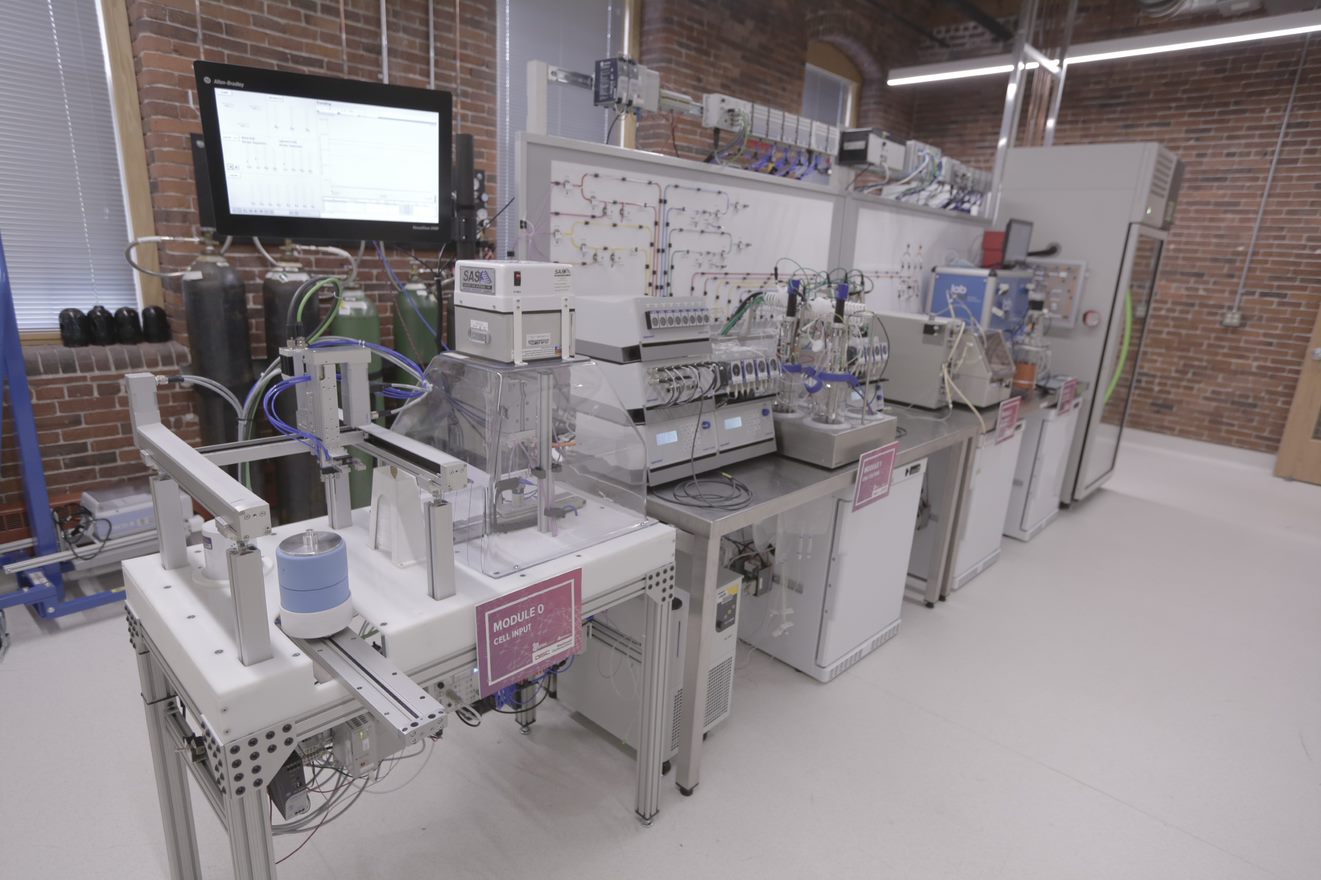
Edit: Here's a photo of the some of the original (now about a decade old) equipment for the tissue foundry. In terms of software technologies, you may notice that it uses more SCADA than AI.
Hosted%20Tissue%20Foundry%20Virtual%20Tour%20.jpg
 
  • Like
Likes   Reactions: BillTre and PeroK
  • #178
.Scott said:
No. It would be Engineering, not "magical AI".
Sure. Like every other technology, "it's right around the corner".

But you take it so much farther.

We're not talking about tissue generation here. We're talking about raising human beings from birth through potty-training, speaking, relationships, etc, to highly-skilled adulthood in the absense of any human interaction. Specifically, no parents, and never a single other human who was not likewise raised by AI.

They have no rudder at all for what it means to be human.
An AI is not human. Recording of their dead loved ones is not interaction.

Living things - and humans - are by far the most complex piece of equipment our universe has ever seen. Far more complex than any spaceship. Spaceships don't know love. Spaceeships don't know fear And you jul MPright past all that to contend that an AI can go ahead and build stable humans from scratch?

That is straight up far-future sci-fi.

Whatever arrives at the destination - if it arrived at all - would not pass as human.

And if you posit this technology that can build the most complex thing in our universe (that takes 18 years to build) and get it right in every detail, why can't it just do the way, way simpler thing and just build us a better rocket instead? At least the rocket (sorry, all 500 individual little rockets at different stages) don't have to be led by the hand through the tween years of hormones and puppy love.

.Scott said:
You also include the phrase "functional humans" which suggests that you have more specific mission requirements in mind.
No no. Way simpler than that.

I mean "able to meaningfully smile at another crew member, feel happy, love, be at peace with their thoughts, care, deal with hormones, not kill each other, not kill themselves". I mean merely just be a human being.
 
Last edited:
  • Like
  • Skeptical
Likes   Reactions: PeterDonis, 256bits and PeroK
  • #179
That's the price you pay to move to Planet B.
 
  • Like
Likes   Reactions: javisot
  • #180
1767637342144.webp

Really? Do you think that AI birthing and raising children to adulthood to become non-neurotic human beings in the utter absence of any human interaction - is not the very farthest of all futuristic sci-fi?

PeroK said:
That's the price you pay to move to Planet B.

Only with this idea. It's the farthest-flung of all the ideas here.
 

Similar threads

Replies
4
Views
4K
  • · Replies 26 ·
Replies
26
Views
7K
  • · Replies 4 ·
Replies
4
Views
2K
  • · Replies 6 ·
Replies
6
Views
4K
  • · Replies 5 ·
Replies
5
Views
4K
  • · Replies 7 ·
Replies
7
Views
2K
Replies
11
Views
2K
Replies
1
Views
3K
  • · Replies 60 ·
3
Replies
60
Views
7K
  • · Replies 78 ·
3
Replies
78
Views
17K