Aluminium and Barium Nitrate reaction

  • Thread starter Thread starter Janiceleong26
  • Start date Start date
  • Tags Tags
    Aluminium Reaction
Join the discussion
Ask a follow-up here, or get your own question answered by working scientists, mathematicians and engineers — people, not an autocomplete.
Real named experts · corrections over time · the nuance an AI answer skips
5 replies · 12K views
Janiceleong26
Messages
276
Reaction score
4
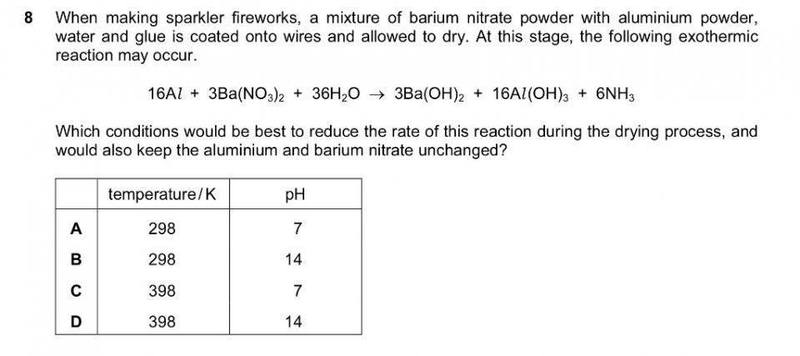
1. Homework Statement
image.jpg


Homework Equations

The Attempt at a Solution


I chose B, because I thought adding more OH- would cause the reaction to shift to the left, and a low temperature would slow the rate of reaction, but the answer is A, why pH 7?
 
Physics news on Phys.org
Think what keeps aluminum powder relatively stable. Despite Al being highly reactive even in powdered form it doesn't react vigorously with the air oxygen. Why?

Next step is to think how this lowered reactivity survives in neutral, acidic and caustic solutions.
 
Borek said:
Think what keeps aluminum powder relatively stable. Despite Al being highly reactive even in powdered form it doesn't react vigorously with the air oxygen. Why?

Next step is to think how this lowered reactivity survives in neutral, acidic and caustic solutions.
Aluminium forms a layer of oxide which makes it unreactive. It is an amphoteric oxide so it reacts with acids and bases, but it doesn't react with water, so aluminium will stay unchanged. Thanks I think I've understood
 
  • Like
Likes   Reactions: Borek
I am not sure what this explanation really is if you were to make it more explicit. It is not an easy question.
However I would be inclined to an explanation involving the protonation of the aluminium hydroxide and protonation and volatility effects on ammonia.
 
Last edited:
  • Like
Likes   Reactions: Janiceleong26
epenguin said:
I am not sure what this explanation really is if you were to make it more explicit. It is not an easy question.
However I would be inclined to an explanation involving the protonation of the aluminium oxide and protonation and volatility effects on ammonia.
Oh I see..thanks
 
I should have said aluminium hydroxide. I am not sure you can be expected to know - I suspected, but had to look up, that this gets deprotonated going from pH 7 to 14. You can be expected to know or to be learning at this time that ammonium is essentially protonated at pH 7 (exists as ammonium ion) and not protonated (exists as NH3) at pH 14, and to relate this to any laboratory frequentation from which you may know that ammonia smells like hell and ammonium salts not, or not very.

I think it is all very well for them to tell you it's at pH 7 or 14. You may feel slightly left in the air. If it is at one pH or another something is making it so. You may wonder.
 
Last edited:
  • Like
Likes   Reactions: Janiceleong26