Elara04
- 5
- 0
Misplaced Homework Thread
Summary: Hey, I'm getting confused with this question and don't think I'm doing it right, I was wondering if anyone could help me
Tides vary so the high tide and low tide height of the water is different every day. At certain times of the year, such as a Spring tide, the water can be very deep and it may not be safe to cross the inlet. During one big tide, the water was 3.9 metres deep at high tide and 0.7 metres deep at low tide.
The Department of Conservation (DOC) recommends that walkers only cross the inlet within one and a half hours before low tide and two hours after low tide.
Find a safe time to cross the inlet during this big tide and discuss DOC’s recommendation in relation to your findings for both tidal situations.
Water is 3.9 meters deep at high tide, Maximum value = 3.9m
Water is 0.7 meters deep at low tide, Minimum value 0.7m
The time period is 12.5 hours between high tides
d(t)=a sin b (x-c) + d or d(t)=a cos b (x-c) + d
where a is the amplitude = (max - min)/2
d=(max + min)/2
a=(3.9-0.7)/2=1.6
b=4pi/25
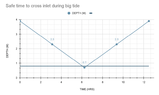
c= Points from graph (6.05 and 6.45 (2dp))
d= (3.9+0.7)/2=2.3
Equations of model
1.6 cos (4pi/25) (x-6.05) + 2.3
1.6 sin (4pi/25) (x-6.45) + 2.3
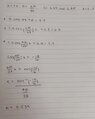
It is safe to cross the inlet at 0.8m, time for which the depth is at 0.8 meters
1.6 cos (4pi/25) t + 2.3=0.8
Tides vary so the high tide and low tide height of the water is different every day. At certain times of the year, such as a Spring tide, the water can be very deep and it may not be safe to cross the inlet. During one big tide, the water was 3.9 metres deep at high tide and 0.7 metres deep at low tide.
The Department of Conservation (DOC) recommends that walkers only cross the inlet within one and a half hours before low tide and two hours after low tide.
Find a safe time to cross the inlet during this big tide and discuss DOC’s recommendation in relation to your findings for both tidal situations.
Water is 3.9 meters deep at high tide, Maximum value = 3.9m
Water is 0.7 meters deep at low tide, Minimum value 0.7m
The time period is 12.5 hours between high tides
d(t)=a sin b (x-c) + d or d(t)=a cos b (x-c) + d
where a is the amplitude = (max - min)/2
d=(max + min)/2
a=(3.9-0.7)/2=1.6
b=4pi/25
c= Points from graph (6.05 and 6.45 (2dp))
d= (3.9+0.7)/2=2.3
Equations of model
1.6 cos (4pi/25) (x-6.05) + 2.3
1.6 sin (4pi/25) (x-6.45) + 2.3
It is safe to cross the inlet at 0.8m, time for which the depth is at 0.8 meters
1.6 cos (4pi/25) t + 2.3=0.8
Attachments