Are Cosmic Rays Intensifying Across the Globe?

  • Context: Undergrad 
  • Thread starter Thread starter Dotini
  • Start date Start date
  • Tags Tags
    Cosmic rays Rays
Click For Summary

Discussion Overview

The discussion centers on the observed intensification of cosmic rays across the globe, particularly in relation to solar activity and its effects on cosmic ray penetration. Participants explore measurements taken in various locations, including the Arctic Circle and California, and consider the implications of these findings for atmospheric phenomena and health. The scope includes theoretical implications, observational data, and potential applications in understanding space weather.

Discussion Character

  • Exploratory
  • Technical explanation
  • Debate/contested
  • Experimental/applied

Main Points Raised

  • Some participants note that neutron monitors indicate an increasing intensity of cosmic rays, particularly in polar and mid-latitude regions.
  • Others argue that the relationship between cosmic rays and phenomena such as cloud nucleation and lightning is interesting but may not be fully settled science.
  • A participant mentions that cosmic rays are approximately 10-13% stronger than they were a year ago, correlating with low solar activity.
  • Some contributions highlight the role of solar storms and coronal mass ejections (CMEs) in modulating cosmic ray intensity, suggesting that lower solar activity allows more cosmic rays to reach Earth.
  • There are references to studies linking cosmic rays with health issues, such as cardiac arrhythmias, although the implications of these correlations remain under discussion.
  • Participants discuss the ongoing decline in solar activity and its expected impact on cosmic ray levels, with some suggesting that a significant increase in cosmic rays is anticipated as the solar cycle approaches a minimum.

Areas of Agreement / Disagreement

Participants generally agree that cosmic rays are intensifying and that this phenomenon is linked to solar activity. However, there is no consensus on the implications of these changes, particularly regarding their effects on weather patterns and health outcomes, as well as the completeness of the scientific understanding of these relationships.

Contextual Notes

Limitations in the discussion include the dependence on observational data from specific locations, potential missing assumptions regarding the mechanisms behind cosmic ray interactions, and the unresolved nature of certain health correlations with cosmic ray exposure.

Who May Find This Useful

This discussion may be of interest to researchers in astrophysics, atmospheric science, health sciences, and those studying the implications of space weather on Earth.

Dotini
Gold Member
Messages
639
Reaction score
230
The following article is from the January 28, 2016 edition of Spaceweather.com:

INTENSIFYING COSMIC RAYS:
For the past year, neutron monitors around the Arctic Circle have sensed an increasing intensity of cosmic rays. Polar latitudes are a good place to make such measurements, because Earth's magnetic field funnels and concentrates cosmic radiation there. Turns out, Earth's poles aren't the only place cosmic rays are intensifying. Spaceweather.com and the students of Earth to Sky Calculus have been launching helium balloons to the stratosphere to measure radiation, and they find the same trend over California:
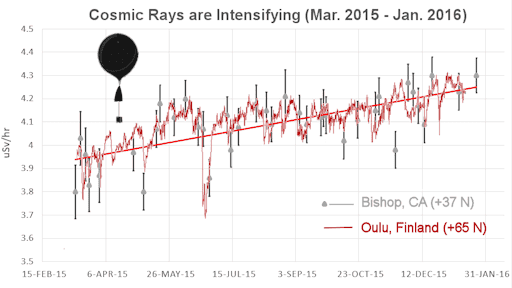
cosmicrays_mar15_jan16_strip.png


In the plot, neutron monitor measurements from the University of Oulu Cosmic Ray Station are traced in red; gamma-ray/X-ray measurements over California are denoted in gray. The agreement between the two curves is remarkable. It means that the intensification of cosmic rays is making itself felt not only over the poles, but also over lower latitudes where Earth's magnetic field provides a greater degree of protection against deep space radiation.

Cosmic rays, which are accelerated toward Earth by distant supernova explosions and other violent events, are an important form of space weather. They can seed clouds, trigger lightning, and penetrate commercial airplanes. Indeed, our measurements show that someone flying back and forth across the continental USA, just once, can absorb as much ionizing cosmic radiation as 2 to 5 dental X-rays. Likewise, cosmic rays can affect mountain climbers, high-altitude drones, and astronauts onboard the International Space Station.

This type of radiation is modulated by solar activity. Solar storms and CMEs tend to sweep aside cosmic rays, making it more difficult for cosmic rays to reach Earth. On the other hand, low solar activity allows an extra dose of cosmic rays to reach our planet. Indeed, the ongoing increase in cosmic ray intensity is probably due to a decline in the solar cycle.
 
  • Like
Likes   Reactions: 1oldman2 and Wee-Lamm
Astronomy news on Phys.org
The report below is from the February 9th, 2016 edition of Spaceweather.com. The linked remarks that cosmic rays are implicated in the nucleation of clouds and the triggering of lightning are interesting and potentially significant, but may not be entirely settled science.

COSMIC RAYS CONTINUE TO INTENSIFY:
Last month, we reported thatcosmic rays are intensifying. Measurements so far in February indicate that the trend is continuing. In fact, the latest balloon flight over California on Feb. 5th detected the highest value yet:

cosmicrays_strip.png

The data show that cosmic rays in the mid-latitude stratosphere now are approximately 10% stronger than they were one year ago.
 
COSMIC RAYS CONTINUE TO INTENSIFY: Researchers have long known that solar activity and cosmic rays have a yin-yang relationship. As solar activity declines, cosmic rays intensify. Lately, solar activity has been very low indeed. Are cosmic rays responding? The answer is "yes." Spaceweather.com and the students of Earth to Sky Calculus have been using helium balloons to monitor cosmic rays in the stratosphere. Their latest flight on Feb. 16th measured the highest values yet:

cosmicrays_strip.png


The data show that cosmic rays in the mid-latitude stratosphere now are approximately 12% stronger than they were one year ago.

Cosmic rays, which are accelerated toward Earth by distant supernova explosions and other violent events, are an important form of space weather. They can seed clouds, trigger lightning, and penetrate commercial airplanes. Furthermore, there are studies linking cosmic rays with cardiac arrhythmias and sudden cardiac death in the general population. Among patients who have an implanted cardioverter - defibrillator (ICD), the aggregate number of life-saving shocks appears to be correlated with the number of cosmic rays reaching the ground.References: http://www.heartrhythmjournal.com/article/S1547-5271%2808%2900481-5/fulltext , #2, #3, http://shao.az/SG/v1n2/SG_v1_No2_2006-pp-13-16.pdf .

Why do cosmic rays increase when solar activity is low? Consider the following: To reach Earth, cosmic rays have to penetrate the inner solar system. Solar storms make this more difficult. CMEs and gusts of solar wind tend to sweep aside cosmic rays, lowering the intensity of radiation around our planet. On the other hand, when solar storms subside, cosmic rays encounter less resistance; reaching Earth is a piece of cake.

Forecasters expect solar activity to drop sharply in the years ahead as the 11-year solar cycle swings toward another deep minimum. Cosmic rays are poised to increase accordingly.
 
Last edited by a moderator:
  • Like
Likes   Reactions: Drakkith
SOLAR CYCLE CRASHING: Anyone wondering why the sun has been so quiet lately? The reason is shown in the graph below. The 11-year sunspot cycle is crashing:

solar-cycle-sunspot-number3_strip.png


For the past two years, the sunspot number has been dropping as the sun transitions from Solar Max to Solar Min. Fewer sunspots means there are fewer solar flares and coronal mass ejections (CMEs). As the explosions subside, we deem the sun "quiet."

But how quiet is it, really? A widely-held misconception is that space weather stalls and becomes uninteresting during periods of low sunspot number. In fact, by https://www.vsp.ucar.edu/Heliophysics/pdf/Lika_sideways_SC.pdf , we see that Solar Minimum brings many interesting changes. For instance, the upper atmosphere of Earth collapses, allowing space junk to accumulate around our planet. The heliosphere shrinks, bringing interstellar space closer to Earth. And galactic cosmic rays penetrate the inner solar system with relative ease. Indeed, a cosmic ray surge is already underway. (Goodbye sunspots, hello deep-space radiation.)

...reposted from Spaceweather.com, March 28, 2016 edition
 
Last edited by a moderator:
  • Like
Likes   Reactions: davenn
Cosmic rays have increased almost 13% since 2015.
- from today's edition of spaceweather.com

COSMIC RAYS INTENSIFY: Researchers have long known that solar activity and cosmic rays have a yin-yang relationship. As solar activity declines, cosmic rays intensify. Lately, solar activity has been very low indeed. Are cosmic rays responding? The answer is "yes." Spaceweather.com and the students of Earth to Sky Calculus have been using helium balloons to monitor cosmic rays in the stratosphere over California. Their latest data show an increase of almost 13% since 2015.

stratosphere_14aug16_strip.png


Cosmic rays, which are accelerated toward Earth by distant supernova explosions and other violent events, are an important form of space weather. They can seed clouds, trigger lightning, and penetrate commercial airplanes. Furthermore, there are studies ( #1, #2, #3, http://shao.az/SG/v1n2/SG_v1_No2_2006-pp-13-16.pdf ) linking cosmic rays with cardiac arrhythmias and sudden cardiac death in the general population.

Why are cosmic rays intensifying? The main reason is the sun. Solar storm clouds such as coronal mass ejections (CMEs) sweep aside cosmic rays when they pass by Earth. During Solar Maximum, CMEs are abundant and cosmic rays are held at bay. Now, however, the solar cycle is swinging toward Solar Minimum, allowing cosmic rays to return. Another reason could be the weakening of Earth's magnetic field, which helps protect us from deep-space radiation.
 
Last edited by a moderator:
  • Like
Likes   Reactions: 1oldman2

Similar threads

  • · Replies 0 ·
Replies
0
Views
897
  • · Replies 4 ·
Replies
4
Views
4K
  • · Replies 6 ·
Replies
6
Views
2K
  • · Replies 8 ·
Replies
8
Views
3K
  • · Replies 0 ·
Replies
0
Views
3K
Replies
3
Views
4K
  • · Replies 46 ·
2
Replies
46
Views
11K
  • · Replies 16 ·
Replies
16
Views
2K
  • · Replies 22 ·
Replies
22
Views
4K
  • · Replies 6 ·
Replies
6
Views
4K