Artinian Modules - Bland - Proposition 4.24

  • Context: Undergrad 
  • Thread starter Thread starter Math Amateur
  • Start date Start date
  • Tags Tags
    Modules
Click For Summary

Discussion Overview

The discussion revolves around understanding a specific part of the proof in Proposition 4.2.4 from Paul E. Bland's book "Rings and Their Modules," particularly the relationship between intersections of modules and their quotients. The focus is on the implications of cogeneration in the context of Noetherian and Artinian modules.

Discussion Character

  • Technical explanation
  • Conceptual clarification
  • Homework-related

Main Points Raised

  • Peter seeks clarification on the proof that states the intersection of modules is equivalent to the intersection of their quotients with respect to a submodule.
  • Andrew provides a detailed argument showing that if an element belongs to the intersection of the modules, it also belongs to the intersection of the quotients, and vice versa, thus establishing the inclusion needed for the proof.
  • Andrew notes that the proof may lack elegance due to fatigue but believes the reasoning is sound.
  • Peter expresses gratitude for Andrew's explanation and indicates that he finds it clear and convincing.

Areas of Agreement / Disagreement

Participants appear to agree on the validity of the reasoning presented by Andrew, as Peter acknowledges the clarity of the explanation. However, the initial question raised by Peter indicates some uncertainty regarding the proof's assumptions and implications.

Contextual Notes

There may be limitations in understanding the cogeneration concept fully, as it is noted to be possibly not well known. The discussion does not resolve all assumptions related to the proof.

Who May Find This Useful

Readers interested in module theory, particularly those studying Noetherian and Artinian modules, may find this discussion beneficial for understanding the nuances of intersections and quotients in module theory.

Math Amateur
Gold Member
MHB
Messages
3,920
Reaction score
48
I am reading Paul E. Bland's book, "Rings and Their Modules".

I am focused on Section 4.2: Noetherian and Artinian Modules and need some help to fully understand the proof of part of Proposition 4.2.4 ... ...

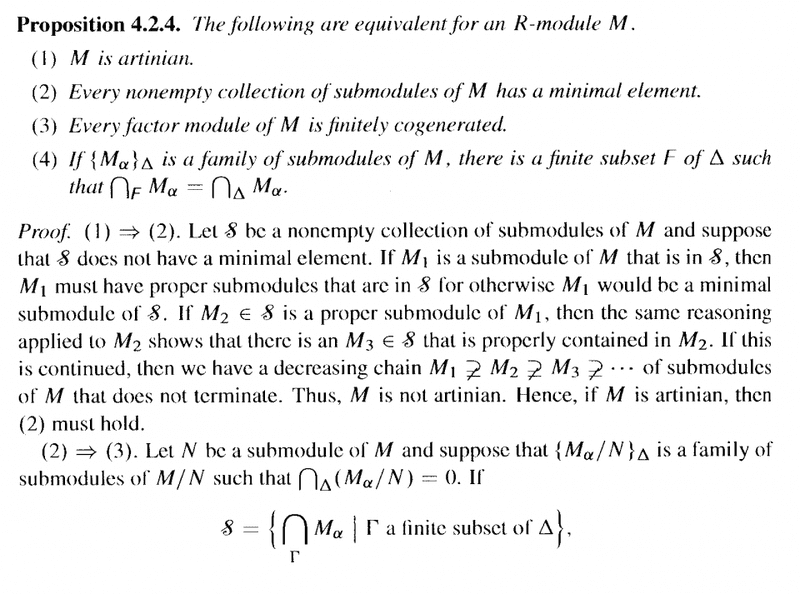
Proposition 4.2.4 reads as follows:
?temp_hash=05dde20a7081ba4eb52a559921ca1799.png

?temp_hash=05dde20a7081ba4eb52a559921ca1799.png


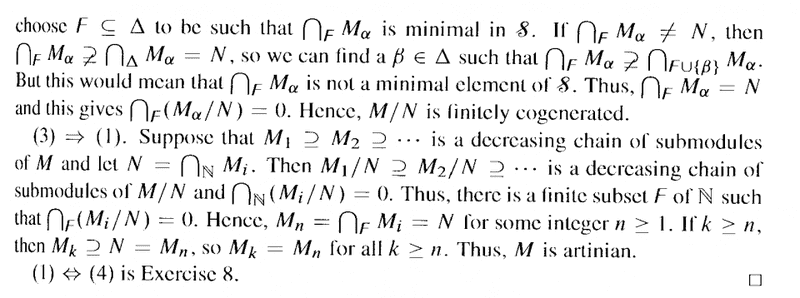
I need help to fully understand Part of the proof proving that ##(2) \Longrightarrow (3)## ...In that part of the proof Bland seems to be assuming that

## \bigcap_F M_\alpha = N ##

if and only if

## \bigcap_F (M_\alpha / N ) = 0 ##
In other words, if ##F = \{ 1, 2, 3 \}## then

##M_1 \cap M_2 \cap M_3##

if and only if

##M_1 / N \cap M_2 / N \cap M_3 / N## But why exactly is this the case ... ...

... ... how do we formally and rigorously demonstrate that this is true ...Hope someone can help ...

Peter
====================================================

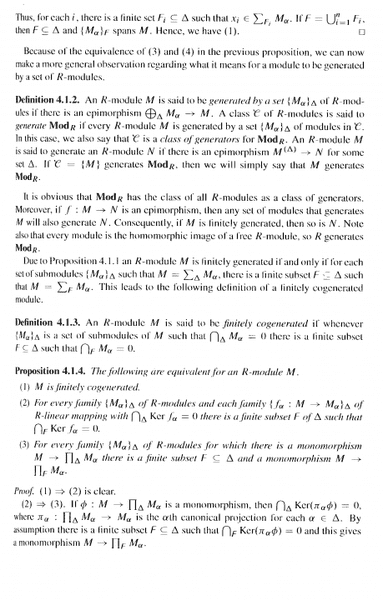
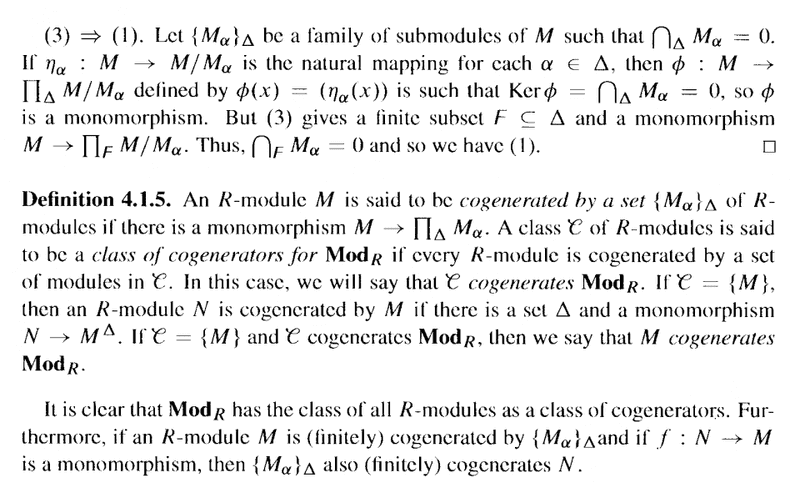
Proposition 4.2.4 refers to the (possibly not well known) concept of cogeneration so I am providing Section 4.1 Generating as Cogenerating Classes ... ... as follows ...
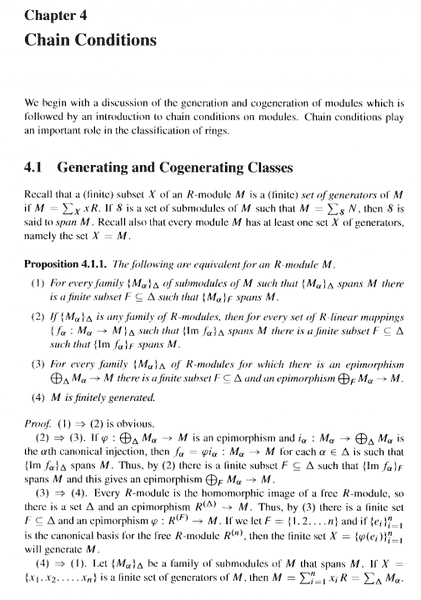
?temp_hash=05dde20a7081ba4eb52a559921ca1799.png

?temp_hash=05dde20a7081ba4eb52a559921ca1799.png

?temp_hash=05dde20a7081ba4eb52a559921ca1799.png
 

Attachments

  • Bland - 1 - Proposition 4.2.4 - PART !.png
    Bland - 1 - Proposition 4.2.4 - PART !.png
    71.2 KB · Views: 802
  • Bland - 2 - Proposition 4.2.4 - PART 2.png
    Bland - 2 - Proposition 4.2.4 - PART 2.png
    31.1 KB · Views: 743
  • Bland -1 -  Section 4.1 - PART 1.png
    Bland -1 - Section 4.1 - PART 1.png
    36.1 KB · Views: 741
  • Bland  - 2 - Section 4.1 - PART 2.png
    Bland - 2 - Section 4.1 - PART 2.png
    43.2 KB · Views: 768
  • Bland  - 3 - Section 4.1 - PART 3.png
    Bland - 3 - Section 4.1 - PART 3.png
    45.4 KB · Views: 783
Physics news on Phys.org
Start by observing that
$$(\bigcap_{\alpha\in F} M_\alpha)/N=N/N$$
which is the zero element of the module ##M/N##.

So we have to show that
$$\bigcap_{\alpha\in F} (M_\alpha/N)=(\bigcap_{\alpha\in F} M_\alpha)/N\ \ \ \ \ \ \ (1)$$

First observe that if ##m\in \bigcap_{\alpha\in F} M_\alpha## then ##\forall\alpha\in F:\ m\in M_\alpha##
so that ##\forall\alpha\in F:\ m+N \in M_\alpha/N## whence
##m+N \in \bigcap_{\alpha\in F}M_\alpha/N##.

Hence we have
$$(\bigcap_{\alpha\in F} M_\alpha)/N\subseteq \bigcap_{\alpha\in F} (M_\alpha/N)$$

For the other direction of inclusion, consider an arbitrary element ##m+N## of the LHS of (1). That is, ##m+N\in \bigcap_{\alpha\in F} (M_\alpha/N)##. Then for any ##\alpha\in F## we have ##m+N\in M_\alpha/N##, so there exists ##m'\in M_\alpha## and ##n\in N## such that ##m=m'+n##, which is in ##M_\alpha## since ##n\in N\subseteq M_\alpha##. Hence ##m\in \bigcap_{\alpha\in F} M_\alpha## and therefore ##m+N## is an element of the RHS of (1).

This is not as elegant as I would like because it is late at night and I am tired. But hopefully it makes sense.
 
  • Like
Likes   Reactions: Math Amateur
Thanks for the help Andrew ... much appreciated...

Will be working through your post very shortly...

Thanks again ...

Peter
 
Thanks Andrew ... found that very clear and convincing ...

Peter
 

Similar threads

  • · Replies 7 ·
Replies
7
Views
2K
  • · Replies 3 ·
Replies
3
Views
2K
  • · Replies 13 ·
Replies
13
Views
3K
Replies
2
Views
2K
Replies
1
Views
2K
Replies
2
Views
2K
  • · Replies 9 ·
Replies
9
Views
2K
  • · Replies 2 ·
Replies
2
Views
3K
Replies
9
Views
2K
  • · Replies 4 ·
Replies
4
Views
2K