Autocorellation of a stochastic process

Click For Summary
SUMMARY

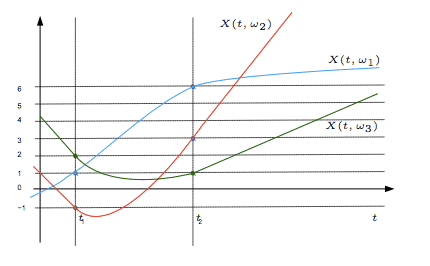
The discussion centers on the concept of autocorrelation in the context of stochastic processes, specifically involving three distinct trajectories represented by red, blue, and green curves. The participants clarify that autocorrelation pertains to a single time series, while the original query mistakenly conflates it with cross-correlation among multiple series. The correct approach involves calculating individual autocorrelation functions for each trajectory and defining the stochastic process accurately, including the probabilities associated with each curve. Key mathematical formulas for calculating the autocorrelation function and expected values are provided, emphasizing the need for precise definitions and calculations.

PREREQUISITES
  • Understanding of stochastic processes and their properties
  • Familiarity with autocorrelation and cross-correlation concepts
  • Knowledge of probability distributions and expected value calculations
  • Proficiency in mathematical notation and functions relevant to time series analysis
NEXT STEPS
  • Study the mathematical foundations of autocorrelation functions in stochastic processes
  • Learn how to derive and interpret cross-correlation functions between multiple time series
  • Explore probability distributions and their applications in stochastic modeling
  • Investigate the implications of stochastic behavior in time series analysis
USEFUL FOR

Researchers, mathematicians, and data scientists involved in time series analysis, particularly those focusing on stochastic processes and their applications in various fields such as finance, engineering, and environmental science.

PHstud
Messages
12
Reaction score
0
Hello ! I am trying an exercice to get a better grip of what is the autocorellation meaning.
I know the mathematical formula, but let's consider a case.

0f49ac4977.png


If in the case above, the probability of the red curve to happen (so w2) is Pr, the blue one Pb and the green on Pg, what would be the result of the autocorellation ?
Would it be something like the sum of the value X(t1,w1)*X(t2,w2)*Pb*Pr + X(t1,w1)*X(t3,w3)*Pb*Pg + ... ?

Thank you for helping me !
 
Physics news on Phys.org
Do you mean to say cross-correlation rather than autocorrelation? Autocorrelation only refers to a single time series and the correlation of that time series with a delay of itself. Your equations seem to be for cross-correlations. But even then, a cross-correlation is between two time series, not three.

You need to tell us what math formula you were given, that you say you know.
 
I do mean autocorellation.
These 3 curves belong to a stochastic signal, and each realisation has a probability to happen and result in one of those trajectories
 
Since the result is one of those three time series, you have three autocorrelation functions, one for each time series. Each of the three would be the normal autocorrelation. If you want a function that combines all three, you should first carefully define what you want the function to represent. I can't think of anything along the lines of autocorrelation that would apply.
 
But if we consider each serie individually, don't we lose the 'stochastic' behaviour of the process ?
 
Only the random selection of which trajectory to follow involves more than one path. That selection should not be involved in an autocorrelation calculation. I would not call the initial selection of the trajectory part of a stochastic process. I would treat it separately as a simple probability because its nature is completely different from the remainder of the problem.
 
You should define the stochastic process clearly:

##X(t)## is a random variable given by the distribution:

##P(X(t) = f_r(t)) = r##

##P(X(t) = f_g(t)) = g##

##P(X(t) = f_b(t) = b##

Since you imply the trajectory of the process has only 3 possibilities, we can think of realizing it as making one random draw to determine the value of ##X(0)##. If the draw selects ##f_r## then ##X(t) = f_r(t) = f_r(s)## etc. In other words we don't make a random draw at ##X(s)## and make a different random draw at ##X(t)##.
( Saying "the process has only 3 possible trajectories" is different that saying "at each time t, we select the value of the process from one of 3 possible functions". )
The autocorrelation function is defined by

##R(s,t) = \frac { E ( (X(s) - \overline{X(s)} )(X(t) - \overline{X(t)} )}{\sigma_s \sigma_t}##
Start by finding the constants ## \overline{X(s)}, \sigma_s, \overline{X(t)}, \sigma_t ##.
For example, ##\overline{X(s)} = r f_r(s) + g f_g(s) + b f_b(s)##

##\sigma_s = \sqrt{ E(X(s)^2) - \overline{X(s)}^2}##

## = \sqrt{ r f_r(s)^2 + g f_g(s)^2 + b f_b(s)^2 - (\overline{X(s)})^2 } ##
Once you find those constants, the expectation symbol "##E##" implies you compute the expected value of the function ##g(s,t) = \frac { (X(s) - \overline{X(s)} )(X(t) - \overline{X(t)}}{\sigma_s \sigma_t}##
Since we only make one random draw, the function ##g(r,s)## has 3 possible values

##P ( g(s,t) = \frac{( f_r(s) - \overline{X(s)})(f_r(t) - \overline{X(t)})}{ \sigma_s \sigma_t}) = r##
##P ( g(s,t) = \frac{( f_g(s) - \overline{X(s)})(f_g(t) - \overline{X(t)})}{ \sigma_s \sigma_t}) = g##
##P ( g(s,t) = \frac{( f_b(s) - \overline{X(s)})(f_b(t) - \overline{X(t)})}{ \sigma_s \sigma_t}) = b##

Maybe there is some theorem that can be used to avoid all the algebra. (That's not a hint, because, off hand, I don't remember one.)
 
  • Like
Likes   Reactions: jim mcnamara and WWGD

Similar threads

Replies
2
Views
2K
  • · Replies 1 ·
Replies
1
Views
975
  • · Replies 5 ·
Replies
5
Views
2K
  • · Replies 3 ·
Replies
3
Views
2K
  • · Replies 2 ·
Replies
2
Views
1K
  • · Replies 2 ·
Replies
2
Views
1K
  • · Replies 5 ·
Replies
5
Views
2K
  • · Replies 4 ·
Replies
4
Views
2K
  • · Replies 9 ·
Replies
9
Views
7K
  • · Replies 1 ·
Replies
1
Views
915