Calculate Aphelion Distance & Velocity of Comet at Perihelion

  • Context: Undergrad 
  • Thread starter Thread starter Unto
  • Start date Start date
  • Tags Tags
    Velocity
Click For Summary

Discussion Overview

The discussion revolves around calculating the aphelion distance and velocity of a comet at perihelion, given its perihelion distance and orbital period. Participants explore the relationships between perihelion, aphelion, and the semi-major axis, as well as the implications for spacecraft trajectories to rendezvous with the comet.

Discussion Character

  • Exploratory
  • Mathematical reasoning
  • Homework-related
  • Technical explanation

Main Points Raised

  • One participant notes the perihelion distance of the comet is 0.6 AU and its period is 341 years, seeking to calculate the aphelion distance and velocity at perihelion.
  • There is confusion regarding whether aphelion is the same as the semi-major axis, with one participant expressing difficulty in calculations leading to incorrect relativistic speeds.
  • Another participant calculates the semi-major axis as 48.8 AU using Kepler's third law, questioning how to derive the aphelion distance from this value.
  • One participant arrives at an aphelion distance of 97 AU but does not clarify the method used to reach this conclusion.
  • Velocity calculations at perihelion yield a result of 54 km/s, but participants express uncertainty about the values used for 'a' and 'r' in the equations.
  • Participants discuss the application of the principle that orbits sweep equal areas in equal times, questioning how it might be utilized in their calculations.
  • One participant describes a Hohmann transfer orbit to rendezvous with the comet, expressing confusion about the necessary calculations and diagramming the scenario.
  • Another participant calculates the time period for the spacecraft's orbit as 0.357 years and a velocity of 40 km/s, but expresses concern about the accuracy of these results.
  • There is a discussion about the energy needed for the spacecraft to match the comet's velocity at rendezvous, with one participant suggesting using the kinetic energy equation.

Areas of Agreement / Disagreement

Participants do not reach a consensus on the calculations, with multiple competing views and uncertainties remaining regarding the aphelion distance, velocity at perihelion, and the spacecraft's trajectory.

Contextual Notes

Participants express confusion over definitions and calculations, particularly regarding the relationships between perihelion, aphelion, and semi-major axis. There are also unresolved issues concerning the accuracy of diagrams and the assumptions made in calculations.

Who May Find This Useful

Students and enthusiasts interested in orbital mechanics, celestial navigation, and the mathematics of cometary orbits may find this discussion relevant.

Unto
Messages
128
Reaction score
0
A comet is observed to have a perihelion distance of 0.6Au and a period of 341 years. Calculate it's Aphelion distance. What is the velocity of the comet at Perihelion?

-------------------------------------------------

The first thing I did was remind myself of some important terminology:

Perihelion - closest distance to the sun/star
Aphelion - furthest distance from the sun/star.

What I'm confused is whether Aphelion is the same as the Major Semi-axis or different.. Because I've done allsorts of calculations, and I keep getting a relativistic speed which is just dumb. So my values for Aphelion are all wrong.

How would I calculate Aphelion?

I can directly determine the semi-major axis by using T^2 = a^3 and that gives me a value of 48.8AU as the semi major axis. Do I add this to the Perihelion and say that the sum is the furthest distance away from the sun? Or am I missing a crucial piece here?

I even drew a diagram, I have no way of finding the eccentricity of the orbit without Aphelion :-(.

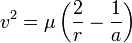
Help please. And lastly for working out the velocity at perihelion, what is 'r' in the equation:
ec3f328abd4ffc5db4adb3c218da2544.png


Assuming that 'a' is the semi major axis.
 
Astronomy news on Phys.org
K I did it again and this time used a diagram, I have Aphelion currently as 97AU..
 
K I got a final velocity of 54km..

I used:

ec3f328abd4ffc5db4adb3c218da2544.png


u = GM

But for some reason you have to put 1.5E11m under the the GM (I don't know why but I've done it before and it resolves things). I think I put in wrong values for a and r though. I know a is semi major axis, but what would r be?
 
Btw, how would I use 'the orbit sweeps equal areas in equal times' to solve this question if possible?
 
Unto said:
K I got a final velocity of 54km..

I used:

ec3f328abd4ffc5db4adb3c218da2544.png


u = GM

But for some reason you have to put 1.5E11m under the the GM (I don't know why but I've done it before and it resolves things).
It's because GM is measured in the MKS system and the distances are given in AU. 1.5e11m is 1 AU, So it gets everything into the same units.
I think I put in wrong values for a and r though. I know a is semi major axis, but what would r be?

r is your perihelion distance.
 
Yeah I thought it would be something along those lines since 1.5E11m is 1AU.

Thank you for your help, I have 1 last question.

A ship from Earth is sent via Hohmann transfer orbit to rendevous with the comet in it's perihelion position. How long would the spacecraft take to reach the comet and at what speed would it be traveling at when it arrives? Assume the comet and Earth move in the same direction and on the same plane.

------------------------------------------------------------------

O_o

I drew a diagram and subsequently became confused. It looks as if the craft would have to slingshot around the Sun to even attempt to get into the orbit of the comet. The question doesn't specify at which point in the orbit of the earth/comet is the craft shot...

The diagram I drew is merely an assumption (a pretty good one I think), but now I don't know what to do. How would I calculate the time taken? And the speed at that point?

Ok I've just worked out how I would find the time period and the speed (I would simply use vis viva again), but the diagram is confusing me. The comet has a Perihelion of less than 1AU, so how would I draw this diagram to make sure I'm doing the correct calculations?
 
K I drew a shoddy diagram. If the Hohmann transfer orbit is eliptical (obviously), then it will have a perihelion of 0.6AU (which is the comets perihelion) and then an Aphelion of 1AU (since it was shot from Earth and that is the origin of the orbit).

It's major axis would therefore be 1.6, half of that is a semi-major axis of 0.8AU.

Now that this is an elliptical orbit, we can use Keplers relationship T^2 = a^3 to find the time for 1 cycle in years, half of which should be when the craft rendevous with the comet which it what I want. I get a time period of 0.357 years... WTF?

I then used vis viva and got a velocity of 40kms-1

Something has gone wrong here, and I blame it on my diagram...

Also, if this is correct, then my craft is going slower than the comet at rendezvous and I need to give it some energy. How would I calculate the energy needed if the craft is 500kg?

Thanks for any help, I will get a good mark in this exam.
 
Last edited:
Unto said:
K I drew a shoddy diagram. If the Hohmann transfer orbit is eliptical (obviously), then it will have a perihelion of 0.6AU (which is the comets perihelion) and then an Aphelion of 1AU (since it was shot from Earth and that is the origin of the orbit).

It's major axis would therefore be 1.6, half of that is a semi-major axis of 0.8AU.

Now that this is an elliptical orbit, we can use Keplers relationship T^2 = a^3 to find the time for 1 cycle in years, half of which should be when the craft rendevous with the comet which it what I want. I get a time period of 0.357 years... WTF?
Looks good to me.
I then used vis viva and got a velocity of 40kms-1

Something has gone wrong here, and I blame it on my diagram...
Both numbers are right in there as far as being correct.
Also, if this is correct, then my craft is going slower than the comet at rendezvous and I need to give it some energy. How would I calculate the energy needed if the craft is 500kg?
Straight forward. What is the difference in velocity between comet and craft when they meet? How much kinetic energy does that equate to for a 500 kg mass?
Thanks for any help, I will get a good mark in this exam.
 
:o

You are a star ^^

I just use the kinematic energy equation with the relative velocites and solve for k.e.

Many Thanks! ^^
 

Similar threads

  • · Replies 14 ·
Replies
14
Views
2K
  • · Replies 3 ·
Replies
3
Views
3K
  • · Replies 1 ·
Replies
1
Views
2K
  • · Replies 7 ·
Replies
7
Views
6K
  • · Replies 5 ·
Replies
5
Views
14K
Replies
11
Views
4K
  • · Replies 2 ·
Replies
2
Views
7K
  • · Replies 11 ·
Replies
11
Views
3K
  • · Replies 2 ·
Replies
2
Views
1K
  • · Replies 3 ·
Replies
3
Views
5K