Calculate Gear Ratio - Helical/Spur Gears

Click For Summary
SUMMARY

The discussion focuses on calculating the gear ratio for a system involving helical and spur gears. The user provided specific gear tooth counts: 7 teeth (driver) to 58 teeth (driven), 19 to 51, and 15 to 54, resulting in individual ratios of 0.12069, 0.3725, and 0.2777 respectively. The overall gear ratio is calculated as (7 * 19 * 15) / (58 * 51 * 54), yielding a final ratio of 80.066:1. It is noted that helical gears operate similarly to spur gears but are preferred for high-speed applications due to their quieter operation.

PREREQUISITES
  • Understanding of gear terminology, including driver and driven gears.
  • Basic knowledge of gear tooth count and its impact on gear ratios.
  • Familiarity with helical and spur gear characteristics.
  • Ability to perform basic mathematical calculations involving fractions and ratios.
NEXT STEPS
  • Research the differences between helical and spur gears in terms of performance and application.
  • Learn about calculating gear ratios for complex gear arrangements.
  • Explore the impact of gear diameter versus tooth count on gear ratio calculations.
  • Investigate the advantages of using helical gears in high-speed machinery.
USEFUL FOR

Mechanical engineers, gear designers, and anyone involved in the design and analysis of gear systems, particularly those working with helical and spur gears in high-speed applications.

namith11
Messages
26
Reaction score
0
Hey,
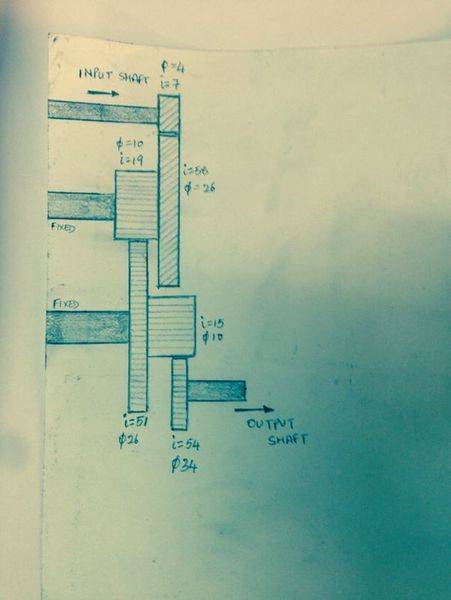
I want to know how to calculate the gear ratio of the given arrangement in the picture. I am not sure of how to calculate the gear ratio of two gears on the same shaft. Also the input gear is helical and the output gear is a spur gear. I have mentioned the number of gear teeth, i hope that is enough. I am very confused. Please help!
gearbox1.jpg
 
Engineering news on Phys.org
If I read it correctly, the ratios of gear pairs are;
driver : driven
7 : 58 = 0.12069
19 : 51 = 0.3725
15 : 54 = 0.2777
The result is ( 7 * 19 * 15 ) / (58 * 51 * 54 ) = 0.0125
or 80.066 : 1

Helical gears behave the same as spur gears. Helical gears are quieter at high speeds so they are used here for the high speed, low torque, input shaft.
 
The diameters in your diagram appear to be tip diameters not pitch circle diameters which explains the slight ratio difference between tooth count and diameters.
 

Similar threads

Replies
2
Views
3K
  • · Replies 10 ·
Replies
10
Views
2K
  • · Replies 9 ·
Replies
9
Views
3K
Replies
1
Views
2K
  • · Replies 7 ·
Replies
7
Views
3K
  • · Replies 7 ·
Replies
7
Views
3K
  • · Replies 2 ·
Replies
2
Views
3K
  • · Replies 2 ·
Replies
2
Views
5K
  • · Replies 4 ·
Replies
4
Views
2K
Replies
2
Views
2K