Calculate the tension in the rope

  • Thread starter Thread starter MathewsMD
  • Start date Start date
  • Tags Tags
    Rope Tension
Click For Summary
SUMMARY

The tension in the rope supporting a gymnast with a mass of 36.7 kg at an angle of 4.0° is calculated to be 2578 N. The analysis confirms that the tension can be treated as two separate strings due to the gymnast's position acting as a node. If the gymnast's angles change, such as θ1 = 6.0° and θ2 = 10.0°, the tensions on each side will differ, necessitating a separate analysis for each segment of the rope. This approach adheres to the principles of static equilibrium in physics.

PREREQUISITES
  • Understanding of static equilibrium principles
  • Basic knowledge of trigonometric functions
  • Familiarity with Newton's laws of motion
  • Concept of tension in ropes and strings
NEXT STEPS
  • Study the concept of static equilibrium in physics
  • Learn about tension in non-uniform ropes
  • Explore the effects of varying angles on tension calculations
  • Investigate real-world applications of tension in sports and gymnastics
USEFUL FOR

Physics students, engineers, gymnastic coaches, and anyone interested in understanding the mechanics of tension in ropes and its applications in real-world scenarios.

MathewsMD
Messages
430
Reaction score
7
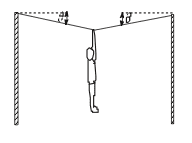
If the gymnast has a mass, m = 36.7 kg, and the angle θ = 4.0°, calculate the tension in the rope from which she is hanging.
XKiKv5l.png


ƩFx = T1x - T2x = 0
Then T1cos4 = T2cos4
T1 = T2 = T

ƩFy = 2Ty - mg
2Tsin4 = mg
T = mg/2sin4 = 2578 N

I have gotten the solution. I am just confused at one part. Do we analyze the tension in the string on each side of the gymnast separately, then add them together? Or, do we just find the tension on one side and that is it (like my solution)?

I am just confused since I remember learning tension in a massless rope is considered to be uniform, but if there is a force being applied to a part of it (this time in the middle) I don't know if we're supposed to analyze tension together or not since it is essentially a node and I considered it like I would two separate strings in my solution.

Also, if the gymnast was not in the middle of the string (i.e. θ1 = 6.0° and θ2 = 10.0°) how would this change the situation and the resultant tension in the rope. Would it have any effect?

Any help would be greatly appreciated!
 
Physics news on Phys.org
You are right to treat it as two separate strings, for exactly the reason that you said: you can treat any point in the rope as a node and require that the forces on it all cancel (as long as the rope isn't accelerating, of course).

If you change the angles, then it becomes even more important to think about it this way, because in general the tension in the two sides will be different. That sounds like a violation of the rule that the tension is uniform throughout the rope, but it's not. The only way of getting different angles is to physically hook the gymnast to a particular point on the rope, and then you really have two separate ropes connected to the eye of the hook, each with their own tension.

(If you don't have that fixed hook, the gymnast's attachment point will slide down the rope until we reach equilibrium with the tensions and angles equal).
 
  • Like
Likes   Reactions: 1 person
Nugatory said:
You are right to treat it as two separate strings, for exactly the reason that you said: you can treat any point in the rope as a node and require that the forces on it all cancel (as long as the rope isn't accelerating, of course).

If you change the angles, then it becomes even more important to think about it this way, because in general the tension in the two sides will be different. That sounds like a violation of the rule that the tension is uniform throughout the rope, but it's not. The only way of getting different angles is to physically hook the gymnast to a particular point on the rope, and then you really have two separate ropes connected to the eye of the hook, each with their own tension.

(If you don't have that fixed hook, the gymnast's attachment point will slide down the rope until we reach equilibrium with the tensions and angles equal).

Thank you!
 

Similar threads

Replies
4
Views
1K
Replies
43
Views
5K
  • · Replies 8 ·
Replies
8
Views
9K
  • · Replies 7 ·
Replies
7
Views
5K
  • · Replies 22 ·
Replies
22
Views
1K
  • · Replies 1 ·
Replies
1
Views
3K
  • · Replies 13 ·
Replies
13
Views
2K
  • · Replies 3 ·
Replies
3
Views
2K
  • · Replies 8 ·
Replies
8
Views
10K
Replies
11
Views
3K