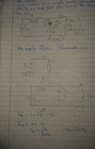
One way to approach this is to substitute your diode model (a switch and a battery) into the circuit. This model has two switch states that have associated restrictions; no forward voltage across the switch when it's open and no reverse current when its shorted. Then you can just pick one state and analyze the circuit in that configuration to determine when the associated restriction is violated. That is the operating point at which the diode will switch states. You can do it with either "on" or "off" assumption, sometimes one is easier to solve than the other.
This approach is a good way to get "unstuck" when you have complex circuits and you don't know where to start. Just make an assumption and get started, but with the knowledge that you may have guessed wrong, then find out if, or under what conditions, you are right or wrong.