6Stang7
- 212
- 0
I have some accelerometer data from an object and I want to find the natural frequency and displacement of this object. A plot of the recorded data looks like this:
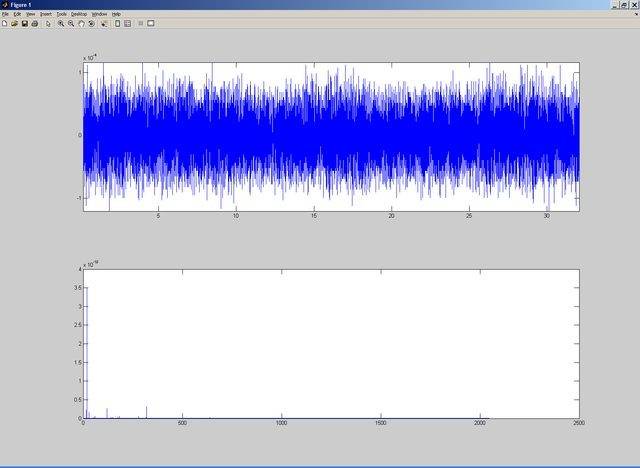
As you can see, I did a FFT of the signal to find it's components, and at ~20Hz, we can see the main component.
I know that, for the most part, this object is at steady state, so the equation for this component is in the forum of asin(wt).
My question comes to finding the value of a. This is noise present on this signal, which can been seen below:
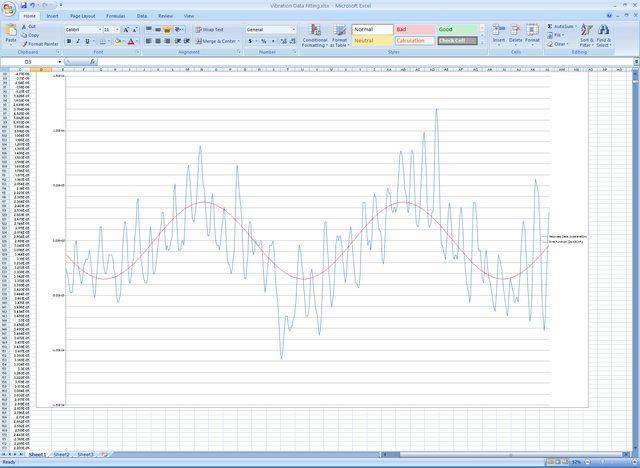
The red sin wave is one that I made to fit the main component of the signal (by plugging in different values until it "looked right"), and the frequency of this wave matches that given from the FFT. The amplitude of this wave (red) should be my acceleration value, correct? If so, then what is the best way to calculate it's value? If I take all the values that the accelerometer recorded (in g) and take the rms of all the values, will that give me the value of a for the main component?
The accelerometer data is a 131328x4 matrix, so if I do:
rms=sqrt(mean(y)^2+std(y)^2);
where y is just the first column of data (that of one of the accelerometers)
in Matlab, will I get the amplitude of my signal?
As you can see, I did a FFT of the signal to find it's components, and at ~20Hz, we can see the main component.
I know that, for the most part, this object is at steady state, so the equation for this component is in the forum of asin(wt).
My question comes to finding the value of a. This is noise present on this signal, which can been seen below:
The red sin wave is one that I made to fit the main component of the signal (by plugging in different values until it "looked right"), and the frequency of this wave matches that given from the FFT. The amplitude of this wave (red) should be my acceleration value, correct? If so, then what is the best way to calculate it's value? If I take all the values that the accelerometer recorded (in g) and take the rms of all the values, will that give me the value of a for the main component?
The accelerometer data is a 131328x4 matrix, so if I do:
rms=sqrt(mean(y)^2+std(y)^2);
where y is just the first column of data (that of one of the accelerometers)
in Matlab, will I get the amplitude of my signal?