Calculating Gauge Pressure on a Sphere

Click For Summary

Homework Help Overview

The discussion revolves around calculating gauge pressure on a sphere, specifically in the context of fluid mechanics and buoyancy. Participants are exploring the definitions and implications of gauge pressure, as well as its application in a problem involving a spherical object submerged in a fluid.

Discussion Character

  • Conceptual clarification, Assumption checking, Problem interpretation

Approaches and Questions Raised

  • Participants discuss the definition of gauge pressure and its distinction from absolute pressure. There are inquiries about the relevance of atmospheric pressure in the context of the problem. Some suggest different approaches to solving the problem, including integrating pressure over the surface area and applying Archimedes' principle.

Discussion Status

The discussion is ongoing, with various interpretations being explored. Some participants have provided insights into the relationship between forces acting on the sphere and the buoyant force. There is an exchange of ideas regarding the calculations needed to determine the buoyant force and the pressure at specific depths.

Contextual Notes

Participants express confusion regarding the definitions and calculations related to buoyant force and gauge pressure. There are mentions of different notations used by participants, which may affect clarity in communication.

LoveBoy
Messages
44
Reaction score
1

Homework Statement


LaS28ZC.png


Homework Equations


What is gauge pressure ?

The Attempt at a Solution


JAMnIeS.png

How to find gauge pressure ?
 
Physics news on Phys.org
Gauge pressure is the true pressure minus the ambient air pressure. It can be thought of as "the pressure difference compared to the surface of the liquid." (It is zero at the surface of a liquid. ) Maybe another way to say it is that it is the pressure due only to the weight of the liquid (as opposed to the liquid+atmosphere).

It doesn't make sense to me why they said "Find the force (...) due to gauge pressure" because all of the answers involve the atmospheric pressure... so they are obviously not using the gauge pressure.

I would say just pretend it says "pressure" in place of "gauge pressure."
 
Nathanael said:
Gauge pressure is the true pressure minus the ambient air pressure. It can be thought of as "the pressure difference compared to the surface of the liquid." (It is zero at the surface of a liquid. ) Maybe another way to say it is that it is the pressure due only to the weight of the liquid (as opposed to the liquid+atmosphere).

It doesn't make sense to me why they said "Find the force (...) due to gauge pressure" because all of the answers involve the atmospheric pressure... so they are obviously not using the gauge pressure.

I would say just pretend it says "pressure" in place of "gauge pressure."
Thanks for your explanation .
Can you please give me some more hint ?
 
LoveBoy said:
Can you please give me some more hint ?
I don't want to hint at it too much before you attempt the problem, but I will say this much:

There are two approaches (that I see), the messy approach and the neat approach. The messy approach involves integrating the pressure over the surface area. The neat approach involves using archimedes principle in a clever way. I will let you contemplate on how to use archimedes principle to solve this problem. (The less hints I give the more satisfying it will be to solve!)
 
Well , I'm sorry , i can't calculate the answer yet.
 
LoveBoy said:
Well , I'm sorry , i can't calculate the answer yet.
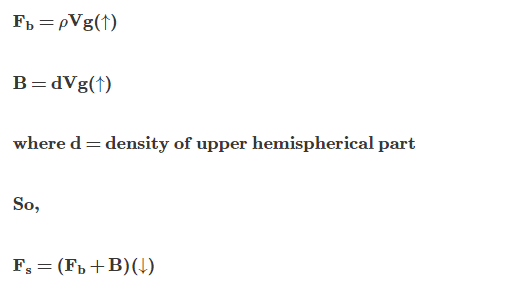
Cut the sphere into halves, and remove the bottom half. Consider the forces acting on the upper half sphere . The force Fb acting at he base is upward, and there is the downward force Fs on the upper half spherical surface. The result of these forces is the buoyant force, B. You can determine Fb and B, so you get Fs.

upload_2016-3-26_17-18-9.png
 
Uk7uQKl.png

Am i right till here ?
 
LoveBoy said:
Uk7uQKl.png

Am i right till here ?
Not yet. What is V?
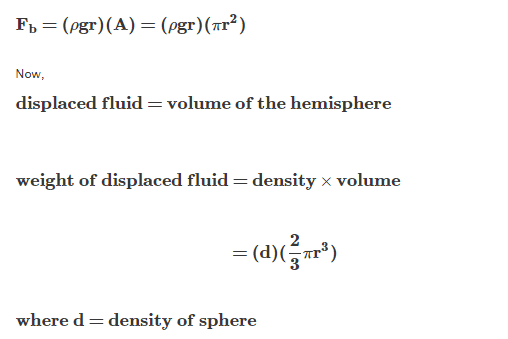
Fb is the force exerted by the fluid on the base of the semiphere. It is equal to the hydrostatic pressure at the position of the base multiplied by the area of the base. At what depth is the base of the semiphere? What is the hydrostatic pressure there?
B is the buoyant force - it is equal to the weight of the fluid displaced.How much is it?
 
  • #10
3Bsdv6d.png

ehild said:
B is the buoyant force - it is equal to the weight of the fluid displaced.How much is it?
By the way,i'm confused in finding the buoyant force i.e weight of fluid displaced .
 
  • #11
LoveBoy said:
By the way,i'm confused in finding the buoyant force i.e weight of fluid displaced .

In my notation, Fb is the force exerted by the fluid at the base of the upper hemisphere. It is equal to the pressure at that depth multiplied by the area of the hemisphere. The radius of the sphere is r, what is that area then? And what is Fb?

Do you know Archimedes' principle? The buoyant force B is equal to the weight of the fluid displaced by the upper hemisphere. There is no fluid at the place of the hemisphere, so the volume of the displaced fluid is equal with the volume of the hemisphere. If you know the volume and the density, you can get the weight, don't you?
 
Last edited:
  • #12
nn3Mz8L.png


Am i right now ?
 
  • #13
LoveBoy said:
nn3Mz8L.png


Am i right now ?

The pressure at a depth is proportional to the depth. The base is at depth of 3r. What is the hydrostatic pressure then?
The pressure in the fluid depends also on the atmospheric pressure Po. The pressure adds to the pressure of the fluid, so the pressure at the base is Po+3rρg. The force exerted on a plane surface of area A is independent of direction of the surface. It is the same upward or downward or sideways.
upload_2016-3-28_8-2-10.png

It is correct that the volume of the displaced fluid is (2/3)πr3, but the weight of the fluid is the volume multiplied by the density of the fluid and g .
The buoyant force comes from the difference of the upward force, acting at the base of the hemisphere and the downward force exerted on the spherical surface.
 
  • #14
9IdPzy1.png

Is it correct ?
 
  • #15
Your notations are completely different from my ones. Is B the force on the spherical surface? And is Fb the buoyant force? And is Fs the force on the base of the hemisphere? If yes, you are right. What do you get for B?
 
  • Like
Likes   Reactions: LoveBoy
  • #16
Thanks a lot @ehild !
I got the answer !
 

Similar threads

Replies
3
Views
2K
  • · Replies 6 ·
Replies
6
Views
3K
  • · Replies 31 ·
2
Replies
31
Views
3K
Replies
6
Views
3K
  • · Replies 6 ·
Replies
6
Views
5K
Replies
1
Views
3K
Replies
10
Views
4K
  • · Replies 13 ·
Replies
13
Views
2K
  • · Replies 5 ·
Replies
5
Views
2K
  • · Replies 7 ·
Replies
7
Views
2K