Discussion Overview
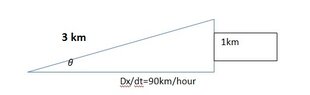
The discussion revolves around a calculus problem involving a spotlight tracking an airship. Participants explore how to determine the rate of change of the angle θ between the spotlight beam and the ground as the airship moves at a constant altitude and speed. The conversation includes aspects of trigonometry, implicit differentiation, and the application of calculus to a real-world scenario.
Discussion Character
- Exploratory
- Mathematical reasoning
- Technical explanation
- Homework-related
Main Points Raised
- Participants discuss the need to draw a diagram to visualize the relationship between the airship, the spotlight, and the angle θ.
- Some participants propose using trigonometric functions to relate the angle θ, the altitude of the airship, and the horizontal distance from the spotlight.
- There is a suggestion to use the tangent function to express the relationship between the angle and the sides of the triangle formed by the spotlight and the airship.
- Others argue for using the cosine function to relate the angle θ to the adjacent side and the hypotenuse.
- One participant expresses uncertainty about how to proceed with the trigonometric relationships.
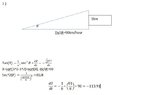
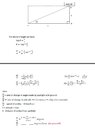
- Several participants engage in implicit differentiation of the trigonometric functions to find the rate of change of θ with respect to time.
- There is a discussion about the implications of the sign of the rate of change of θ based on the direction of the airship's movement.
- Participants calculate the rate of change of θ using different approaches, leading to slightly different numerical results.
- One participant highlights a discrepancy between their calculation and that of a tutor, prompting a discussion about assumptions made in the problem.
Areas of Agreement / Disagreement
Participants generally agree on the need to use trigonometric functions and implicit differentiation to solve the problem. However, there are multiple competing views regarding the correct interpretation of the distance involved and the resulting calculations, leading to different numerical outcomes. The discussion remains unresolved regarding which method yields the correct answer.
Contextual Notes
Participants note that the altitude of the airship remains constant while the horizontal distance changes, which affects the calculations. There is also mention of the importance of the interpretation of distances in the problem, particularly whether to consider the horizontal distance or the hypotenuse.
Who May Find This Useful
This discussion may be useful for students studying calculus, particularly those interested in applications of trigonometry and rates of change in real-world scenarios. It may also benefit those looking for collaborative problem-solving approaches in mathematics.